
How ERP Automation Improves Financial Control and GST Compliance
Financial management sits at the center of every growing business. Yet when accounting, invoicing, reconciliation, expenses, and tax compliance run on disconnected tools, the result is usually the same: delayed closes, avoidable errors, and a limited view of where the business actually stands.
ERP automation brings these activities into one connected system, creating a more structured and controlled financial environment. Here is how it makes a practical difference.
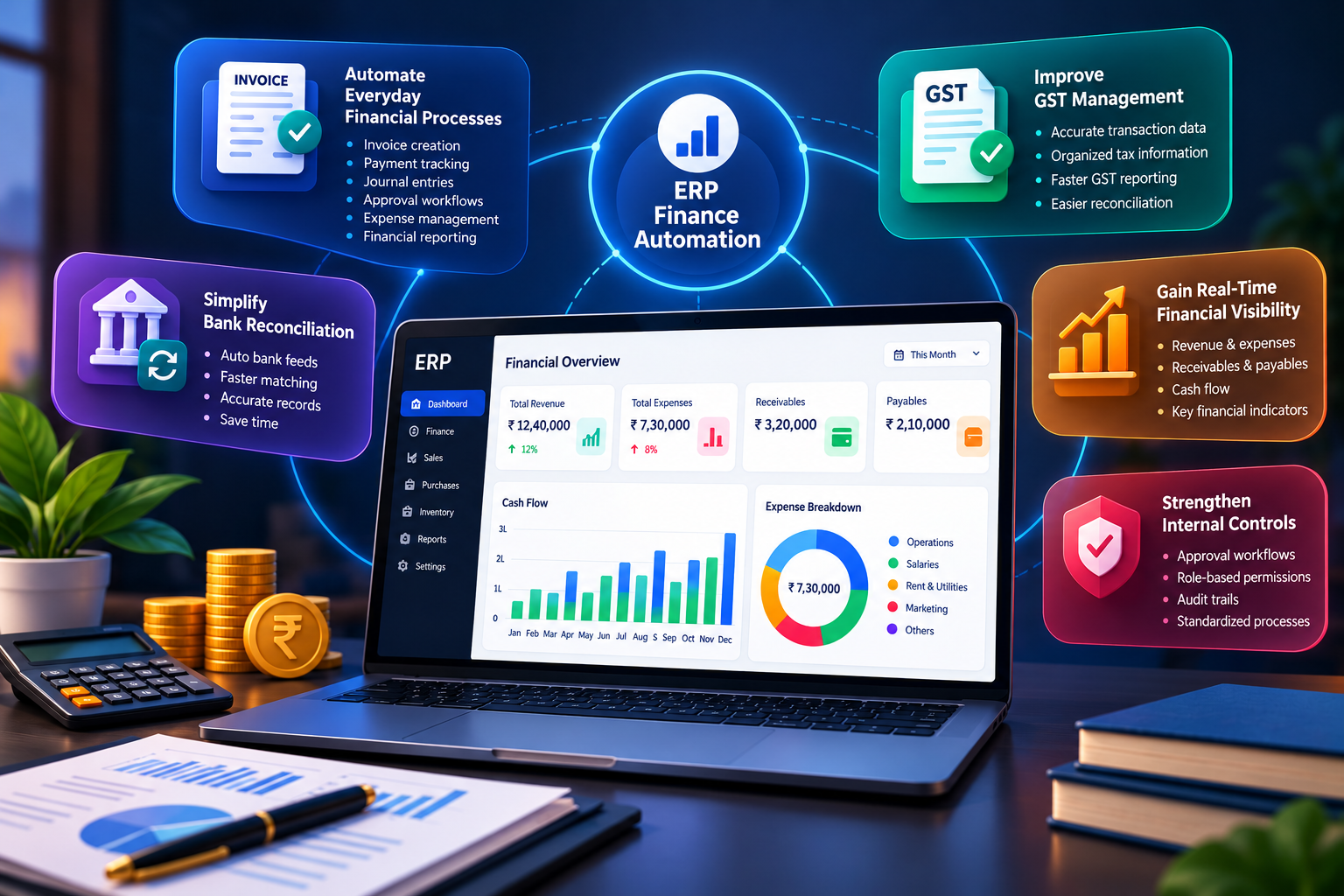
Automate Everyday Financial Processes
Finance teams spend a surprising amount of time on repetitive work. A modern ERP can automate much of it, including:
- Invoice creation and delivery
- Payment tracking and follow-ups
- Journal entries
- Approval workflows
- Expense management
- Financial reporting
When manual intervention drops, accuracy improves and your team gets time back for analysis instead of data entry.
Improve GST Management
Businesses that handle a high volume of transactions need clean, well-organized records to manage GST properly. When invoices, purchases, and tax details live in separate spreadsheets or tools, reporting and reconciliation become slow and error-prone.
An integrated ERP keeps transaction data accurate and tax information organized in one place. That makes GST reporting and reconciliation more efficient, and it reduces the last-minute scramble at filing time.
Simplify Bank Reconciliation
Matching bank statements against accounting records by hand can eat up hours every month. With bank feeds and reconciliation automation, finance teams can identify and match transactions much faster, while keeping records more accurate and up to date.
Gain Real-Time Financial Visibility
In traditional setups, management often sees reports only after someone has manually consolidated data from several sources. By then, the numbers may already be out of date.
ERP dashboards change this by offering a live view of:
- Revenue and expenses
- Receivables and payables
- Cash flow
- Other key financial indicators
Leaders can make decisions based on current business data instead of last month's summary.
Strengthen Internal Financial Controls
Control becomes harder to maintain as a company grows and more people touch financial data. ERP systems support this through:
- Approval workflows for sensitive transactions
- Role-based user permissions
- Audit trails that record who did what, and when
- Standardized, structured processes
Together, these capabilities reduce the risk of unauthorized changes and make audits far less stressful.
Where to Start
You do not need to automate everything at once. Most businesses see the best results by starting with the areas that cause the most friction, such as invoicing, reconciliation, or GST reporting, and expanding from there. The key is to design workflows around how your business actually operates rather than forcing your team to adapt to rigid software.
Build Your Finance Automation with Teenva AI
At Teenva AI & Digital Ventures, we help businesses implement and customize ERP solutions that fit their real requirements, from finance and accounting workflows to system integrations and ongoing managed IT support. Whether you want to automate invoicing, streamline GST-ready record keeping, or get a real-time view of your finances, our team can design and build it with you.
Ready to bring more control and clarity to your finances? Contact Teenva AI at sales@teenvaai.com or +91 9572020107, or visit teenvaai.com to get your ERP solution implemented.