
How to Reduce Shopping Cart Abandonment (2026 Guide)
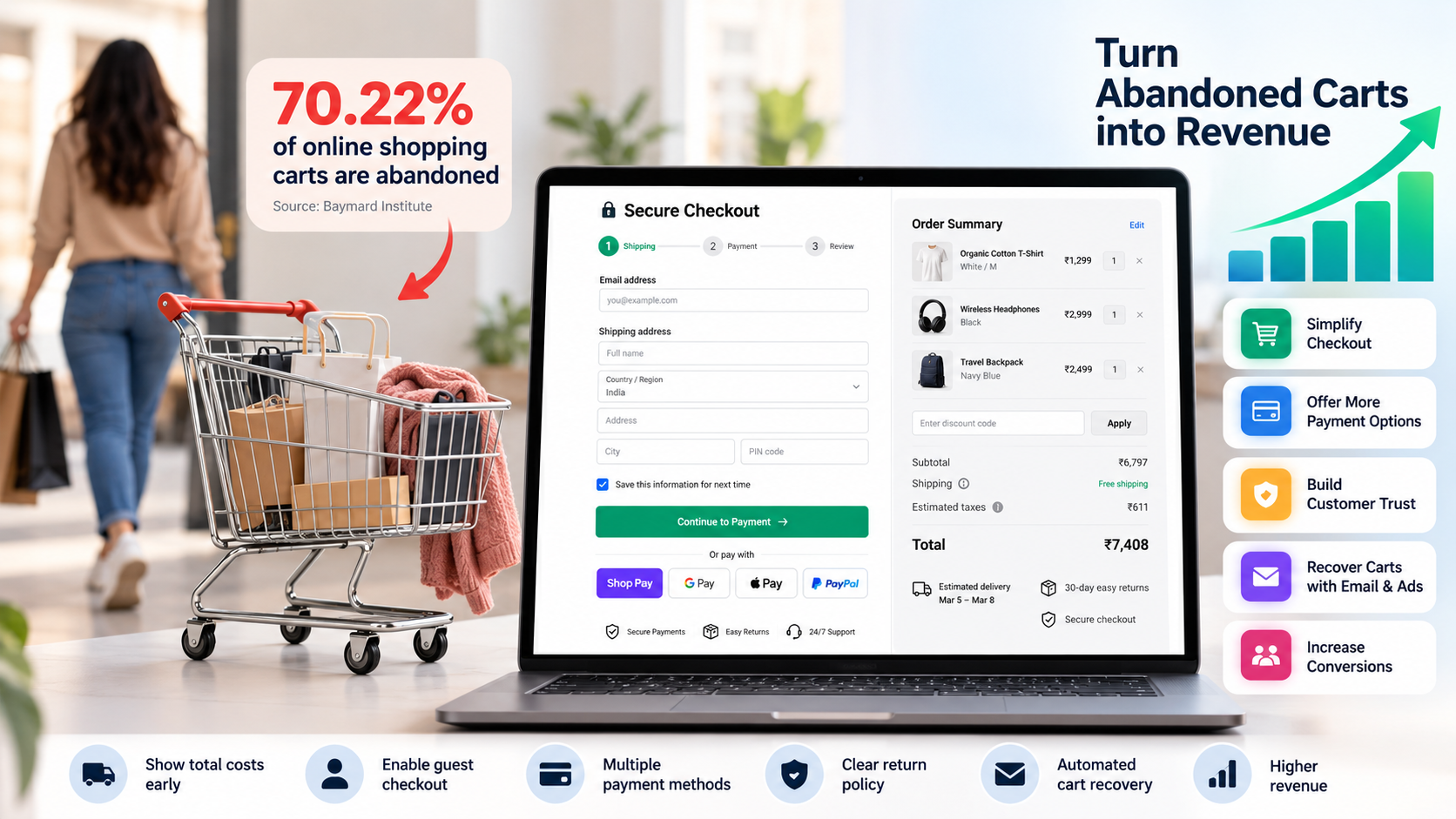
Roughly seven out of every ten online shopping carts end without a purchase. Baymard Institute, which averages findings from dozens of studies, puts the figure at 70.22%. For an online store, that is not a small leak. It is the single biggest pool of revenue you have already paid to attract and almost won.
The scale matters more as you grow. Imagine a store with 125,000 monthly visitors, a $100 average order value and a 0.92% conversion rate. Lifting conversion by just half a percentage point adds about $62,500 a month, or $750,000 a year, with no extra traffic spend. That is why fixing cart abandonment is one of the highest-return jobs in ecommerce.
This guide explains what cart abandonment is, why it happens, how to benchmark your own rate, and 12 tactics to prevent and recover abandoned orders.
What Is Cart Abandonment?
Cart abandonment happens when a shopper adds products to an online cart and leaves without paying. Two related measures are worth separating:
- Cart abandonment rate counts every shopper who added an item and left.
- Checkout abandonment rate counts only shoppers who began checkout and left before paying.
Platforms define these differently. On Shopify, for example, a checkout is treated as abandoned once the shopper has entered an email address and not completed the order after more than 10 minutes. Always check how your platform counts before comparing numbers.
Why Do Shoppers Abandon Their Carts?
Baymard's research shows that the top reason, at about 42%, is simply that the shopper was browsing or not ready to buy. That group is hard to prevent but can be recovered later. The rest of the reasons fall into four areas.
Pricing and delivery transparency
- Extra costs such as shipping, taxes and fees were too high (40%)
- Delivery was too slow (20%)
- The total order cost could not be seen up front (12%)
Checkout experience
- The site forced account creation (18%)
- The checkout was too long or complicated (17%)
- The site showed errors or crashed (17%)
Payments and trust
- The shopper did not trust the site with card details (19%)
- The card was declined (10%)
- Preferred payment methods were missing (9%)
Return policy
- The returns policy was unsatisfactory (13%)
Most of these are design and operations problems, which means most of them are fixable.
What Is a Good Cart Abandonment Rate?
The commonly cited average is around 70%, but treat it as a baseline to beat rather than a target. Your real number depends on your product category, device mix, region and traffic source. Mobile carts are generally abandoned more often than desktop ones, and high-consideration categories such as luxury goods involve longer decision cycles.
To calculate your own rate:
Cart abandonment rate = (abandoned carts ÷ carts created) × 100
If 100 visitors create carts and 40 buy, 60 carts were abandoned, so your rate is 60%. Use one definition and one reporting period consistently so trends stay meaningful, and segment by device and market.
Baymard also estimates that better checkout design alone could recover a very large amount of lost orders, and that the average large retailer could lift conversion by more than a third through checkout improvements.
12 Ways to Reduce Shopping Cart Abandonment
1. Show Total Costs and Delivery Timing Early
Surprise costs are the most common fixable cause of abandonment. Move every cost signal earlier:
- Show shipping costs on the product page or in the cart, not at the last step.
- Display taxes and duties before checkout, especially for cross-border orders.
- Use a visible free-shipping progress message such as "$15 away from free shipping" to encourage a larger basket.
- Show a delivery estimate on the product page and a dated range for each shipping method.
2. Simplify Checkout and Make Guest Checkout Easy
Forced accounts and long forms push shoppers away. Make guest checkout the default and offer account creation after the order is confirmed. Remove every field that fulfilment does not strictly need. Baymard's benchmark shows the average checkout displays 23 form elements, while well-tested flows can work with 12 to 14. Accelerated checkouts such as Shop Pay, Apple Pay and Google Pay also remove most typing for returning customers.
3. Offer the Payment Methods Your Market Expects
Card distrust, declines and missing payment options all drive abandonment. Cover the basics with cards and major wallets, then add what your region prefers:
- Digital wallets such as Apple Pay, Google Pay, PayPal and Shop Pay for one-tap payment
- Local methods such as UPI in India, iDEAL in the Netherlands or Bancontact in Belgium
- Buy now, pay later for higher-priced items
- Net payment terms if you sell to business buyers
Clear error messages and a fallback option when a card is declined also save orders that would otherwise be lost.
4. Build Trust at Every Step of Checkout
Trust is not just a padlock icon near the pay button. Place the right reassurance where the shopper needs it:
- Product page: stock status, delivery estimate and a returns policy link
- Cart: accepted payment logos, shipping cost and the free-shipping threshold
- Shipping step: a dated delivery range for every option
- Payment step: visible security assurance beside the card fields
- Order review: returns policy and customer support contact near the final button
A slide-out side cart can keep this information visible without sending shoppers away from the product page.
5. Make Returns Easy and Visible
Returns confidence directly affects buying confidence. Industry research from the National Retail Federation and Happy Returns found that most shoppers see free returns as a major factor in where they buy, and many say a poor returns experience makes them less likely to shop with that retailer again. Publish a clear policy before checkout, offer self-serve return requests, and consider instant exchanges. If you also run physical stores, state whether online orders can be returned in person.
6. Personalize with First-Party Data
As third-party cookies fade, the data customers share directly with you becomes your most valuable asset. A unified customer profile lets you recognize returning shoppers, pre-fill their details, and show relevant offers and upsells. Personalized checkout extensions can also raise average order value without adding friction.
7. Send Abandoned Cart Emails
Email is usually the first recovery channel to switch on, because it works for any shopper who entered an email address. Klaviyo's benchmark data shows automated cart recovery flows achieve an average open rate of about 50%, a click rate above 6% and a placed-order rate above 3%, with revenue per recipient the highest of any automated flow.
Build a short sequence rather than a single message:
- A simple reminder with a link back to the exact cart
- A follow-up that answers the most likely objection, such as shipping, delivery date or returns
- A final message that may include a discount, used sparingly
Treat timing as something to test, not a fixed rule.
8. Run Retargeting Ads
Many abandoners are still deciding. Retargeting ads show them the exact products they left behind across social platforms and the web. Build audiences from people who added to cart but did not purchase, exclude recent buyers, and refresh creative often so the ads do not feel repetitive.
9. Use Push Notifications
Push notifications reach shoppers who never shared an email address. Use them narrowly: a reminder of the items left in the cart, or a nudge toward a product viewed repeatedly. Over-messaging quickly leads to opt-outs, so cap frequency.
10. Add Live Chat
Live chat resolves the last-minute doubts that end shopping sessions: delivery times, return rules, sizing and payment questions. Being able to see what is in the shopper's cart while chatting, and offer help at the right moment, turns hesitation into a completed order. Chatbots can handle common questions around the clock and hand over to a human when needed.
11. Use Exit-Intent Pop-Ups
Exit-intent pop-ups appear as a visitor moves to leave. Offered well, they can save the cart, offer free shipping, or capture an email address for later follow-up. Research from Wisepop found they convert about 2.8% of visitors on average, with the best campaigns performing far higher. Keep them helpful and rare, and never block the checkout itself.
12. Answer Comparison Shopping with Social Proof and Rewards
Some of the "just browsing" shoppers are comparing you with competitors. Two things help them decide:
- Social proof: product reviews, ratings and customer photos on product pages
- A reason to buy here: loyalty points, referral rewards or member-only pricing shown next to the regular price
Review and loyalty apps make both easy to add to most ecommerce platforms.
How to Measure What Works
Fixing abandonment is an ongoing process, not a one-off project.
- Track your abandonment rate before and after every change using one consistent formula.
- Segment results by device, market and traffic source, since each behaves differently.
- Monitor checkout error rates and page speed, especially before sales events.
- Track recovery revenue from emails, ads and notifications separately.
- Change one thing at a time so you know what caused the result.
Final Thoughts
Cart abandonment will never reach zero, because some shoppers are always just looking. But most of the rest is preventable: surprise costs, slow delivery, forced accounts, long forms, missing payment methods and low trust. Fix those first, then add recovery channels such as email, retargeting and push notifications on top.
At Teenva AI & Digital Ventures, we help ecommerce brands build faster checkouts, integrate the right payment and shipping options, design conversion-focused storefronts and set up automated recovery flows. If you want to stop losing sales at the final step, get in touch with us at sales@teenvaai.com, call +91 9572020107, or visit teenvaai.com to get your store optimized and built for higher conversions.