

Travel agencies
Juggling enquiries across walk-ins, phone, WhatsApp, and their website, who need every lead in one place instead of three.
See a live 30-minute walkthrough with your own routes and destinations
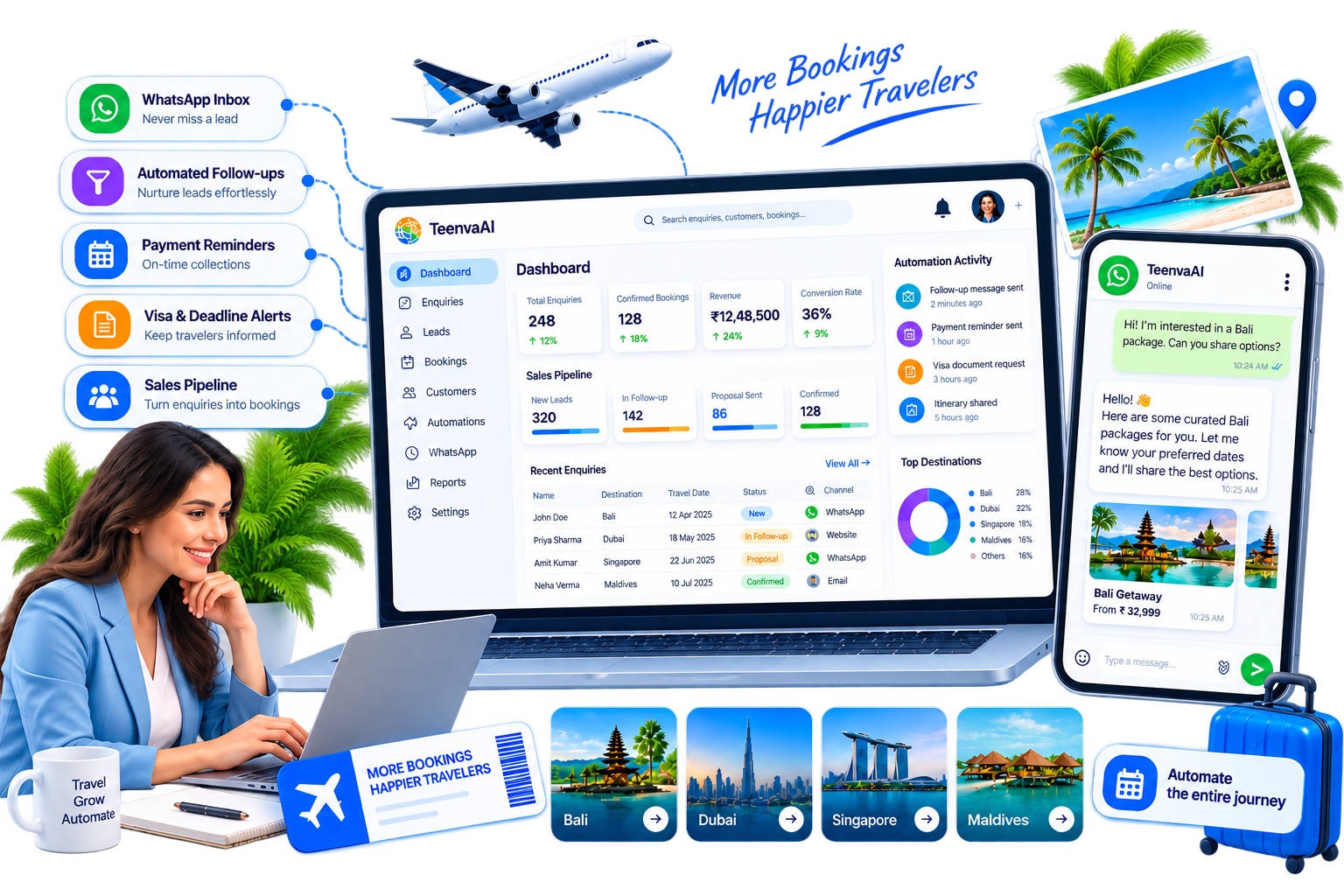
The Problem
Most travel agencies run their sales process across four or five tools that were never meant to talk to each other.
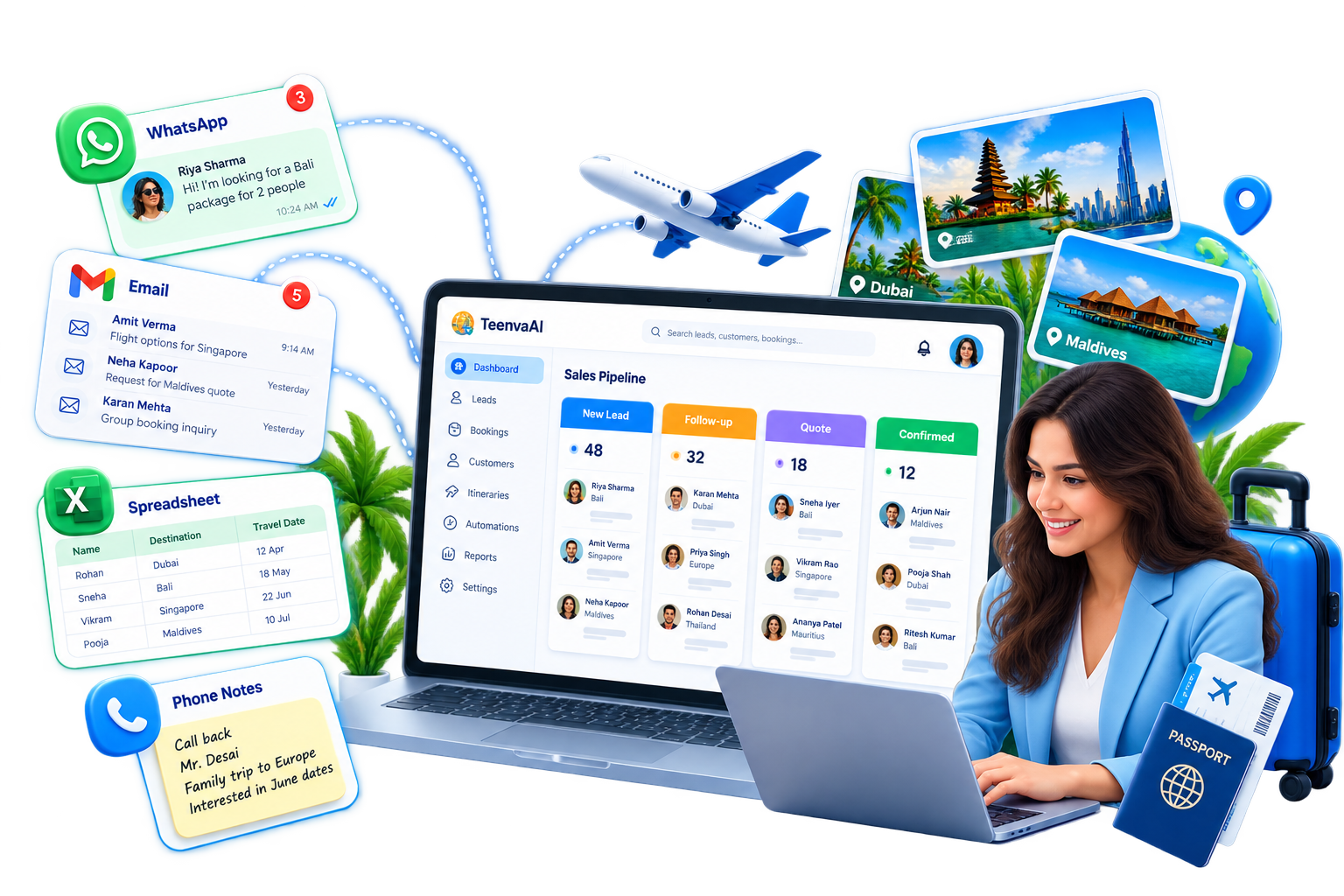
A lead comes in through the website contact form. Another lands in the agency's WhatsApp Business number. A third calls the front desk and someone jots the destination and dates on a sticky note. By the time all three get typed into a shared spreadsheet — if they get typed in at all — half a day has passed and the fastest-moving competitor has already sent a quote.
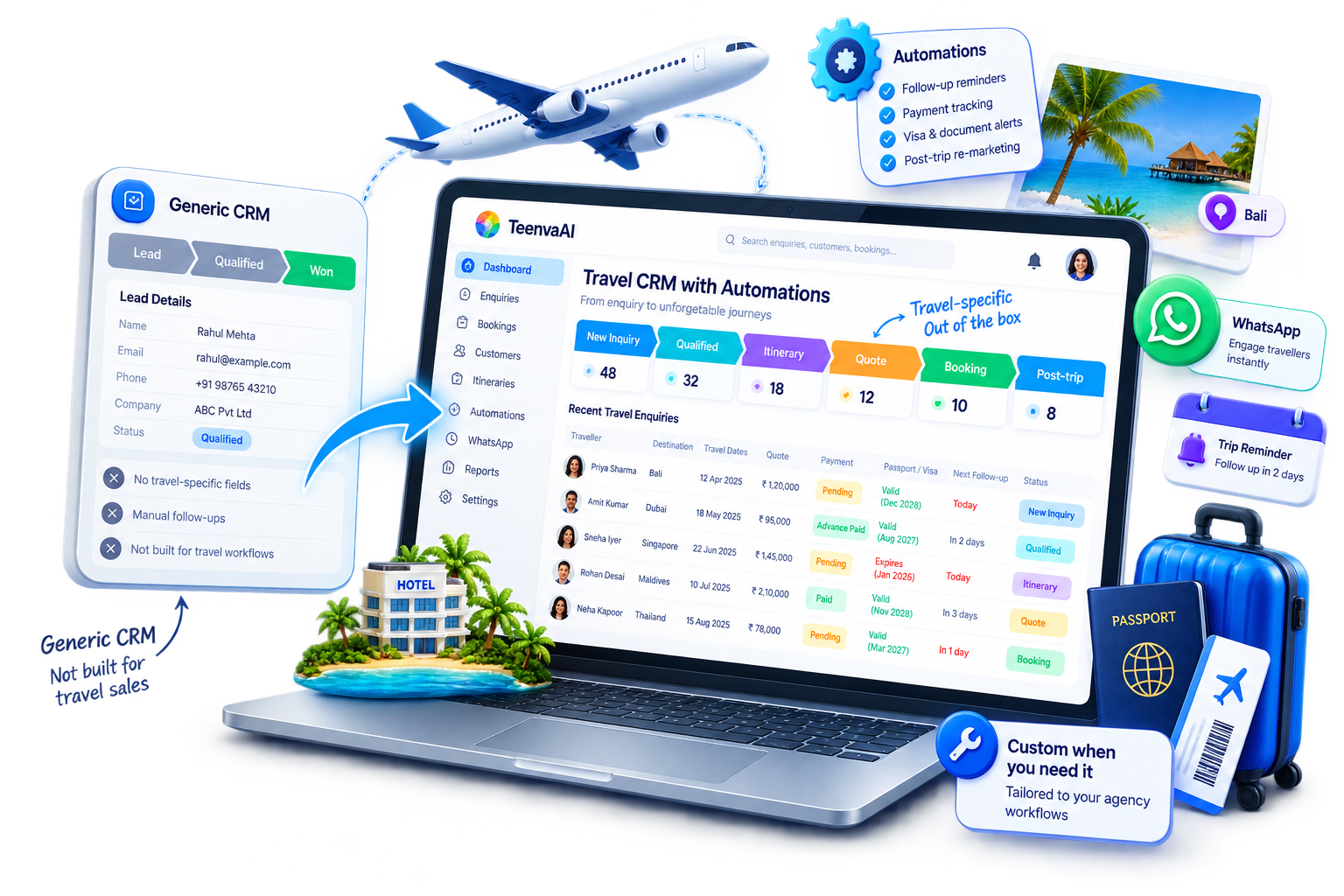
Generic CRMs don't fix this, because they weren't built for how travel sales actually works. A deal in a typical sales CRM moves from "Lead" to "Qualified" to "Won." A travel enquiry moves from a first message about a Kerala honeymoon, to an itinerary draft, to three rounds of "can you shave off a day and swap the hotel," to a confirmed booking, to a traveler who is now somewhere on a houseboat and needs their agent reachable on WhatsApp, to a trip that's over and due for a thank-you note and a re-marketing nudge next anniversary. None of that maps onto "Lead → Qualified → Won," so agencies either abandon the CRM within a few months or bend it with a pile of custom fields nobody remembers how to use.
The real cost shows up quietly. An agent means to follow up on a quote in three days and forgets, because there's no system reminding them — just their own memory, competing with fifteen other open conversations. A passport renewal deadline slips past because it lived in someone's notebook. A repeat traveler who booked a family trip to Bali eighteen months ago gets treated like a stranger on their next enquiry, because nobody can pull up what they booked last time, what they complained about, or which hotel they loved. None of this is a training problem. It's a tooling problem.
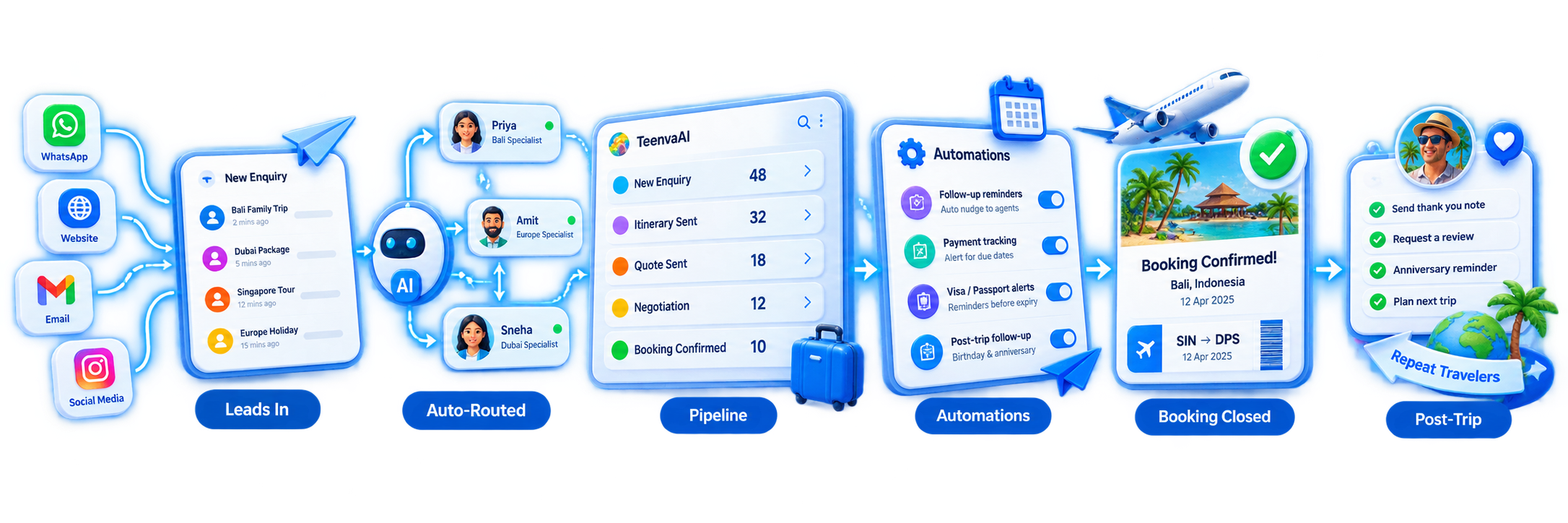
Enquiry to post-trip, on autopilot. text-center
A lead arrives, from anywhere
A website enquiry, a WhatsApp message, an email, a missed-call callback, or a form fill from a Facebook or Instagram ad — all of it lands in one shared inbox, tagged with source and destination automatically. Nobody re-types anything from one tool into another.
The lead gets routed to the right agent, automatically
Rules you set once — by destination, by language, by branch, or round-robin within a team — assign the enquiry to an agent within seconds, not whenever someone happens to check their inbox.
The agent works the enquiry inside a travel-specific pipeline
New Enquiry moves to Itinerary Sent, then Quote Negotiation, then Booking Confirmed, then Traveling, then Post-Trip Follow-up — stages that match what's actually happening with the client, not a generic sales funnel.
Automations quietly do the chasing
If a quote's gone cold for a set number of days, the system nudges the agent (and can nudge the traveler). Payment due dates and passport or visa document deadlines get flagged before they become a problem, not after.
The agent closes with full context, every time
Trip history, preferences, family members traveling, past complaints or praise — it's all sitting in the traveler's profile, so a repeat client never has to re-explain who they are.
After the trip, the relationship doesn't go cold
Post-trip follow-up nudges, birthday and anniversary trip re-marketing, and review requests go out on schedule — turning a one-time booking into a returning client.
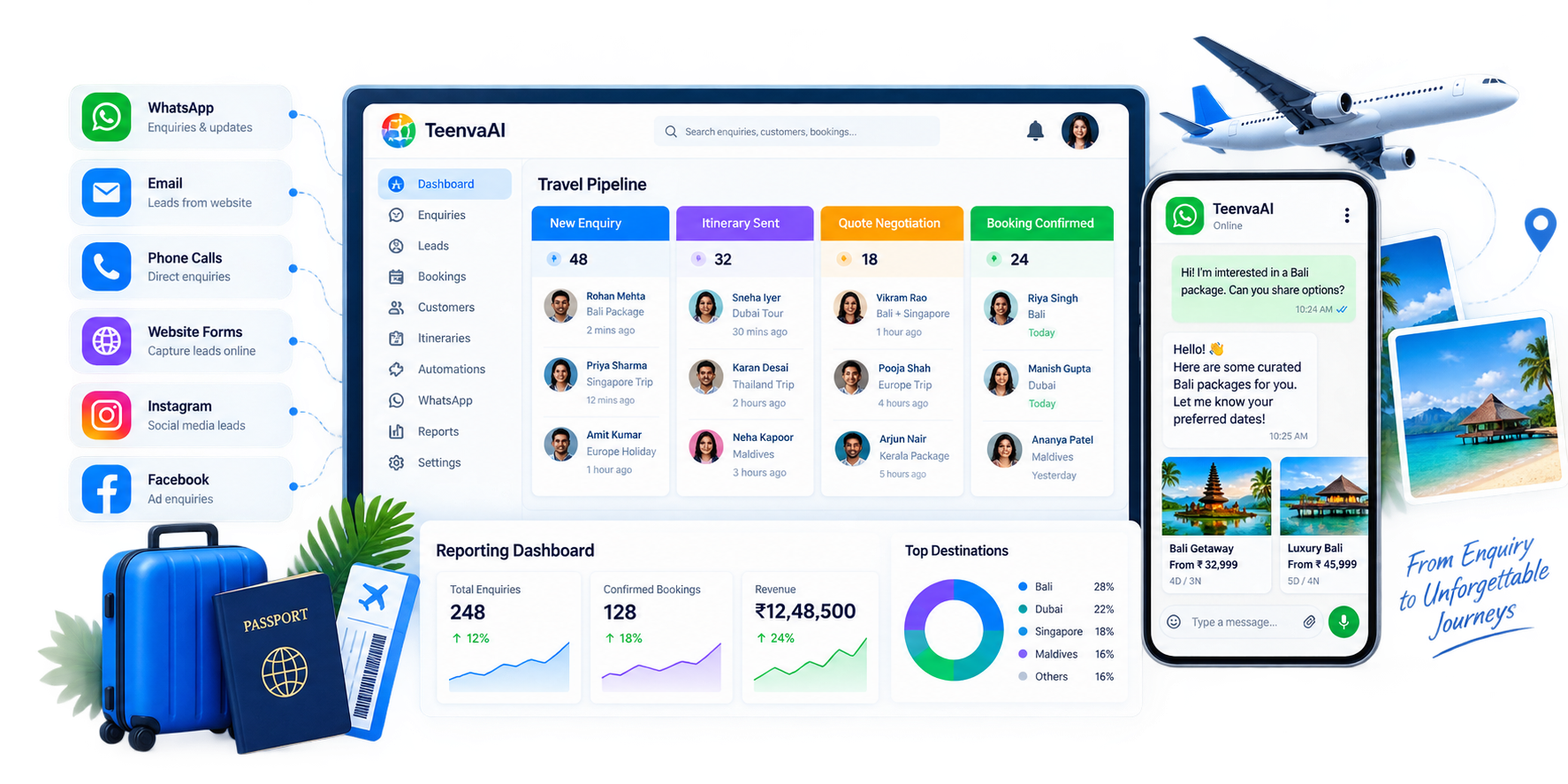
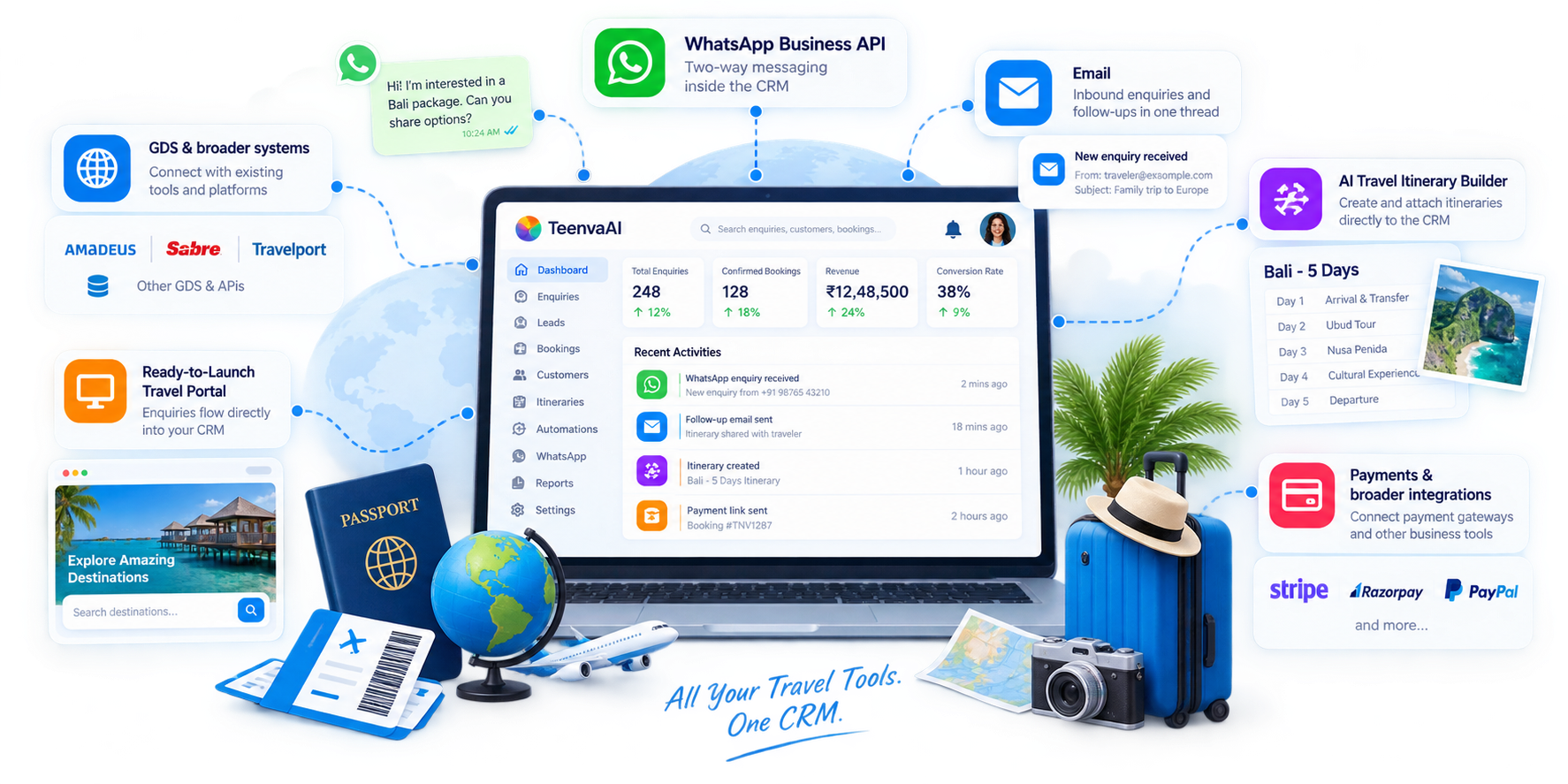
Website forms, WhatsApp Business, email, phone call logs, and social ad forms all feed one shared inbox — no manual copy-paste between tools.
New Enquiry → Itinerary Sent → Quote Negotiation → Booking Confirmed → Traveling → Post-Trip Follow-up, matching how a travel sale actually unfolds.
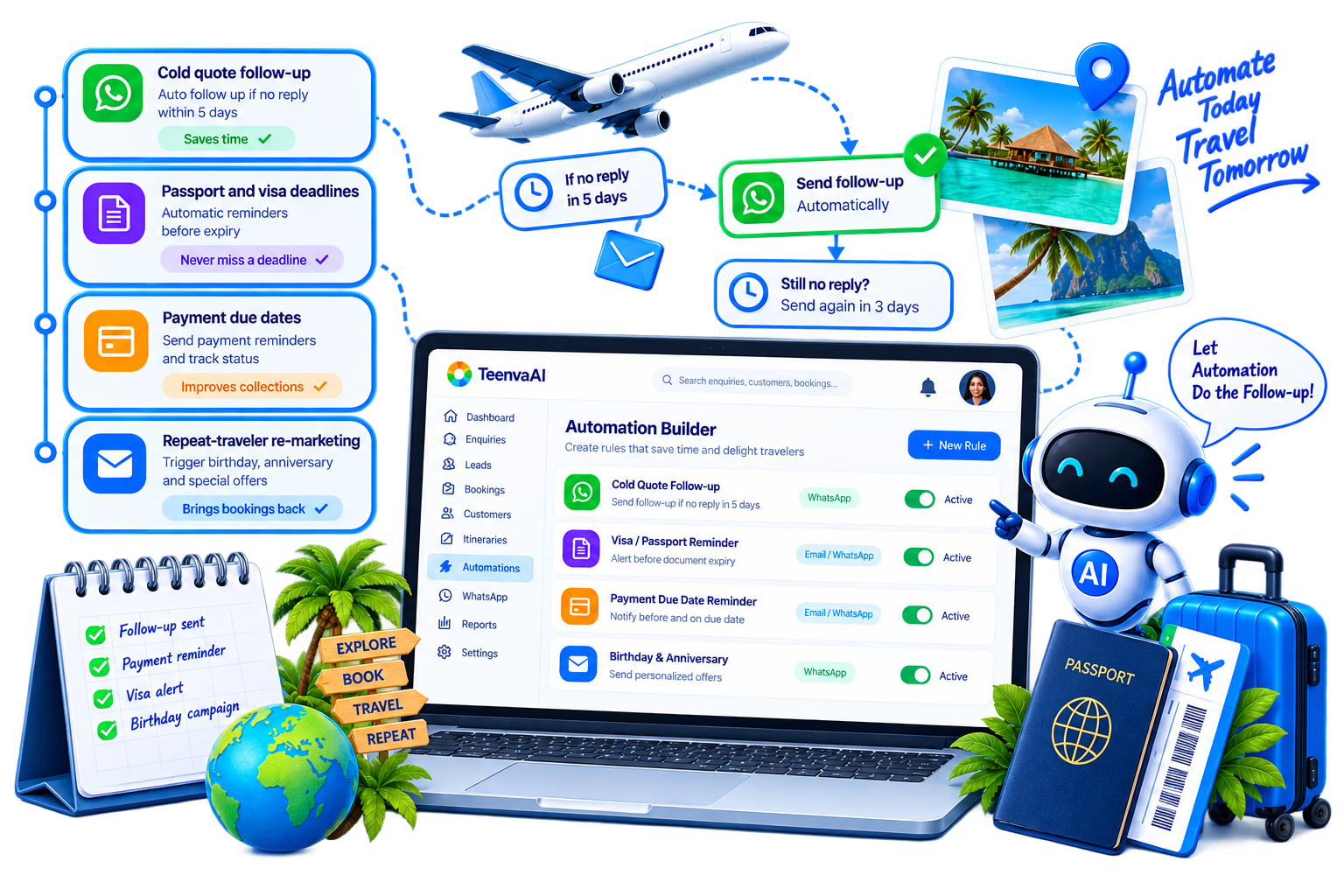
Auto-assign by destination or language, auto-chase cold quotes, auto-remind on payment and document deadlines, auto-nudge for birthday/anniversary re-marketing.
Two-way WhatsApp messaging lives inside the traveler's record — agents reply without switching apps or losing the conversation history.
Trip history, preferences, passport and document expiry, family members, and past complaints or praise, all attached to one traveler record.
Quotes sent from the AI Travel Itinerary Builder show open and view status right inside the CRM, so agents know when to follow up.
See partial payments, balance due, and refund status per booking at a glance — it surfaces status, it doesn't replace your accounting system.
Lead source performance, agent conversion rates, average response time, and revenue by destination or season, without exporting to a spreadsheet.
Travel CRM with Automations bundles the pieces an agency actually needs into one product, instead of asking you to stitch together a CRM, a WhatsApp tool, a spreadsheet, and a reminders app.
Automation only matters if it removes work an agent was already doing badly — not if it adds another dashboard nobody checks. Here's what that looks like in practice.
Before:an agent sends an itinerary, means to follow up in three days, gets pulled into four other conversations, and follows up nine days later — if at all — by which point the traveler has already booked with someone else.
After:the CRM watches the Quote Negotiation stage, and if there's been no reply after a set number of days, it automatically sends a polite check-in and flags the lead on the agent's dashboard as "going quiet." The agent doesn't have to remember anything; the system remembers for them.
Before:document deadlines live in a notebook, an old email thread, or an agent's memory — and memory fails right when it matters most, close to departure.
After:every traveler profile carries document expiry dates, and the CRM raises a reminder to the agent (and optionally the traveler) with enough runway to actually act — weeks out, not two days before a flight.
Before:balance-due reminders happen whenever an agent happens to glance at a booking, which usually means either too early to matter or too late to be useful.
After:payment status per booking is visible on the record, and due-date automations prompt the agent to chase the balance on a schedule that's actually tied to the travel date — not to whenever someone remembers to check.
Before:a family that took a wonderful trip to Bali last year gets zero contact until they happen to enquire again on their own — if they do.
After:the CRM flags upcoming birthdays and trip anniversaries from traveler profiles and triggers a personalised nudge — "It's been a year since your Bali trip, thinking about the next one?" — turning a one-time booking into a relationship an agency actually nurtures.
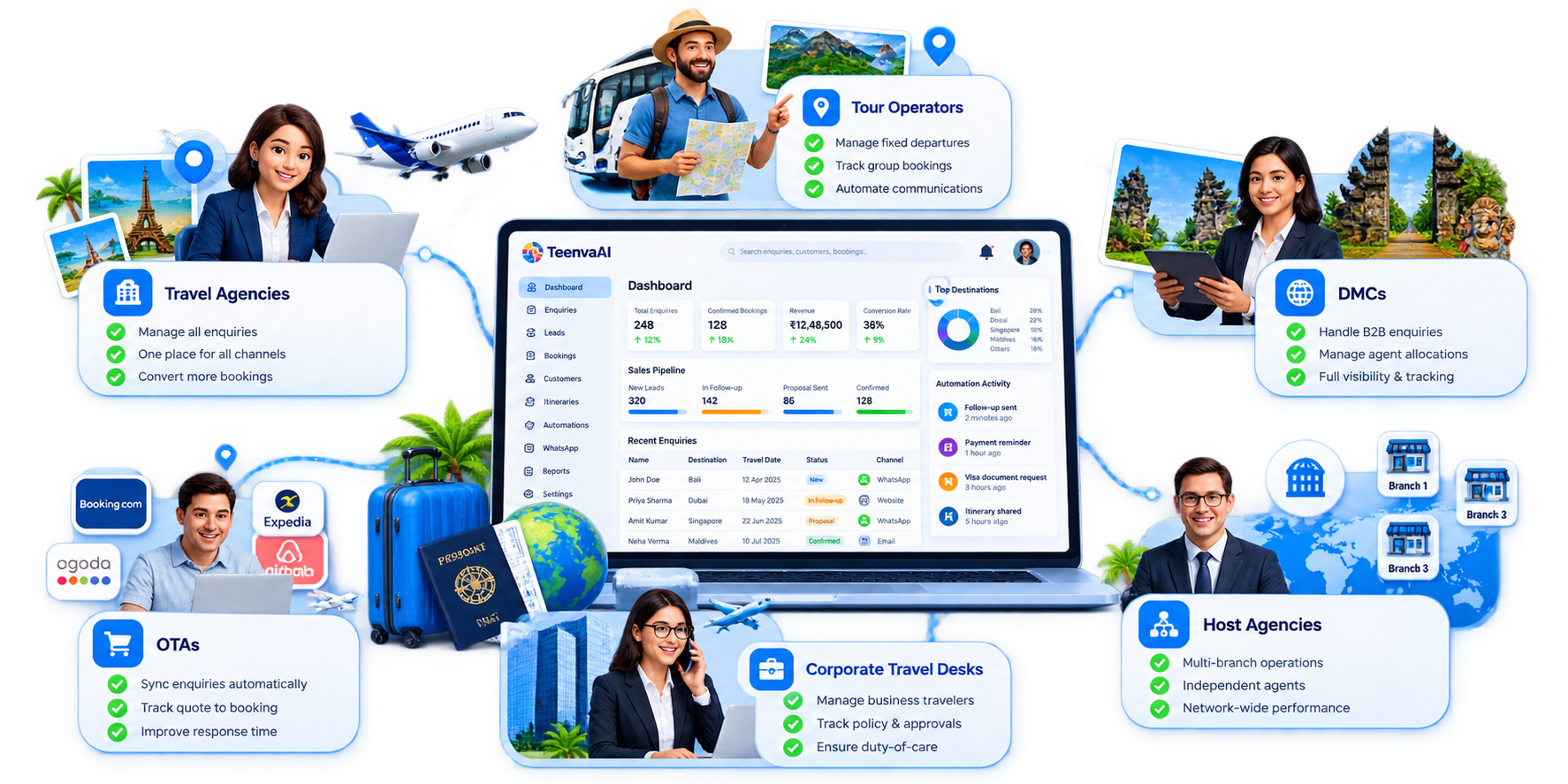
Juggling enquiries across walk-ins, phone, WhatsApp, and their website, who need every lead in one place instead of three.
Running fixed-departure and custom packages, who need to track quote negotiations and group bookings without losing track of who's confirmed and who's still deciding.
Handling incoming enquiries from overseas partners and agents, who need clean handoffs and full visibility into every traveler's itinerary status.
That need a structured back-office sales layer behind their booking engine, especially for high-touch or custom-quote enquiries that don't fit a pure self-service flow.
Managing recurring business travelers, where document expiry and traveler preferences genuinely affect service quality.
That need agents and branches to work independently, with owners still able to see performance across the whole network.
Travel CRM with Automations fits any team selling trips to individual travelers or managing a network of agents who do.
Most CRMs sold to travel agencies are general-purpose sales tools with a travel skin stretched over them after the fact. Teenva AI built this one the other way round.
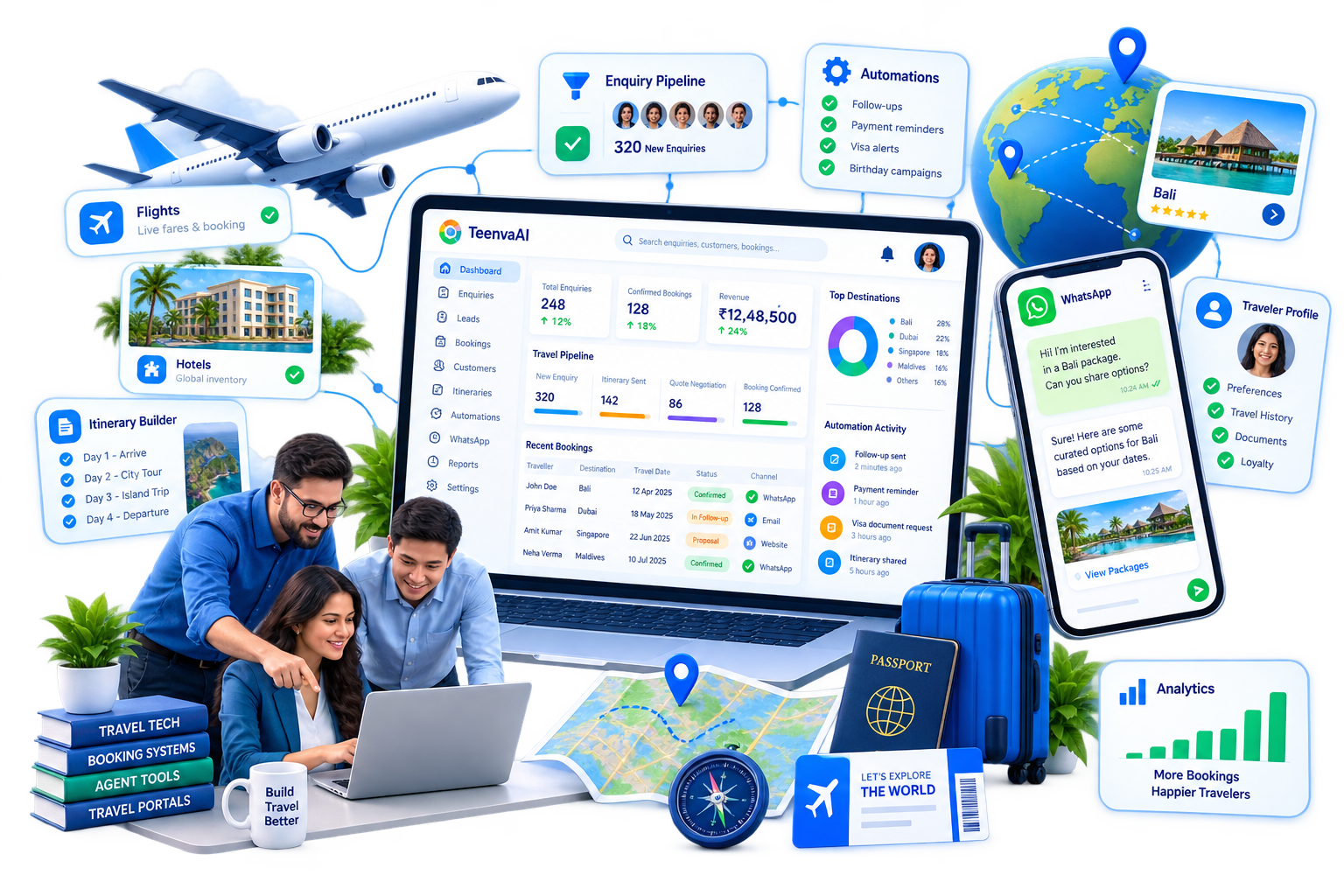
Travel CRM with Automations is built to sit inside the tools an agency already runs, not replace all of them.
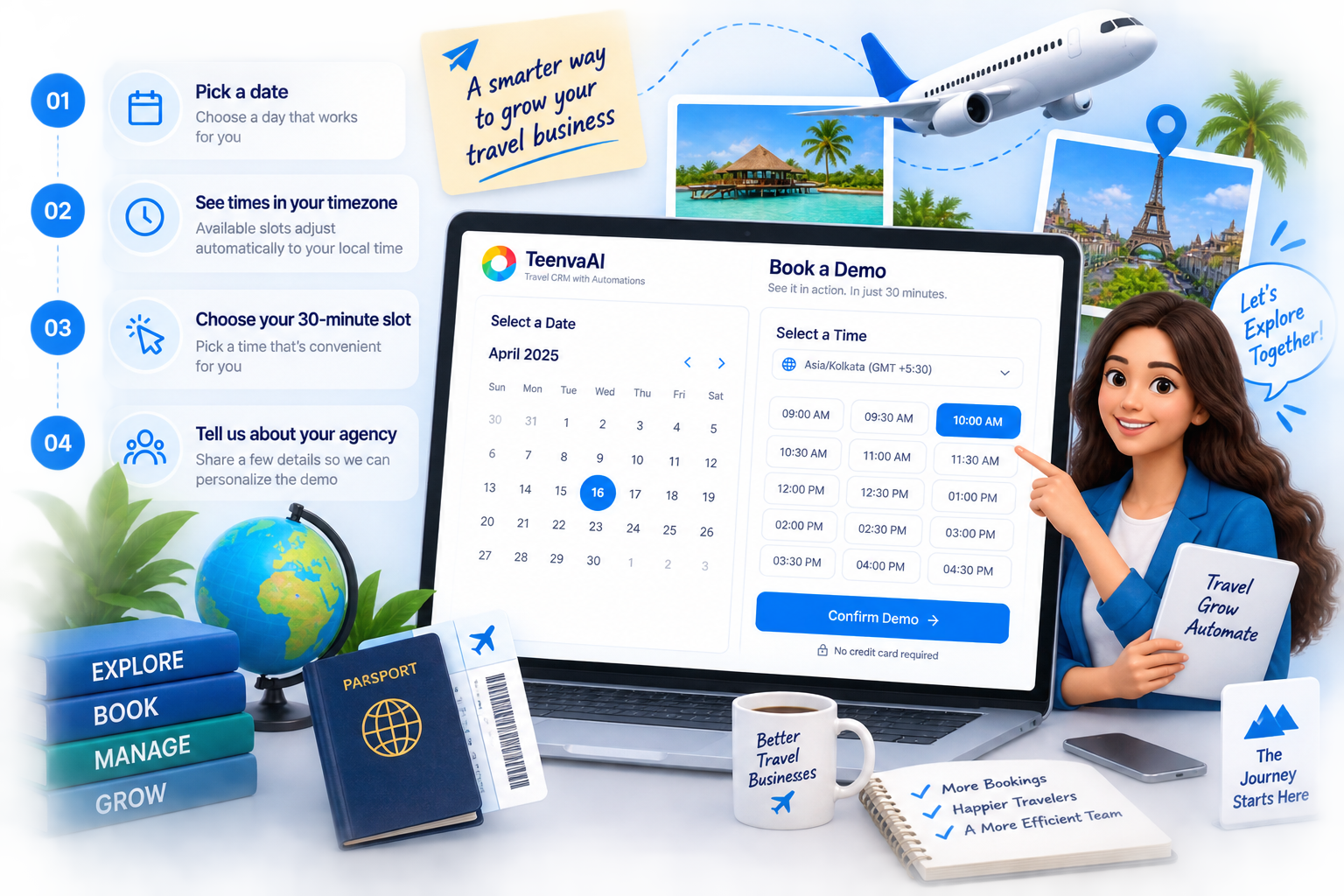
Pick a date
See times in your timezone
Choose your 30-minute slot
Tell us about your agency
Reading about a CRM only gets you so far. You want to see your own leads flowing through it before you commit to anything.
Booking time is deliberately painless. Pick a date on the calendar, and the available slots show up already converted to your local timezone — no mental math, no "wait, is that IST or my time." If you're dialling in from Dubai, London, or Singapore, switch the timezone selector and the same slots re-render instantly in your zone. Pick a 30-minute window that works for you, tell us a little about your agency — how many agents, which destinations you sell, what you're hoping the CRM will fix — and you're done. No sales form with twenty fields, no "someone will call you back within 24 hours."
You'll get an instant email confirmation the moment you book, with the date and time already shown in your timezone so there's no confusion on the day. On the call, we walk through the actual product — the pipeline, the automations, the WhatsApp panel, the traveler profile — using scenarios close to how your agency actually sells, not a generic canned demo script. Thirty minutes is enough to know whether this replaces the spreadsheet-and-WhatsApp shuffle your team is currently stuck with.
If a screen-share isn't your style yet, talk to sales first and we'll take it from there.
Straight answers about our services, how we work, and how to get started with Teenva.
Custom software, AI solutions, and travel technology — built for teams that need more than templates.
For a travel agency's sales process, yes — that's exactly what it's built to do. Zoho and HubSpot are excellent general-purpose CRMs, but you'll spend real time configuring custom fields and stages to approximate a travel pipeline, and you'll still be missing things like passport-expiry tracking or WhatsApp-native traveler records out of the box. If your agency needs something even more specific to a unique internal process, Teenva's travel CRM development team can also build a fully bespoke system.
Yes. WhatsApp messaging is built directly into each traveler's CRM record — agents send and receive messages without leaving the CRM or switching to a separate WhatsApp Business app. It's powered by the same WhatsApp API integration foundation Teenva uses across its travel technology work.
Yes. Role-based access lets agency owners see performance across every branch, while senior and junior agents see only what's relevant to their own leads and branch. It's designed with host agencies and multi-branch operators in mind, not just single-location shops.
Thirty minutes, live, over a screen share. We walk through lead capture, the pipeline stages, an automation rule in action, and the WhatsApp and traveler-profile views — using examples close to how your agency actually sells, not a generic script. Book a slot in your own timezone and you'll get an instant confirmation email.
Yes. We help migrate existing leads, past bookings, and traveler details from spreadsheets or your current CRM so you're not starting from a blank inbox on day one — bring it up during your demo and we'll scope the specifics for your data.
No, and that's intentional. It tracks payment and invoice status per booking — partial payments received, balance due, refunds in progress — so agents and owners always know where a booking stands financially. It doesn't replace your accounting system or process payments itself.
Yes, natively. Quotes created in the AI Travel Itinerary Builder show open and view status inside the CRM record, and enquiries from the Ready-to-Launch Travel Portal flow straight into the CRM inbox without manual re-entry.
That's exactly what Teenva's travel CRM development service and broader travel technology practice are for — a fully bespoke build on top of the same team's experience, once you know precisely what the SaaS product can't stretch to cover.
The quote and itinerary engine that plugs straight into this CRM.
A B2C/B2B booking portal whose enquiries flow directly into this CRM.
For agencies that need a fully custom-built CRM instead of the SaaS product.
The messaging foundation behind the CRM's built-in WhatsApp panel.
Teenva's broader practice building booking engines, portals, and systems integrations for the travel industry.
Book a 30-minute demo and see Travel CRM with Automations working against your own destinations, your own pipeline, and your own agents' day-to-day — not a generic script. Or, if you'd rather talk it through first, reach our sales team directly.
Teenva AI & Digital Ventures Private Limited · Bangalore, India · https://teenvaai.com
Tell us a bit about yourself.
We'll follow up to schedule a live walkthrough of the product.