

Cloudbeds Channel Manager Explained: How It Boosts OTA Distribution & Revenue
Hotels that still log into five, six, or ten separate OTA extranets every morning are fighting a battle they don't need to fight. Rates drift out of sync, availability updates lag by minutes or hours, and every gap between "what the PMS says" and "what Booking.com shows" is a seat left empty or a room sold twice. The Cloudbeds channel manager exists to close that gap — permanently, automatically, and in real time.
This article breaks down how the Cloudbeds channel manager actually works under the hood, why its architecture matters more than a simple feature checklist, and how it fits into a broader distribution and revenue stack. We'll also look at where custom API work — the kind Teenva AI builds for OTAs, TMCs, and DMCs — extends what an out-of-the-box channel manager can do.
What the Cloudbeds Channel Manager Actually Does
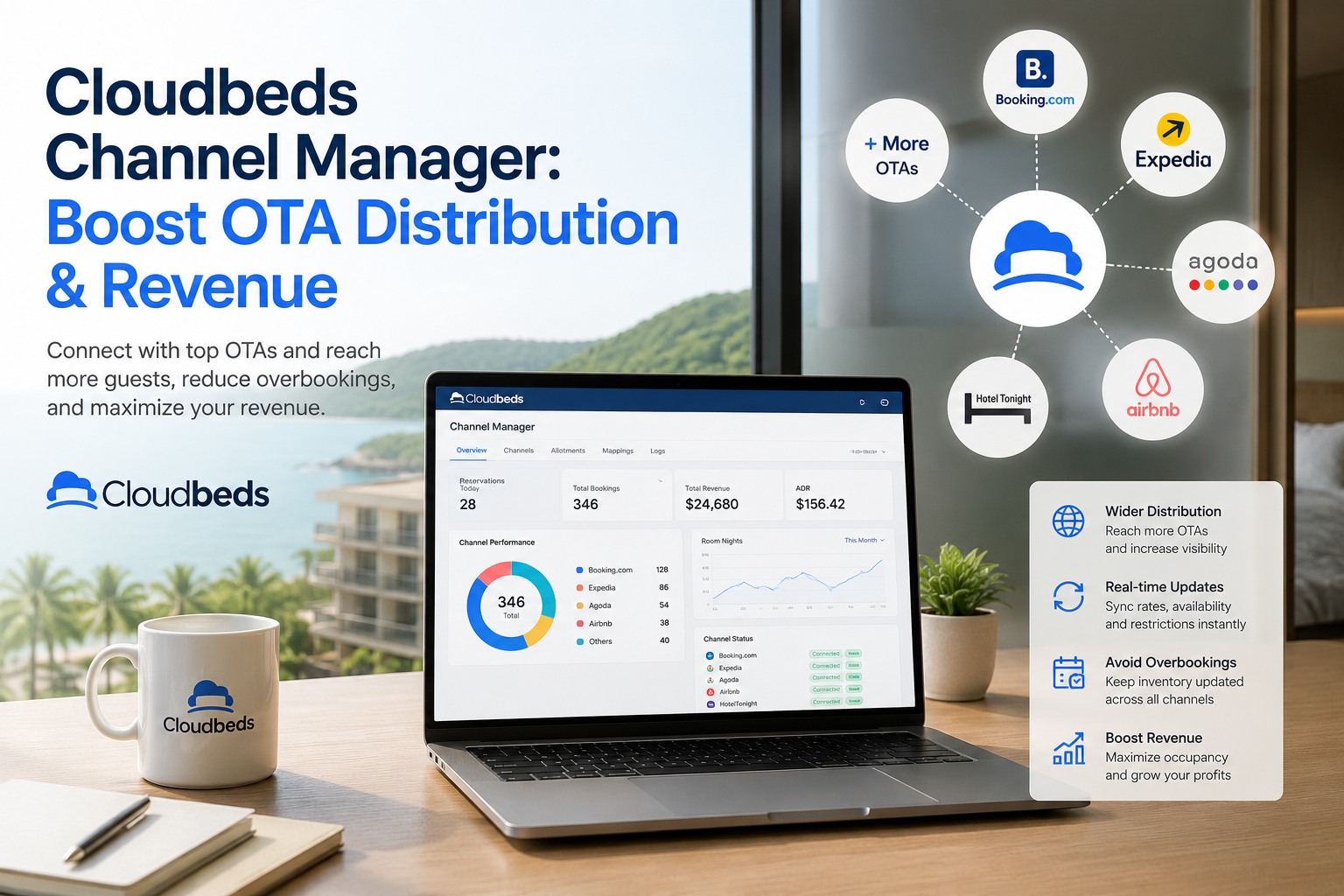
At a high level, the Cloudbeds channel manager sits between a property's PMS and every channel it sells through — OTAs, metasearch engines, GDS connections, and the property's own direct booking engine. It connects to over 450 global and regional channels, including Booking.com, Expedia, and Airbnb, with real-time two-way synchronization and no additional commission on Cloudbeds' side for the connectivity itself.
Three mechanics make this work reliably at scale:
Two-way sync over API/XML. Rate, availability, and restriction (ARI) changes made in the PMS push outward to every connected channel. Reservations and cancellations flow back in automatically, so the PMS is always the single source of truth.
Pooled inventory. Rather than allocating a fixed number of rooms to each channel, availability is drawn from one shared pool tied to real-time PMS state. This is the mechanism that actually prevents double-selling a room, not just a policy or a manual check.
Channel mapping. Room types, rate plans, and restrictions are translated into each channel's specific formatting requirements, so a "Deluxe King" in the PMS displays correctly and consistently whether it's on Expedia or a niche boutique OTA.
Reference Architecture
The diagram below shows the core data flow between the PMS, the channel manager layer, and downstream distribution channels.
Note the position of the pooled inventory model in the middle of the diagram — every channel reads from and writes to the same availability state. This is what makes the "sell everywhere without overbooking" claim structurally true rather than aspirational.
Booking Flow: From OTA Click to PMS Record
When a guest books through an OTA, the reservation has to travel back through the channel manager and land in the PMS within seconds to keep every other channel's availability accurate. Here's the typical sequence:
Delivery speed matters here. Delayed sync windows — even by a few minutes — are exactly where overbookings and rate mismatches creep in on weaker integrations. Real-time delivery is the difference between a channel manager that's a genuine safety net and one that's a reporting dashboard with a delay.
Beyond Distribution: Revenue Intelligence and Guest Marketing
Channel management alone syncs inventory; it doesn't set strategy. Cloudbeds pairs its channel manager with two additional layers that turn synced data into revenue decisions:
Revenue Intelligence applies demand forecasting — reportedly out to a 90-day horizon with high accuracy — combined with ongoing competitor rate scanning, to recommend dynamic pricing adjustments aimed at improving ADR and RevPAR. Because this sits on top of the same real-time inventory data the channel manager maintains, pricing recommendations reflect actual current availability rather than a stale snapshot.
Guest Marketing CRM targets a different cost center: OTA commissions, which typically run in the 15–30% range per booking. By capturing guest data from OTA bookings and running win-back campaigns that funnel repeat guests to a commission-free direct booking engine, this layer works to shift the channel mix over time toward higher-margin direct revenue — without reducing overall distribution reach.
Resilience and Compliance Considerations
For any hotel technology team evaluating or integrating with a channel manager API, a few architectural patterns matter regardless of vendor:
Circuit breaker patterns on each channel connection prevent one slow or failing OTA endpoint from degrading sync performance across all other channels.
Supplier abstraction layers (often built with adapter or factory design patterns) let a property or aggregator swap or add channel connections without rewriting core booking logic every time a new OTA integration is added.
Redis or similar in-memory caching reduces read load on the PMS for high-frequency ARI checks, while write-through updates still hit the pooled inventory source of truth immediately.
PCI DSS compliance is non-negotiable wherever guest credit card data crosses the channel manager–PMS boundary, particularly for OTAs offering guest credit card integration or virtual card payments.
Where Custom Integration Work Adds Value
Off-the-shelf channel managers like Cloudbeds cover the vast majority of standard hotel-to-OTA distribution needs. But OTAs, TMCs, and DMCs building their own supply-side platforms often need something more specific: custom middleware that normalizes ARI data across multiple bed banks and PMS providers simultaneously, white-label booking layers on top of pooled inventory feeds, or resilience engineering (retry logic, circuit breakers, rate-limit handling) tuned to a specific mix of supplier APIs rather than a single vendor's defaults.
This is the layer where Teenva AI's engineering work typically sits — building the adapter layers, caching strategy, and failover logic that let a travel platform plug into channel managers, PMS systems, and OTA APIs as interchangeable, resilient components rather than one-off integrations.
Choosing the Right Setup for Your Property
If you're deciding how to connect a channel manager to your distribution strategy, the three broad setups are: a unified platform (PMS + channel manager in one, like Cloudbeds), a separate PMS with an integrated third-party channel manager, or a channel manager running without a PMS at all (workable only for very small properties). The right choice depends on how many properties you manage, how many channels you sell through today, and how much custom logic — pricing rules, supplier-specific mapping, multi-property inventory pooling — your distribution strategy actually needs.
For teams building or scaling a travel technology stack around any of these setups, the underlying question is usually less "which channel manager" and more "how do we make our systems talk to each other reliably." That's where a dedicated integration partner earns its keep.
Need a channel manager, PMS, or OTA integration built around your specific supplier mix? Teenva AI & Digital Ventures designs and builds custom API integrations, booking engines, and resilient supplier abstraction layers for OTAs, TMCs, DMCs, and travel agencies. Reach out at sales@teenvaai.com or +91 9572020107 to talk through your architecture.