
Average Order Value: Formula and 7 Ways to Increase It (2026)
Average order value is one of the first numbers every online store owner learns to watch, and for good reason. When traffic is healthy and conversion rates look decent but each checkout stays small, revenue stalls no matter how hard you push on ads. At Teenva AI, we work with Shopify merchants every day, and we see the same pattern again and again: the stores that grow steadily are the ones that learn to raise average order value without hurting profit. This guide explains the formula, shows how to read the number properly, and walks through seven practical ways to lift it in 2026.
What Is Average Order Value?
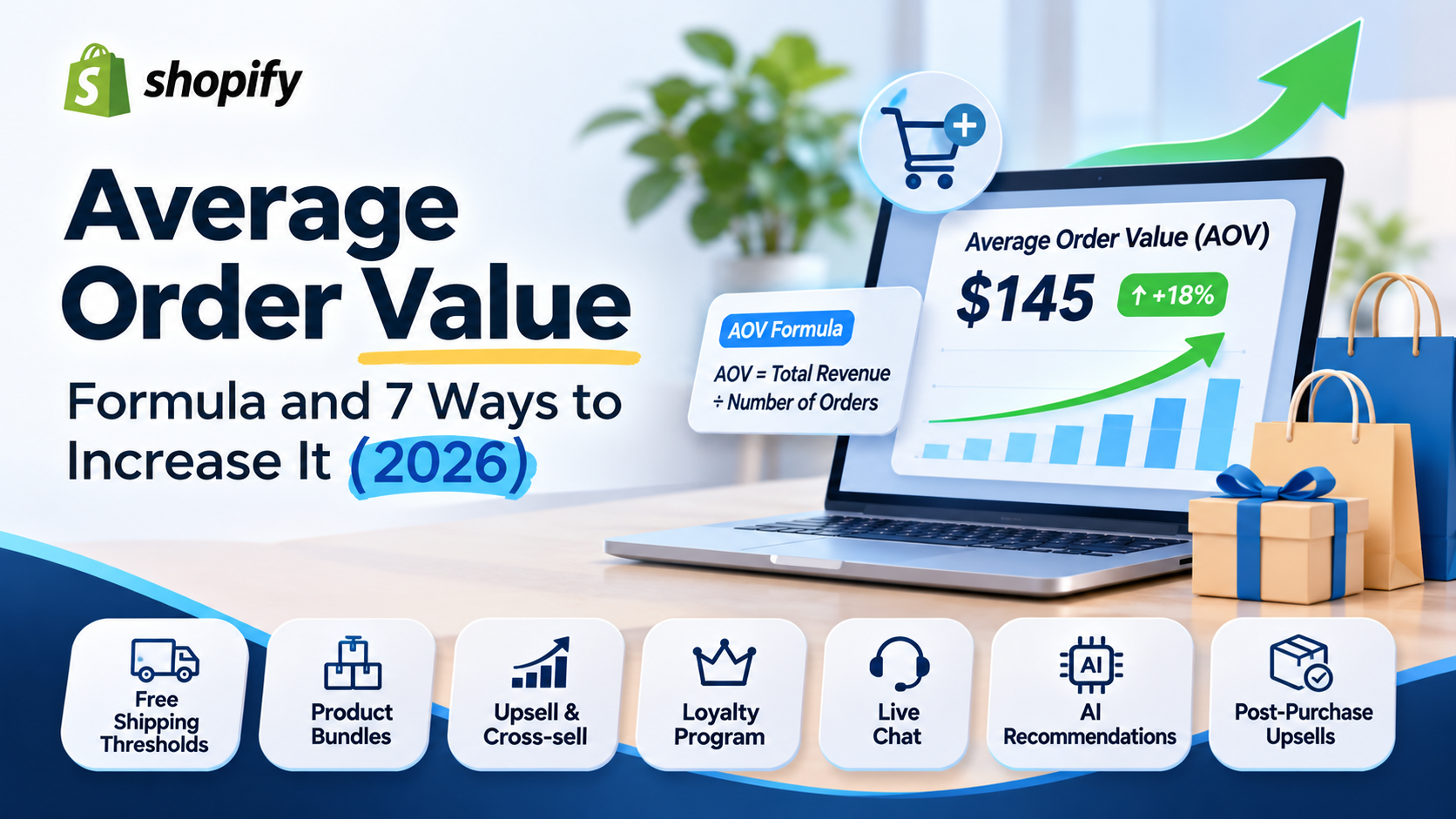
Average order value (AOV) tells you how much a customer spends, on average, each time they check out. It is a quick health check for your pricing, your product mix and your checkout experience. Globally, the figure sits at roughly $145 across industries, though your own benchmark depends heavily on what you sell.
The logic is simple: if the same number of buyers each spend a little more, revenue goes up without paying for a single extra visitor. The catch is that a bigger cart does not automatically mean a bigger profit, so the goal is smarter orders, not just larger ones.
How to Calculate Average Order Value
The formula needs only two numbers from the same time period:
AOV = Total Revenue ÷ Number of Orders
If your store earned $2,000 from 100 orders, your AOV is $20. In Shopify, you can find this under your reports and analytics, next to other customer behaviour data.
Mean, Median and Mode: Reading AOV Correctly
A plain average can mislead you. A few very large orders pull the number up and hide what most shoppers actually do. That is why it helps to look at three measures together:
- Mean: the traditional AOV, the average of every order.
- Median: the middle order when you line them all up.
- Mode: the order value that appears most often.
Picture a hot sauce store whose mean order is $24 while the most common order is only $15. A handful of big purchases are inflating the average. In that case, the smarter move is to focus on the $15 shoppers and encourage a small add-on, because nudging the majority up a little usually beats chasing rare big spenders.
Average Order Value Benchmarks by Industry
Benchmarks give context, but they vary widely between categories:
- Luxury and jewelry: often above $300 per order.
- Apparel and accessories: commonly between $40 and $170.
- Beauty and personal care: usually around $15 to $90.
Compare yourself with stores in your own niche, then look at what shapes spending inside your store. A smooth checkout matters because roughly 70% of carts are abandoned, and personalisation matters because brands that personalise well tend to convert and earn noticeably more than those that do not.
7 Ways to Increase Average Order Value
1. Set Order Minimums for Free Shipping and Gifts
Many shoppers will happily add another item to avoid paying for delivery. Base your threshold on your most common order value rather than the mean. A good rule of thumb is to set it around 30% above that figure, so free shipping feels reachable for most buyers. If the bar is too high, people simply abandon their carts.
You can also reward bigger baskets with a free gift or a flat discount, such as a fixed coupon above a certain spend. A fixed amount keeps margins more predictable than a percentage off. Show the goal clearly with a promotion bar or in-cart message so shoppers know exactly how much more to add.
2. Bundle Products Into Packages
Bundles make it easy to buy everything for one purpose in a single click, and they raise the perceived value of the purchase. A camping stove sold together with its accessories is a classic example: the buyer skips the research, and you sell several items instead of one. You can also let customers build their own bundle by picking the add-ons they want.
3. Upsell and Cross-Sell Complementary Items
Upselling suggests a better version of what the shopper is already buying, while cross-selling suggests something that goes with it. The key is to recommend the way a helpful friend would, with hand-picked pairings such as batteries with a remote or a mouse with a laptop. Keep add-ons low in price, because a $20 extra is far easier to accept than another $100. Overdoing it leads to diminishing returns, so be selective.
4. Launch a Customer Loyalty Program
Rewards and tiered perks give shoppers a reason to spend more per visit and to return. Free shipping, early access to launches and small gifts can all work. Keep the program in tune with the economy, since lavish rewards may not make sense when budgets are tight. A simple points system that customers can understand at a glance usually performs best.
5. Offer Live Chat Support
Live chat answers questions at the moment of doubt, which means fewer abandoned carts and more confident buyers. It is especially valuable for high-ticket products such as furniture or mattresses, where shoppers want reassurance before paying. Every conversation also builds a relationship that can lead to repeat orders.
6. Use AI-Powered Product Recommendations
AI looks at browsing behaviour, past purchases and cart contents to show each shopper the items they are most likely to add. Brands that move budget from blanket discounts to personalised offers can see much stronger returns. On Shopify, tools such as Search & Discovery, Rebuy and Gorgias Shopping Assistant can bring this personalisation to your storefront.
7. Add Post-Purchase Upsells
Offers shown right after payment carry no risk to your main conversion, because the customer has already said yes. A shopper who just bought a skincare product might see a matching serum or a travel-size version. Over time, the data shows which products people naturally buy together, which helps you design better bundles and recommendations before checkout.
Tracking and Optimizing Your AOV
AOV works best alongside other numbers. Watch it together with customer acquisition cost, customer lifetime value and conversion rate, so you can tell whether larger orders are truly improving profit.
A simple routine keeps you honest:
- Track AOV over consistent periods, such as month over month or quarter over quarter.
- Set a realistic target, for example a 5% to 10% lift next quarter.
- Test shipping thresholds, bundles and post-purchase offers one at a time before rolling them out.
Start Increasing Your Average Order Value Today
Your best opportunity sits with visitors who already want to buy. Rather than paying again and again to find new shoppers, help the people in front of you discover items that genuinely suit them. When customers get more value, they spend more, and your store grows on a healthier footing.
If you would like help setting up bundles, upsells, personalised recommendations or a smoother checkout on your Shopify store, the team at Teenva AI is ready to build it with you. Get in touch to turn a higher average order value into lasting revenue growth.