

Shopify International Selling: Global Expansion Guide
Introduction
Shopify international selling lets you reach shoppers abroad, but that is only half the job in international ecommerce. Once they land on your store, customers need to understand your products, see exactly what they’ll pay, and know when their order will arrive. Every new country adds decisions about pricing, delivery, taxes and content, and each one has to be kept accurate over time.
Shopify Markets lets you manage all of this from a single store. This guide to Shopify international selling covers what to look for in international sales tools, how to localize your store, how to run cross-border operations, and how to choose between Shopify Markets and Managed Markets.
What Are International Sales Tools?
International sales tools are software features that help you sell and fulfill orders across borders. They let you adapt the shopping experience for visitors in different countries, for example by showing product pages in the local language and checkout in the local currency. They can be built into your ecommerce platform or added through apps.
Why do people buy from abroad? In DHL's 2026 survey of 29,000 online shoppers across 29 countries:
Reason for buying internationally | Share of shoppers |
|---|---|
Lower prices | 60% |
Products or brands not available at home | 44% |
Better product quality | 32% |
The Customer Journey in a Cross-Border Sale

What to Look for in International Sales Tools
Judge any tool against the experience you want customers to have. Use this checklist:
Local currencies and pricing. Show prices and accept payment in the shopper's currency. Look for exchange-rate controls and custom pricing so you can reflect costs in each market.
Translation and regional content. Translate product pages and checkout, then fine-tune wording for each audience, such as local clothing-size terms.
Local payment methods. Offer options shoppers already trust. Check availability for both your business location and the customer's country before activating a method.
International domains and SEO. Give each market its own URL, and make sure hreflang tags tell search engines which language and region each page targets.
Duties and import taxes. Calculate and collect charges at checkout, and confirm your carrier supports delivered duty paid (DDP) shipping.
Shipping and returns. Compare options per destination, show delivery estimates, and explain return rules, including who pays for return shipping.
Market controls and reporting. Decide which products you sell where, and review sales by location to guide your next investment.
Tip: Check plan eligibility and fees before you commit. Add up subscription costs, transaction fees and currency conversion charges when comparing providers.
Localize Your Store for International Customers
1. Sell in Local Currencies
In a 2025 survey, 45% of online shoppers said seeing prices in their own currency would encourage them to buy from a foreign store.
With Shopify Payments, customers can browse, pay and receive refunds in their local currency. You can:
Convert prices automatically using current exchange rates, or set rates manually for more predictable pricing.
Apply rounding rules so converted prices keep the endings you use in each market (for example, .99).
2. Translate Your Store
A multilingual store lets customers read product details and check out in their preferred language.
Shopify's Translate & Adapt app translates your store into up to two languages for free.
A side-by-side editor lets you compare translations against your original copy and add further languages manually.
Once a language is published, translated content appears at checkout, and order emails use the customer's checkout language when translations exist.
Review essential content, such as your return policy, before publishing.
3. Adapt Content by Market
Markets that share a language can still need different wording. Translate & Adapt lets you adjust phrasing to local usage or tailor promotions to the season shoppers are in.
Example: Japanese lifestyle brand Her lip to localizes content with Translate & Adapt, adjusts its product selection for local seasons and import restrictions, and customizes its storefront theme by country.
4. Give Each Market Its Own Domain
Separate URLs help both shoppers and search engines find the right version of your store.
Option | Example |
|---|---|
Subfolder |
|
Subdomain |
|
Country domain |
|
Shopify automatically adds hreflang tags based on your market and language settings, so search engines can match each page to the right country and language. You can also use automatic redirection to show visitors the storefront that fits their location or browser language, and add country and language selectors so they can change it.
Note: For EU visitors browsing an EU country domain, Shopify doesn't redirect automatically to another market. A third-party app can suggest a country that the shopper accepts.
5. Offer Local Payment Methods
Shoppers want to pay in ways they recognize. Among US shoppers who abandoned a cart for reasons beyond casual browsing, 9% blamed too few payment methods.
With Shopify Payments you can activate local methods in eligible markets. For instance, Bancontact gives Belgian customers a familiar option. Always verify each method's eligibility for your business location and the customer's country and currency.
Example: The brand SilkSilky uses checkout customization to reorder payment methods so the most popular ones appear first in each market.
6. Collect Duties and Import Taxes Up Front
Showing duties and taxes before purchase was the top incentive to order more from abroad in Sendcloud's 2026 survey of 8,000 consumers across eight European markets (20.24% chose it).
To set this up in Shopify:
Add accurate Harmonized System (HS) codes and country-of-origin details to your products.
Use a carrier that offers delivered duty paid (DDP) shipping so the charges collected at checkout cover customs.
Remember that Shopify charges a transaction fee for the calculation, and estimates are only as accurate as your product data.
US-bound orders: The duty-free de minimis exemption was suspended globally on August 29, 2025, and the suspension continued into 2026. Commercial shipments valued at or below the former $800 threshold no longer qualify for duty-free treatment.
Manage International Operations with Shopify Markets
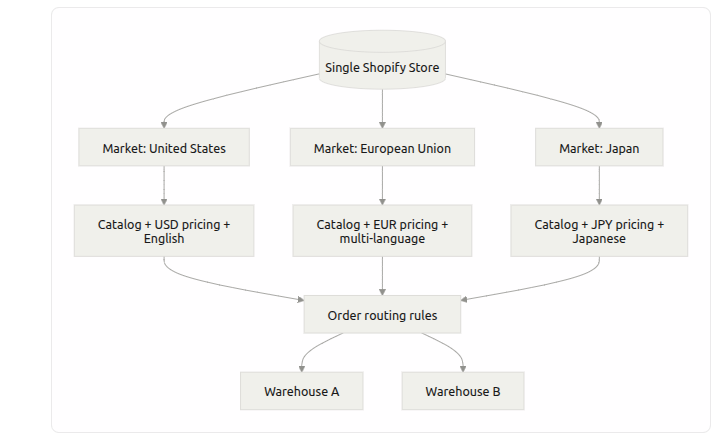
Shopify Markets pulls your international settings into one place. You can choose new markets, group countries, control pricing and product availability, and route orders between fulfillment locations.
Architecture of One Store, Many Markets
Find Your Next Market
Open the Sessions by location report in Shopify Analytics to see which countries already send visitors. Compare that traffic with your existing orders and shipping costs to decide where to expand. Then create a draft market, review the settings it inherits, and configure shipping rates before activating it.
Configure Market Areas
Group countries that share a selling strategy into one market.
Create individual markets for countries that need different settings.
For example, you might manage several European countries together and give one country its own market because it needs different pricing.
Set Custom Pricing
Use market catalogs to raise or lower prices by a percentage across products, or set fixed prices for individual items. Fixed prices override the catalog's percentage adjustment. This is handy for protecting your margin where delivery costs more.
Control Product Availability
Catalogs assigned to each market decide which products shoppers see, including in your store's search results. For instance, you can leave out an item you aren't licensed to sell in a certain country.
Define Order-Routing Rules
If you have at least two active fulfillment locations, Shopify's order-routing rules decide where each order ships from. The defaults run in this order:
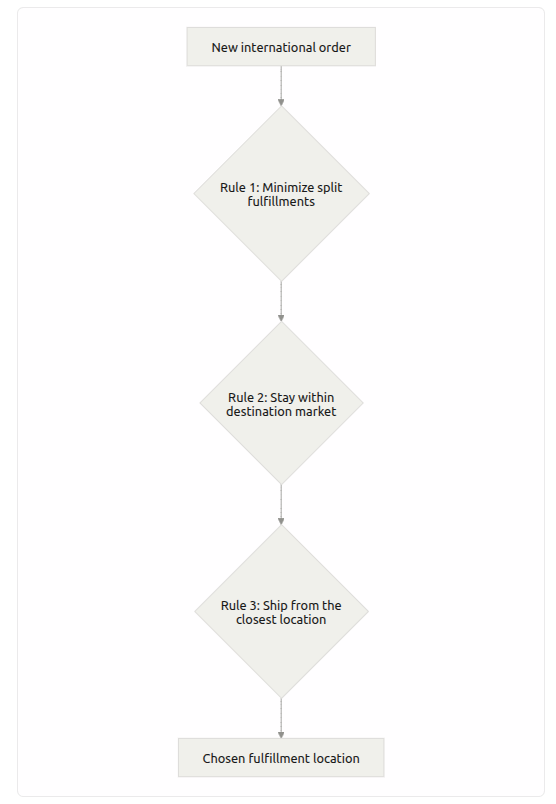
You can reorder these rules under Settings > Shipping and delivery > Order routing. Their sequence sets which locations take priority. As volume grows, holding inventory in a warehouse closer to customers can cut both shipping costs and transit times.
Shopify Markets vs. Managed Markets: Which Do You Need?
Shopify Markets gives you the tools to run international sales yourself. Managed Markets adds services from Global-e, which acts as the merchant of record (the legal seller) for eligible international orders.
Trust is a real barrier: in DHL's 2026 survey, 45% of shoppers cited fear of fraud or lack of trust as a barrier to buying abroad, tied with high delivery costs and long delivery times.
Consideration | Shopify Markets | Managed Markets |
|---|---|---|
Merchant of record | Your business | Global-e, for eligible international orders |
Pricing and fees | Standard payment-processing and currency conversion fees; optional duties calculation currently carries a temporary 0.5% fee | 3.5% transaction fee (3.25% on Shopify Plus) on top of payment processing and currency conversion; no separate monthly fee |
Compliance | You handle tax registrations and remittance, and check import restrictions | Global-e handles tax registration, remits taxes and duties, and manages import restrictions; you still provide accurate origin information |
Fraud and chargebacks | You manage fraud review and disputes; eligible US Shop Pay orders qualify for Shopify Protect | Eligible US orders get Shopify Protect coverage for fraudulent and unrecognized chargebacks |
Duty-inclusive pricing | You choose whether duties are included in prices or added at checkout; calculations are estimates | Prices can include duties and taxes plus service fees; calculations are guaranteed |
Shopify subscription and shipping costs apply to both options. For US stores, the currency conversion fee is 1.5% when applicable.
Which One Fits You?
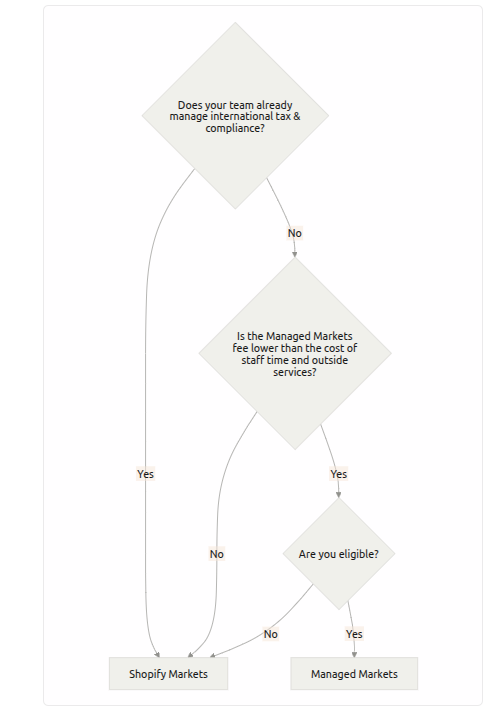
Choose Markets if you already handle international tax and compliance in-house.
Consider Managed Markets if its fee compares favorably with the staff time and external services that work would otherwise require.
Real-world result: Outdoor gear brand BattlBox used Managed Markets to reach more than 140 countries. CEO John Roman said the launch "has added revenue with zero process change."
Eligibility: Managed Markets is available to eligible merchants in the continental US and selected stores in Canada and the UK. Confirm eligibility before planning a rollout.
Your 5-Step Global Launch Plan
Start with one market, then use the results to guide the next0.

Find existing demand. Review the Sessions by location report and your international orders to pick a priority country.
Assign responsibility for taxes and compliance. Compare the cost of doing it yourself with Managed Markets' fees and eligibility.
Prepare your store. Create a draft market, set local pricing, translate essential product information and review the storefront.
Check the order economics. Configure shipping rates and duties settings, then calculate what you'll earn after delivery costs and transaction fees.
Launch and review. Activate the market, monitor sales and conversion, and use delivery issues and customer questions to decide what to
improve before expanding further.
Frequently Asked Questions
What are international sales tools, and who should use them?
They are ecommerce features that tailor how you sell across borders, covering currencies, languages, payment methods, domains, duties, taxes and market-specific pricing. They suit businesses that already receive international traffic or plan to enter new countries.
Does each country need its own online store?
No. Shopify Markets lets you manage multiple countries from one store and create a distinct experience for each. Separate stores can work for regional teams that need independent inventory, storefronts or operations, but they aren't necessary for every country.
How do shipping and return policies affect international conversions?
A clear international shipping policy tells shoppers what delivery costs, when the order will arrive and how returns work. State the carriers you use, delivery estimates, return deadlines and who pays return shipping. If duties or import taxes may be charged separately, explain when customers will see and pay them.
What is Shopify Markets?
It is a set of tools for managing sales across countries and customer groups from one Shopify store. You can customize currencies, languages, domains, catalogs, pricing, duties and storefront content for each market from the Shopify admin.
Is Shopify international?
Yes. Merchants can sell to customers in many countries through localized storefronts, international payment options and cross-border shipping tools. Availability of Shopify Payments, local payment methods and Managed Markets varies by your business location and the target country.
Conclusion
Selling globally doesn't mean running a separate store for every country. With Shopify Markets you can localize currency, language, domains, payments and duties from one admin. Pair it with Managed Markets if you'd rather hand off compliance and fraud risk. Pick one market backed by real demand, get the economics right, and expand from there.
Ready to take your store global? Start with the Sessions by location report in your Shopify admin and pick your first market today.