
ERP vs CRM: Key Differences, Benefits, and Which One Your Business Needs
As a business grows, spreadsheets and manual tracking stop being enough. Orders get lost, customer follow-ups slip, and nobody has a clear picture of what is actually happening. This is usually the point where companies start looking at enterprise software, and two names come up almost immediately: ERP and CRM.
They are often mentioned together, but they solve very different problems. This guide explains what each system does, the benefits they bring, how they differ, and how to decide which one (or both) your business needs.
What Is ERP?
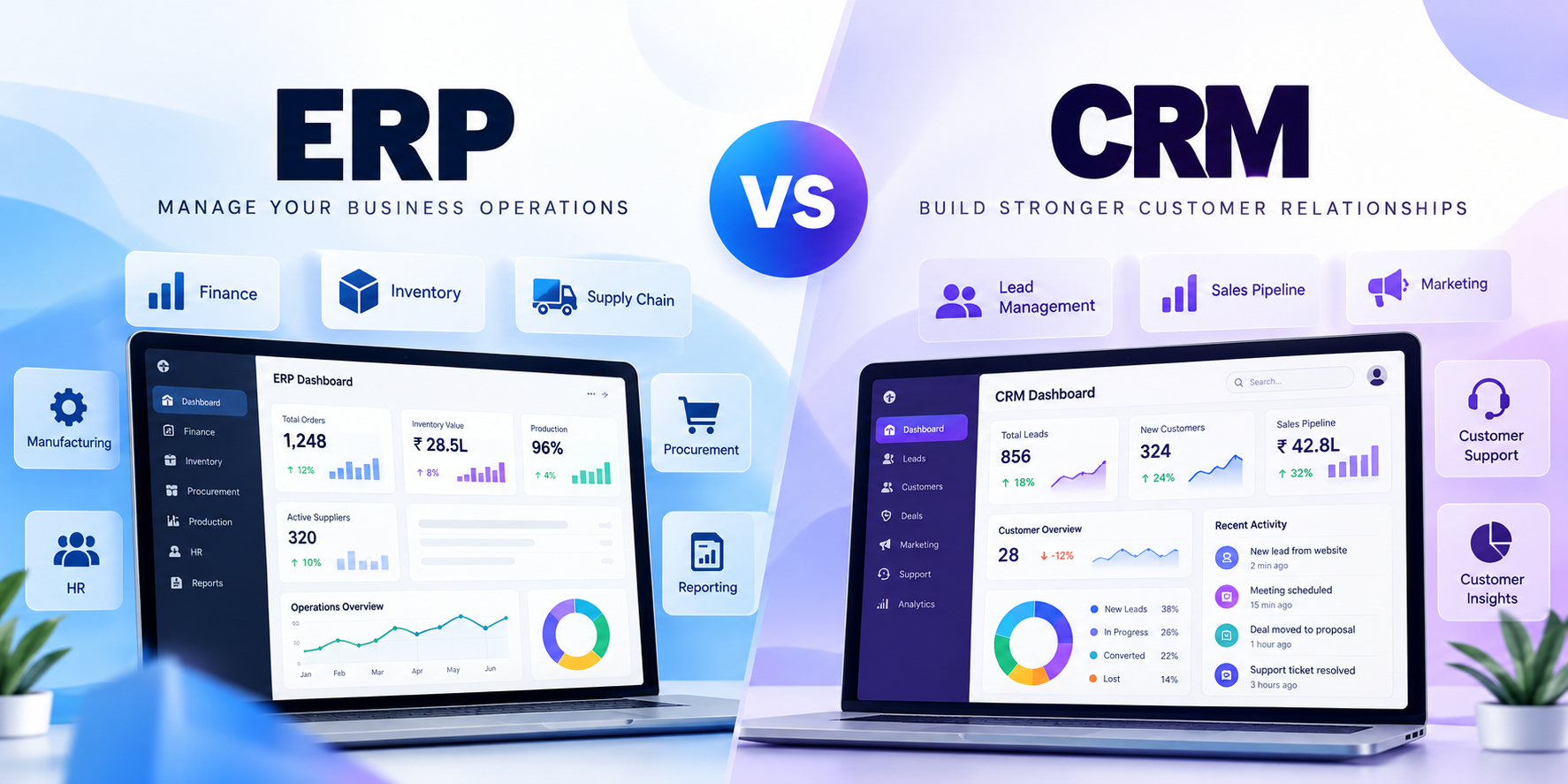
ERP stands for Enterprise Resource Planning. It is software that helps an organization plan and run its internal operations, such as finance, manufacturing, supply chain, inventory, procurement, and human resources, from one connected platform.
Instead of each department keeping its own files and tools, an ERP system stores everything in a shared database. When the warehouse updates stock, finance and sales see it instantly. When an order is placed, production and procurement can react to it right away.
A typical ERP platform offers:
- A single, common database for all departments
- Real-time data across operations
- A consistent interface across modules
- Integration with other systems and applications
- Flexible deployment: on-premise, cloud-hosted, or SaaS
Common ERP Modules
ERP software is organized into modules, each covering a functional area. Common ones include:
- Financials and accounting
- Manufacturing and production
- Supply chain and procurement
- Inventory and warehouse management
- Quality management
- Asset management
- Human resources
- Analytics and reporting
Who Uses ERP?
ERP is widely used in manufacturing, automotive, electronics, healthcare and pharma, food and beverage, construction, agriculture, hospitality, and retail. Larger companies typically choose enterprise-grade ERP, while smaller businesses often prefer lighter, more affordable small-business ERP editions.
Benefits of ERP
- Lower costs: Automation and integration reduce repetitive work and improve productivity.
- Fewer errors: Less manual data entry means fewer mistakes and less wasted time.
- Better decisions: Accurate, real-time reports show where money and resources are going.
- Stronger compliance: Processes are standardized, which makes regulatory requirements easier to track.
- Team collaboration: Departments work from the same data instead of competing versions of it.
- Scalability: The system grows with the business instead of holding it back.
- Better supplier and partner management: Procurement and vendor data stay organized in one place.
What Is CRM?
CRM stands for Customer Relationship Management. It is software that helps a business manage its relationships with leads, customers, and partners across the entire customer journey, from the first marketing touchpoint to sales, support, and long-term loyalty.
A CRM stores contact details, communication history, preferences, purchases, and support requests in one place. Anyone on the team can see the full story of a customer before they pick up the phone or send an email, which makes outreach more personal and prevents leads from falling through the cracks.
CRM is used by sales, marketing, customer support, business development, and even recruiting teams.
Benefits of CRM
- Customer-focused growth: A complete view of every customer helps you serve them better and sell more.
- Consistent experience: Every team member sees the same history, so customers do not have to repeat themselves.
- Smarter marketing: Campaign results and customer behavior are tracked, so you can focus on what works.
- Better sales pipelines: Leads are prioritized and follow-ups are tracked, so opportunities are not forgotten.
- Improved support: Questions, complaints, and feedback from every channel are pulled into one timeline.
- Protection against turnover: Customer knowledge stays in the system when a salesperson leaves.
- Resource savings for small teams: A CRM can automate tasks that would otherwise need extra hires.
ERP vs CRM: What Is the Difference?
The simplest way to remember it: ERP organizes processes, while CRM organizes people. ERP looks inward at how the business runs. CRM looks outward at how the business connects with customers.
| Area | ERP | CRM |
|---|---|---|
| Primary focus | Internal operations and resources | Customer relationships and interactions |
| Typical users | Finance, operations, supply chain, HR | Sales, marketing, support |
| Key functions | Accounting, inventory, production, order processing, procurement | Lead management, sales pipelines, campaigns, customer support |
| Core data | Financials, stock, orders, resources | Contacts, conversations, preferences, deals |
| Main goal | Efficiency and accuracy in operations | Better customer experience and revenue growth |
What Do ERP and CRM Have in Common?
Despite their different roles, both systems deliver similar overall value:
- Higher operational efficiency
- Better use of resources
- Stronger reporting and analytics
- More informed decision-making
- Improved communication across teams
- Business growth and higher profitability
- Anywhere access when built on the cloud
Do You Need ERP, CRM, or Both?
If your business is struggling with inefficiency, unhappy customers, or shrinking margins, one of these systems may help. These signs can tell you which direction to look.
Signs You Need an ERP
- Operations are slowing down because of bottlenecks
- Growth is being held back by your current tools
- Too many disconnected spreadsheets and programs are in use
- Data is entered and checked manually
- Your IT team spends most of its time maintaining old systems
- Current software cannot scale with your plans
- Resources and staff are not being used well
- Security and risk management feel weak
Signs You Need a CRM
- Customer information is scattered across inboxes, sheets, and phones
- Teams forget to follow up with prospects
- Several people talk to the same customer without shared context
- Customers complain about repeated calls or unfulfilled requests
- You are a growing B2B company with a long, multi-step sales cycle
- Business decisions are based on guesswork
- You lose pipeline whenever a salesperson leaves
- You run marketing campaigns without enough tools or people
If you recognize signs from both lists, using both systems is usually the right answer.
Why Integrate ERP and CRM?
Running ERP and CRM separately works, but connecting them unlocks much more value. Integration joins the front office (sales and customer data) with the back office (orders, inventory, and finance), giving you a true 360-degree view of the business.
- Real-time sync: Updates in one system automatically appear in the other.
- No double entry: Orders entered in the CRM flow straight into the ERP, which saves time and cuts errors.
- Better forecasting: Sales teams can combine order history from the ERP with customer behavior from the CRM to predict demand.
- Faster processing: Automation shortens the path from quote to order to delivery.
- Clearer reporting: One reliable data source means more complete and trustworthy reports.
How to Choose the Right ERP or CRM System
Before committing to a platform or vendor, ask these questions:
- Does the software meet our functional and technical requirements?
- Does it support our business goals?
- Will it work with the systems we already use?
- What training and support does the vendor offer?
- What do existing customers say about it?
- Is the vendor investing in new technology and keeping up with trends?
- Can it scale and be customized without heavy cost?
Taking time to answer these honestly helps you avoid expensive customizations and rework later.
Final Thoughts
ERP and CRM are not competitors. They are two halves of a well-run business: one keeps your operations tight, the other keeps your customers close. Whether you start with one or implement both, the right choice depends on where your biggest pain points are today and where you want to be tomorrow.
Ready to Build Your ERP or CRM Solution?
At Teenva AI & Digital Ventures, we help businesses across travel, healthcare, e-commerce, and retail design, build, and integrate custom ERP and CRM solutions, connect them to your existing systems, and automate workflows with AI.
Ready to get started? Reach out to our team at sales@teenvaai.com, call +91 9572020107, or visit teenvaai.com to discuss your requirements.