
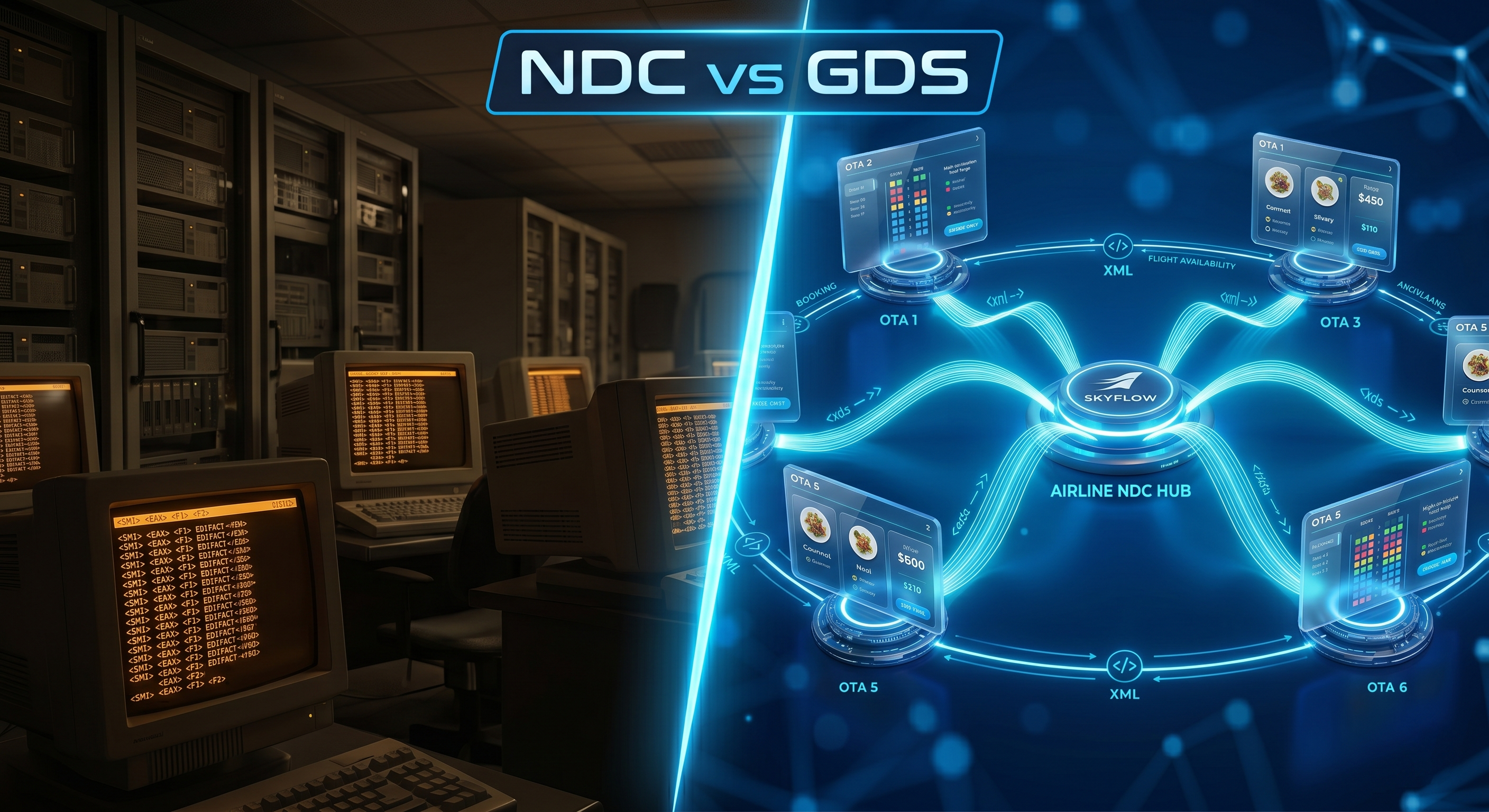
NDC vs GDS APIs: Complete Comparison Guide
Airline distribution is undergoing its most significant transformation in decades. At the heart of this shift is a battle between two systems: the legacy GDS (Global Distribution System) and the modern NDC (New Distribution Capability) standard. For travel agencies, OTAs, and technology teams building on top of airline inventory, choosing the right API layer is no longer just a technical decision — it shapes pricing power, customer experience, and long-term revenue.
This guide breaks down the NDC vs GDS API debate in depth — covering architecture, data protocols, personalization, ancillary access, integration complexity, and where the industry is headed.
What Is a GDS and How Does Its API Work?
A Global Distribution System is a network platform that aggregates flight inventory, fares, and schedules from multiple airlines into a single interface. The major GDS providers — Amadeus, Sabre, and Travelport — act as intermediaries between airlines and travel sellers.
GDS API Architecture
GDS APIs use a request-response model built on the EDIFACT (Electronic Data Interchange for Administration, Commerce and Transport) messaging standard — a protocol dating back to the 1980s. While modern GDS providers have introduced SOAP and REST wrappers on top, the underlying data format remains legacy-heavy.

What GDS APIs Offer
Unified access to hundreds of airlines from a single integration point
Real-time seat availability and fare lookups (availability and pricing calls)
Booking, ticketing, and post-booking services (PNR management)
Historical reliability and wide industry adoption
Hotel, car, and rail content bundled alongside flights
GDS API Limitations
Content is restricted to filed fares — airlines cannot dynamically price or bundle ancillaries
EDIFACT-based data is rigid, making it difficult to transmit rich media (seat maps, images, fare rules in plain language)
Agents pay booking fees, and airlines pay distribution surcharges — creating cost friction on both sides
Ancillary upsell (bags, meals, upgrades) is limited and often not real-time
Customer data is siloed — airlines cannot identify or personalise for individual travellers through GDS
What Is NDC and How Does Its API Work?
NDC (New Distribution Capability) is an IATA-led XML-based API standard designed to modernise how airlines distribute their content. Rather than routing through a GDS intermediary, NDC allows airlines to expose their full product catalogue — including dynamic pricing, ancillaries, and rich content — directly to travel sellers via APIs.
NDC API Architecture
NDC APIs use XML over HTTPS, following IATA's NDC schema. Travel sellers can connect directly to airline NDC APIs or via an NDC aggregator (also called an NDC gateway) that normalises connections across multiple airlines.

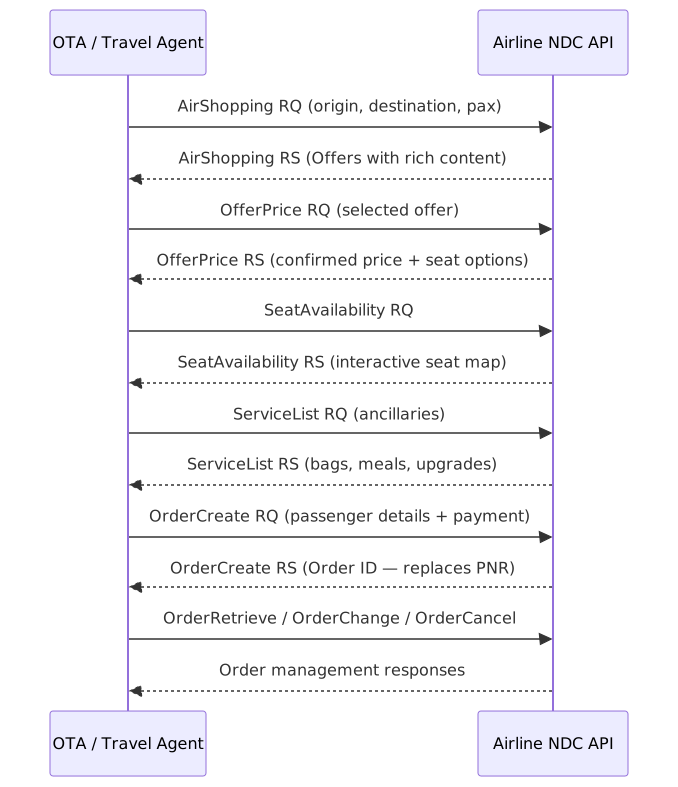
Core NDC API Message Flows
NDC follows an Offer and Order model — a fundamental shift from the traditional PNR (Passenger Name Record) paradigm.
What NDC APIs Offer
Dynamic, real-time offer creation personalised to traveller profile
Rich content: seat maps with images, cabin photos, fare condition plain text
Full ancillary catalogue: seats, bags, meals, lounge access, fast track
One Order model — a single order record replaces the fragmented PNR ecosystem
Direct customer data flow to the airline — enabling loyalty recognition and targeted pricing
No EDIFACT dependency — clean REST/XML integration
NDC vs GDS API: Side-by-Side Comparison
Feature | GDS API | NDC API |
|---|---|---|
Data Standard | EDIFACT / SOAP (legacy) | XML over HTTPS (modern) |
Pricing Model | Filed fares only | Dynamic offer-based pricing |
Ancillary Access | Limited, not real-time | Full catalogue, real-time |
Rich Content | Minimal | Images, seat maps, fare rules |
Personalisation | Not supported | Traveller profile-aware offers |
Booking Record | PNR-based | Order-based (One Order) |
Integration Complexity | Mature tooling, but complex legacy | Varies by airline; aggregators help |
Airline Coverage | 400+ airlines | 50+ NDC-certified airlines (growing) |
Cost to Agents | GDS booking fees apply | Direct or aggregator fees; often lower |
Data Ownership | GDS holds customer data | Airline retains customer data |
Innovation Speed | Slow — protocol constraints | Fast — XML schema evolves with IATA |
The API Developer's Perspective: Integration Complexity
For engineering teams, the integration experience differs significantly between GDS and NDC.
GDS API Integration
Most GDS providers offer SDKs and developer portals, but the underlying protocol adds complexity:
SOAP/XML envelopes with verbose schemas
Cryptic EDIFACT error codes requiring domain expertise to decode
Sandboxes that don't always reflect production behaviour
Tight coupling to GDS-specific business rules (queuing, pseudo-city codes, ticketing carriers)
NDC API Integration
NDC promises a cleaner developer experience, but implementation realities vary:
Each airline may implement a different NDC version (17.2, 18.1, 20.1, 21.3)
Schema interpretation differs across airlines and their IT vendors
Direct airline connections require separate certifications per carrier
NDC aggregators (such as Verteil, Duffel, or Travelfusion) normalise these differences into a single API, significantly reducing integration burden

For most OTAs and travel startups, the NDC aggregator path offers the best balance of content richness and integration speed.
Pricing and Business Model Differences
The business model behind each API shapes how agencies and airlines profit.
GDS Economics
Airlines pay a per-segment distribution fee to GDS (~$3–$7 per segment, depending on carrier and region)
Travel agencies receive booking incentives from GDS, creating dependency
Airlines surcharge GDS bookings to offset fees — passed on to customers
Ancillary revenue (bags, seats, upgrades) largely bypasses agents because GDS cannot distribute it efficiently
NDC Economics
Distribution costs shift — airlines control the economics of direct or aggregator connections
Agents access full ancillary revenue potential, including commissions on upsells
Dynamic pricing means airlines can offer exclusive fares only through NDC channels
Over time, airlines are directing their best fares and content to NDC — making GDS-only connectivity increasingly limiting
IATA's Role and the ARM Index
IATA continues to evolve the NDC standard. Key initiatives shaping the future of NDC APIs include:
Airline Retailing Maturity (ARM) Index — Launched in 2021, the ARM Index consolidates multiple certifications (NDC, One Order, Dynamic Offer Creation, Future of Interline) into a single benchmark, making it easier for airlines and IT providers to demonstrate end-to-end retailing capability.
NDC Version 21.3 — Introduces enhanced payment capabilities, improved post-booking servicing, and better interoperability between carriers and intermediaries. IATA expects broad airline adoption in the near term.
One Order — Replaces the PNR/e-ticket/EMD fragmentation with a single order record managed by the airline. When combined with NDC, it creates a seamless retailing experience from search through to post-travel service.
GDS Giants Embrace NDC
The major GDS players are no longer resisting NDC — they are integrating it:
Amadeus has built NDC connectivity into its platform, partnering with major carriers to surface NDC content alongside traditional GDS inventory.
Sabre launched its NDC-enabled marketplace, allowing agencies to access NDC offers via familiar Sabre interfaces.
Travelport has been active in NDC certification and is expanding its airline NDC partnerships.
This convergence means the future is unlikely to be GDS or NDC in isolation — hybrid platforms that aggregate both will become the norm, at least through the mid-2020s.
Which API Should You Integrate?
The right answer depends on your use case:

For new travel portals, a hybrid approach — GDS for broad coverage and NDC for key carriers with strong ancillary programmes — is increasingly the recommended architecture. Teams at Teenva AI & Digital Ventures regularly evaluate this exact integration strategy when building travel portals for clients, ensuring the platform is positioned for both today's inventory realities and tomorrow's NDC-first landscape.
What's Next for Airline Distribution APIs?
Several trends will shape the GDS vs NDC conversation over the next three to five years:
NDC airline adoption will accelerate — More carriers are building NDC capabilities, and IATA's ARM certification is smoothing the process.
GDS NDC coverage will expand — Rather than competing with NDC, GDS platforms will aggregate it, becoming meta-distribution layers.
One Order will gain traction — As more airlines implement One Order, the complexity of multi-carrier itineraries will reduce significantly.
Continuous Pricing — Dynamic, offer-level pricing will become standard, replacing filed-fare structures. GDS cannot support this natively; NDC is built for it.
AI-driven personalisation — NDC's richer customer data layer enables AI models to surface personalised fares and bundles in real time — an area where legacy GDS is structurally unable to compete.
Build Your Travel Platform on the Right Foundation
The NDC vs GDS API decision is foundational to how your travel platform performs commercially and technically. Getting it right at the start saves months of re-architecture later.
At Teenva AI & Digital Ventures, we specialise in building travel portals, booking engines, and OTA platforms that integrate both GDS and NDC APIs — designed for scale, personalisation, and long-term adaptability. Whether you're launching a new travel startup or upgrading a legacy booking system, our team can guide your API strategy and build the end-to-end solution.
Get in touch with us:
Email: sales@teenvaai.com
Phone: +91 9572020107
Website: teenvaai.com
Let's build the travel platform your customers deserve.