
TrekkSoft API Integration Guide: Build Seamless Activity Booking Systems
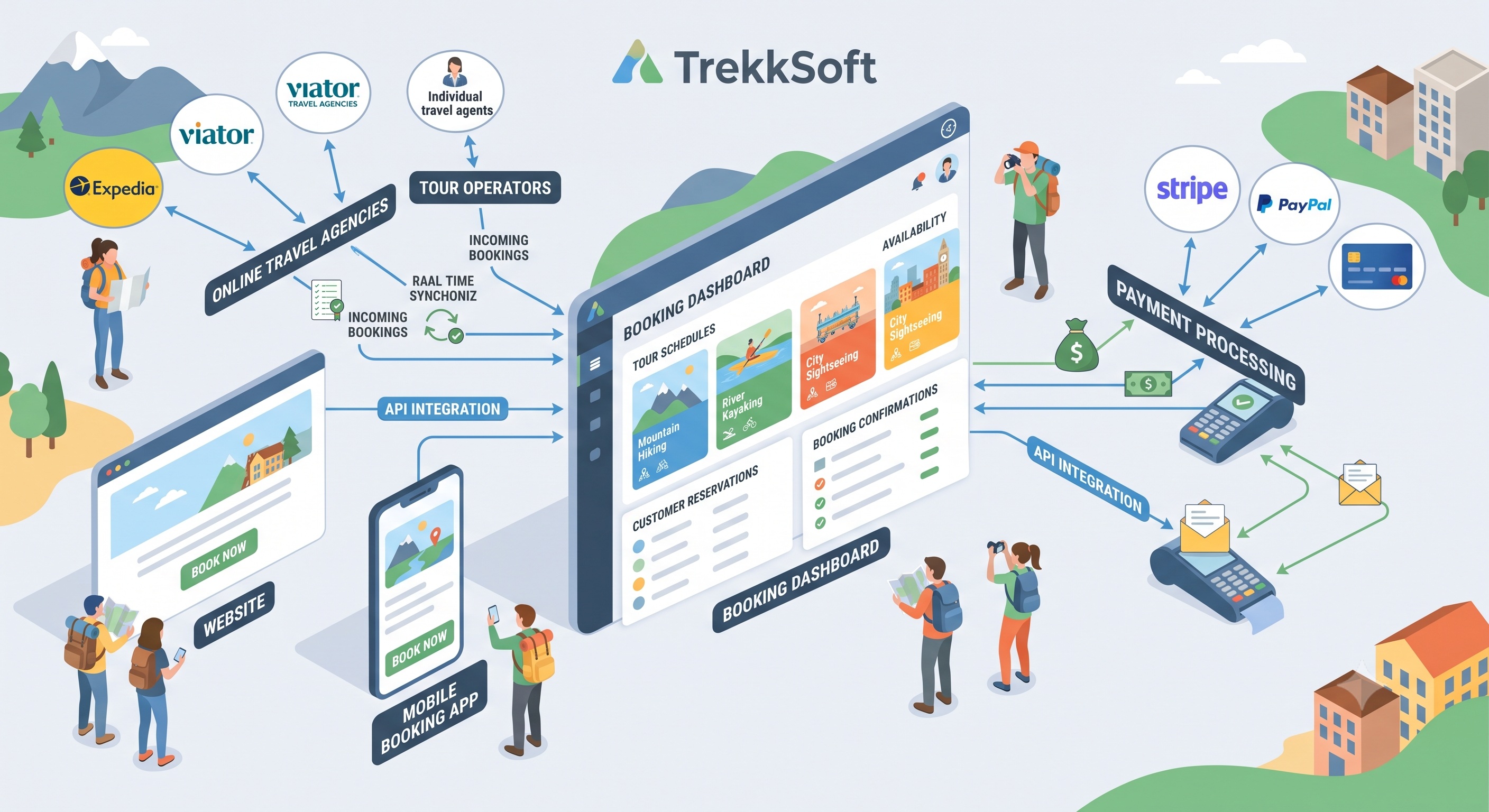
Tour and activity operators running on TrekkSoft don't just need a booking dashboard — they need that dashboard talking to their website, their OTA channels, their CRM, and their payment stack in real time. That's what TrekkSoft API integration is really about: turning a standalone booking system into one node in a connected distribution network.
This guide walks through the architecture, authentication model, and integration patterns developers need to connect TrekkSoft into a broader travel technology stack — whether you're building a custom booking engine, a channel manager, or a middleware layer that syncs TrekkSoft with other supplier systems.
Why activity operators need API-level integration
Manually managing bookings, availability, and OTA listings through a dashboard doesn't scale past a handful of sales channels. Every additional OTA, every new payment method, and every marketing automation tool adds another manual sync point — and manual sync points are where double-bookings, stale pricing, and lost revenue creep in.
TrekkSoft exposes a REST API (hosted at api.trekksoft.com) that lets developers programmatically manage tours, availability, bookings, and payments, rather than relying solely on the back-office UI. Combined with TrekkConnect, TrekkSoft's unified channel manager API, operators can push both content and real-time availability to resellers from a single integration point instead of building separate connections for every OTA.
For a TMC, DMC, or OTA building on top of TrekkSoft, that API surface is the foundation for:
Syncing inventory and pricing from TrekkSoft into a central booking engine
Pushing real-time availability out to multiple distribution channels
Automating booking confirmations, cancellations, and payment capture
Feeding booking data into CRM, marketing, and reporting systems
Core components of a TrekkSoft integration
1. Authentication
TrekkSoft's API uses merchant-scoped credentials — a public key, secret key, and merchant ID — to authenticate requests. These are required for both general API calls and for payment-specific flows like credit card tokenization through Payyo Vault. In a production integration, credentials should never be hardcoded; store them in a secrets manager and inject them at runtime per merchant, since most middleware layers serve multiple TrekkSoft accounts across different operators.
A typical request signs each call with the merchant's key pair, and every response should be validated for auth failures before the payload is processed downstream — a bad or expired credential should fail loudly rather than silently returning empty inventory.
2. Inventory and content sync
TrekkSoft separates content (tour descriptions, images, itineraries) from availability (real-time slots, capacity, pricing). This separation matters architecturally: content changes infrequently and can be cached aggressively, while availability changes constantly and needs near-real-time freshness.
A clean integration pattern:
Pull content on a scheduled sync (hourly or on merchant-triggered update) and store it in your own product catalog
Pull availability on-demand, backed by a short-lived Redis cache (30–60 second TTL) to absorb repeated lookups during traffic spikes without hammering the upstream API
Invalidate the availability cache immediately on webhook events indicating a new booking or cancellation
3. Booking creation and payments
Booking creation is the highest-stakes call in the integration — it needs to be idempotent, retry-safe, and PCI compliant. TrekkSoft's newer payment flow requires tokenizing card data through Payyo Vault before it reaches the booking call, rather than passing raw card details directly into the "Create a Booking" method. Practically, this means your integration layer needs two sequential calls: tokenize the card first, then reference that token (alias) when creating the booking or adding a payment.
Wrap the booking call in a circuit breaker so that a slow or failing TrekkSoft endpoint doesn't cascade into your entire checkout flow timing out. If the circuit trips, fail gracefully with a "try again" state rather than silently retrying a payment call, which risks duplicate charges.
4. Webhooks and event-driven sync
Rather than polling for booking status changes, TrekkSoft supports webhook notifications for events like booking confirmations and cancellations. Your webhook listener should:
Verify the payload source before processing
Write the event to a queue (rather than processing inline) so a slow downstream service — CRM sync, email confirmation, analytics — doesn't block the webhook response
Be idempotent, since webhook delivery can occasionally duplicate events
5. Channel manager (TrekkConnect) integration
If you're building a reseller platform or OTA rather than a single-merchant booking engine, TrekkConnect is the relevant integration point. It's designed as a unified API that shares both content and availability with connected resellers, meaning suppliers can distribute inventory to multiple channels — and resellers can pull from multiple suppliers — through one consistent interface rather than bespoke integrations per partner.
Recommended architecture: the adapter pattern
If your platform integrates with more than one supplier system — TrekkSoft alongside Viator, Amadeus, or a custom in-house inventory system — avoid writing TrekkSoft-specific logic directly into your booking flow. Instead, wrap it behind a supplier adapter interface with a consistent contract (getAvailability(), createBooking(), cancelBooking()), and use a factory to route calls to the correct adapter based on supplier ID.
This keeps your core booking orchestration supplier-agnostic, so adding a new supplier later doesn't require touching existing integrations, and a TrekkSoft API version change or outage stays isolated to its adapter instead of rippling through the rest of the platform.
Common integration challenges
Rate limits: batch content sync calls and cache aggressively rather than calling the API per page view.
Time zone handling: tour availability slots are merchant-local; normalize to UTC in your own database and convert only at the display layer.
Partial failures during checkout: if card tokenization succeeds but booking creation fails, make sure your flow can safely retry the booking call using the same token instead of re-tokenizing.
Multi-merchant credential management: if you're integrating on behalf of multiple TrekkSoft merchants, isolate credentials and rate-limit tracking per merchant, not globally.
Final thoughts
TrekkSoft API integration is straightforward at the level of individual calls — authenticate, fetch availability, create a booking — but the real engineering work is in the layer around those calls: caching, idempotency, webhook-driven sync, and supplier abstraction. Getting that layer right is what separates a booking integration that works in a demo from one that holds up under real OTA-scale traffic.
Looking to integrate TrekkSoft or other travel supplier APIs into your platform? Teenva AI & Digital Ventures builds and maintains travel technology integrations for OTAs, TMCs, and DMCs. Reach out at sales@teenvaai.com or +91 9572020107 to talk through your integration.