
Cloudbeds API Integration: Complete Guide for Hotel Systems
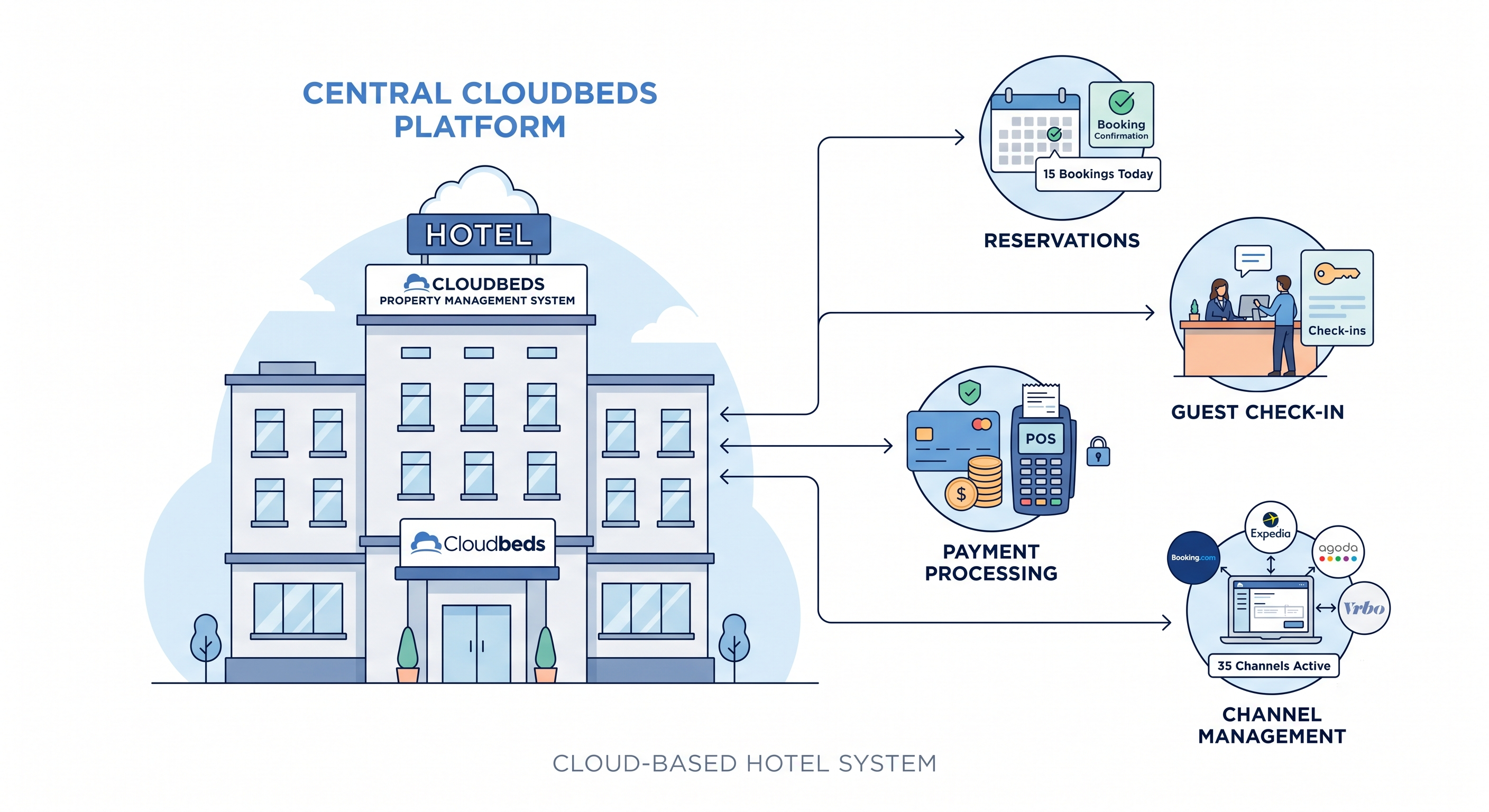
Building a technology product for hotels almost always means, sooner or later, connecting into a property management system (PMS). Cloudbeds is one of the more widely adopted cloud PMS platforms among independent hotels and small chains, which makes Cloudbeds API integration a common requirement for OTAs, channel managers, revenue management tools, and other travel software vendors.
Unlike a typical public REST API where you sign up and start calling endpoints immediately, Cloudbeds runs its integrations through a structured partner program. That structure is good news for engineering teams — it means the path from prototype to production is well defined — but it also means the integration timeline depends on process steps, not just code. This guide breaks down the architecture, authentication model, and certification workflow so your team can plan development realistically.
Why Cloudbeds Uses a Partner-Gated Integration Model
Most PMS and GDS-adjacent platforms gate write-level API access behind a partnership process, and Cloudbeds is no exception. This protects the shared customer base (hotel properties) from integrations that could corrupt reservation data, mishandle guest PII, or create duplicate bookings across systems.
For engineering teams coming from more open API ecosystems, the practical implication is this: budget calendar time for partnership review and certification, not just for writing code. A typical end-to-end timeline includes:
Partnership application and Connectivity Agreement (plus NDA where relevant)
Sandbox/test account provisioning with dummy property data
Development against test credentials only
A certification call to validate authentication, authorization flows, and connect/disconnect handling
A Limited Release phase across a small set of live properties
General availability in the Cloudbeds Marketplace
Core Architecture Pattern for a Cloudbeds Integration
Whether you're building a channel manager, a CRM sync, or a booking engine plugin, the internal architecture for a Cloudbeds integration tends to follow the same shape as other PMS/GDS connectors: an adapter layer that isolates Cloudbeds-specific logic from your core domain model.
This adapter/supplier factory pattern keeps your core booking, inventory, or CRM logic decoupled from Cloudbeds' specific request/response shapes — the same principle used when integrating multiple suppliers like Amadeus, Sabre, or Hotelbeds behind a common interface. If you later add a second PMS partner, you extend the factory rather than rewriting core logic.
Authentication: API Keys vs. OAuth 2.0
Cloudbeds supports two primary authentication paths, and the one you choose affects both your certification call and your production architecture:
1. API Key Authentication Cloudbeds' preferred method for many partner types. Keys are issued per property connection, so your adapter layer needs to store and rotate them securely — treat them the same way you'd treat any credential tied to PCI-adjacent guest and payment data, even though Cloudbeds itself handles the PCI DSS scope for payment processing.
2. OAuth 2.0 Required when your app supports a self-service "Connect your Cloudbeds account" flow. The redirect URI must be HTTPS, and the authorization flow needs to be fully automated end-to-end — this is one of the specific items verified live during the certification call.
A few implementation details worth planning for early:
Token refresh handling — build refresh logic before certification, since token expiry during a live demo is a common cause of failed certification calls.
Multi-property support — if your app serves group accounts, your adapter needs a property-selection layer so a single user session can operate across multiple linked Cloudbeds accounts.
Circuit breaker pattern — wrap Cloudbeds API calls with a circuit breaker so a temporary outage or rate-limit response on their side doesn't cascade into failures across your own platform.
Handling Connect/Disconnect Lifecycle Events
One of the three mandatory certification checkpoints is correctly handling a property disconnecting your app from inside Cloudbeds. This is a lifecycle event many teams underestimate. Your integration needs to:
Detect the revoked session (typically via a failed auth call or webhook, depending on your flow)
Cleanly deactivate the property's data sync without leaving orphaned jobs in your queue
Support a clean reconnect without requiring a full re-onboarding of the property
Building this as a first-class state in your adapter — rather than an edge case handled with a try/catch — will save you a failed certification round.
Caching and Rate Limit Strategy
PMS APIs like Cloudbeds' are read-heavy for most integration types (inventory sync, rates, reservations), and hotel data doesn't change every second. A Redis caching layer in front of frequently polled endpoints — availability, room types, rate plans — reduces both your API call volume and your exposure to rate limiting, while keeping data fresh enough for guest-facing use cases.
A reasonable pattern:
Cache read-heavy, low-volatility data (room types, rate plan metadata) with a longer TTL
Poll high-volatility data (live availability) more frequently, but respect Cloudbeds' recommended polling intervals — excessively high polling is explicitly called out as a "mild issue" during Cloudbeds' Limited Release evaluation
Use webhooks where available instead of polling, to cut unnecessary load entirely
What Gets Verified During Certification
Before scheduling a certification call, Cloudbeds requires a completed support article, in-app marketing content, and correctly scoped permissions (request only what your integration actually uses). During the ~60-minute call itself, three things are mandatory:
Authentication implementation in your production environment
The full end-user authorization and functionality flow
Connect/disconnect handling across two test properties in different "Islands" (Cloudbeds' term for its infrastructure partitioning)
Passing moves you into Limited Release with five properties; failing gets you specific, actionable feedback and a path to re-certify — it's a feedback loop, not a dead end.
Planning Your Support Model Post-Launch
Once live, Cloudbeds holds partners to defined support SLAs — same-day resolution for urgent end-user issues, 24-hour response for onboarding questions. Repeated SLA misses escalate from a written warning to marketplace removal and, eventually, integration termination. If your team is building a Cloudbeds integration as one of several travel API connections, it's worth budgeting ongoing developer support time the same way you would for payment gateway or GDS partner support.
Final Thoughts
A Cloudbeds API integration is less about wrestling with an unfamiliar API shape and more about architecting for a structured, multi-stage partner lifecycle — sandbox development, a certification gate, a limited live rollout, and ongoing support obligations. Teams that model connect/disconnect handling, token refresh, and rate-aware caching from day one tend to move through certification faster and avoid the "severe issue" bucket that sends you back to development.
If you're building or scaling a Cloudbeds integration — or evaluating it alongside other PMS and GDS connections for your platform — Teenva AI & Digital Ventures can help architect and implement the connector layer.
Get in touch: sales@teenvaai.com | +91 9572020107