

Stripe Payment Integration for OTA Systems: A Complete Developer Guide
Stripe Payment Integration for OTA Systems: A Complete Developer Guide
Online travel agencies operate in one of the most payment-complex verticals in eCommerce. Flight bookings, hotel reservations, ancillary upsells, multi-currency transactions, deferred ticketing, and multi-supplier settlements — each demands its own payment logic. Getting it right starts with choosing the correct gateway and architecting flows that are both operationally sound and PCI DSS compliant.
Stripe has emerged as one of the leading choices for OTA platforms globally. With support for 135+ currencies, built-in fraud detection via Radar, Buy Now Pay Later (BNPL) support, and a well-documented REST API, it is well-suited for both startup OTAs and scaling mid-market platforms. This guide walks development teams and platform architects through every critical layer of Stripe payment integration for OTA systems.
Why OTAs Need Purpose-Built Payment Architecture
More than two-thirds of travel and tourism sales are made online today — and that share continues to grow. Accepting online payments is no longer optional; it is a core product requirement.
But travel payments are not like standard eCommerce. A single customer journey may trigger:
- A flight booking flow with deferred ticketing via IATA BSP or ARC
- A hotel guarantee hold with conditional charge-on-checkout logic
- Low-cost carrier (LCC) instant ticketing that bypasses BSP entirely
- NDC ancillary purchases billed under separate Electronic Miscellaneous Documents (EMDs)
- Debit card flows that require tokenization and internal wallet buffers
Each of these scenarios requires dedicated business logic beyond what a standard gateway integration provides out of the box. Understanding this before you write a single line of integration code is critical.
Step 1: Decide Your Merchant of Record (MoR) Position
Before integrating Stripe — or any payment gateway — your OTA must answer a foundational question: Will you act as the Merchant of Record?
Option A: You Are NOT the MoR
In this model, your OTA forwards cardholder data to the airline, hotel, or GDS supplier, which processes the transaction under its own merchant account. Commissions are paid back to you afterward.
Advantages:
- No need to maintain a merchant account
- Simplified payment infrastructure
- Lower financial liability for fraud and chargebacks
Disadvantages:
- Limited pricing control (no easy markup)
- Delayed commission payouts (weeks or months in some cases)
- You still handle cardholder data — PCI DSS still applies
Option B: You ARE the MoR
Here, your OTA processes payments directly, collects funds, and remits supplier costs separately.
Advantages:
- Full control over pricing and markups
- Immediate access to customer funds
- Ability to offer internal wallets, BNPL, and loyalty credits
Disadvantages:
- Must maintain a merchant account
- Higher PCI DSS scope and compliance burden
- Gateway transaction fees reduce margin, especially on refunds
For Stripe integration, this guide primarily addresses the MoR model since it involves a full gateway integration. If you are not an MoR, you will still need tokenization infrastructure — covered in Step 3.

Step 2: Understand Your PCI DSS Compliance Level
Stripe is certified as a Level 1 PCI DSS service provider — the highest tier. Integrating Stripe offloads a significant portion of your PCI compliance burden. However, it does not eliminate your own compliance obligations.
PCI DSS divides merchants into four levels based on annual card transaction volume:
| Level | Transaction Volume | Validation Requirements |
|---|---|---|
| Level 1 | 6M+ Visa/Mastercard; 2.5M+ AmEx | On-site audit (RoC), quarterly ASV scan, AoC |
| Level 2 | 1M–6M Visa/Mastercard | SAQ, quarterly ASV scan, AoC (sometimes RoC) |
| Level 3 | 20K–1M Visa/Mastercard | Annual SAQ, quarterly ASV scan, AoC |
| Level 4 | <20K Visa/Mastercard | Annual SAQ, quarterly ASV scan, AoC |
Large OTAs, international hotel chains, and major carriers typically fall under Level 1. Travel startups and regional booking platforms usually begin at Level 3 or 4.
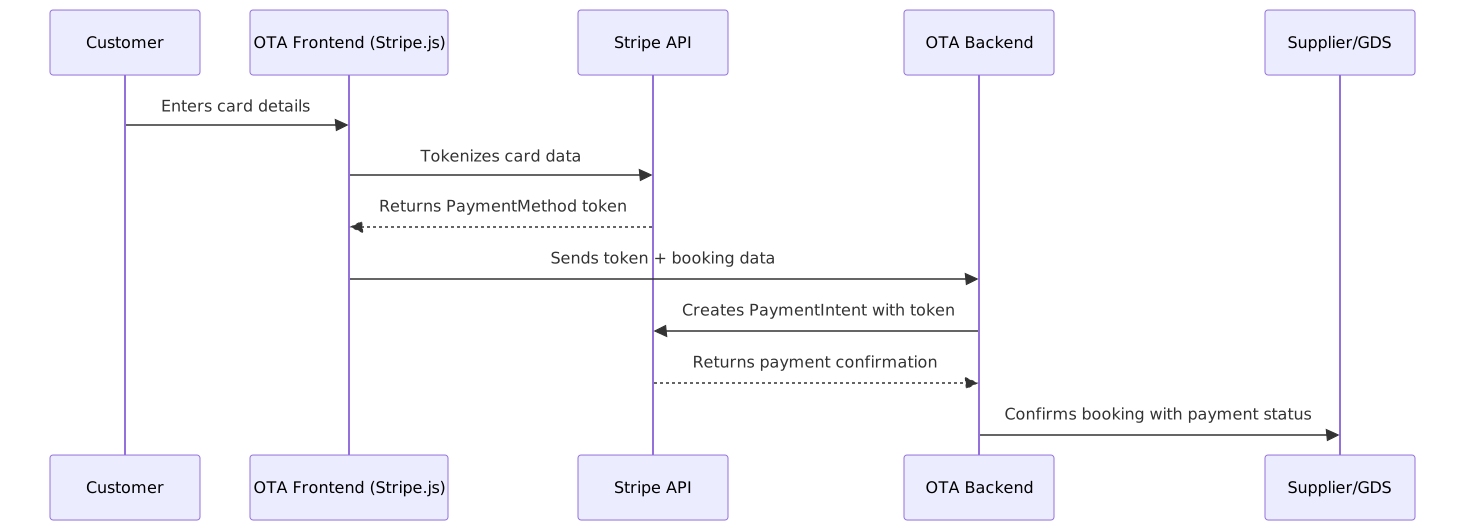
Key principle for Stripe integrations: Use Stripe.js or Stripe Elements on the frontend so that raw card data never touches your server. This dramatically reduces your PCI scope — your systems only see tokens, not card numbers, expiry dates, or CVV codes.
Step 3: Tokenization Strategy for Non-MoR Flows
Even if your OTA is not the merchant of record, you will likely need to store or forward payment details at some point — for PNR-to-ticket delays, service fee markups, or deferred hotel charges. This is where tokenization becomes essential.
Stripe's PaymentMethod tokens allow you to securely store a customer's payment method without persisting raw card data in your database. You can create a Customer object in Stripe and attach a PaymentMethod to it for later use.

For scenarios requiring you to forward actual card data to a GDS or airline (not just a Stripe token), you may need a dedicated PCI-compliant tokenization intermediary such as TokenEx or PCI Proxy alongside your Stripe integration.
Step 4: Core Stripe Integration Components
4.1 PaymentIntents API
The PaymentIntents API is the recommended integration path for OTA use cases. It supports:
- Asynchronous confirmation — essential for flight bookings where ticketing is deferred
- Authentication flows — 3D Secure 2 (3DS2) for European SCA compliance
- Partial captures — for hotel guarantee holds that may be charged partially or in full
- Cancellation and refunds — programmatic via the Refunds API
Basic PaymentIntent creation:
const paymentIntent = await stripe.paymentIntents.create({
  amount: 125000,         // Amount in smallest currency unit (e.g., paise, cents)
  currency: 'usd',
  payment_method: 'pm_xxxxx',
  confirmation_method: 'manual',
  confirm: false,
  metadata: {
    booking_ref: 'TEN-2024-9871',
    supplier: 'Amadeus',
    segment_type: 'flight'
  }
});
4.2 SetupIntents for Deferred Charges
For hotel bookings where the card is stored as a guarantee but charged at check-out — or for LCC bookings pending fare confirmation — use the SetupIntents API to save a payment method without charging it immediately.
const setupIntent = await stripe.setupIntents.create({
  customer: 'cus_xxxxx',
  payment_method_types: ['card'],
  metadata: {
    booking_ref: 'TEN-HTL-4421',
    charge_trigger: 'checkout',
    property_id: 'HTL-BLR-007'
  }
});
4.3 Stripe Radar for Fraud Detection
Stripe Radar is a machine learning-based fraud detection layer trained on data from millions of global transactions. For OTAs — especially those operating in high-risk markets — Radar is a critical component.
Key Radar capabilities relevant to travel:
- Risk scoring per transaction
- Blocking by IP, card country, or BIN range
- Custom rules (e.g., flag transactions where billing country ≠ destination country)
- 3DS2 dynamic triggering based on risk score
Radar adds $0.05 per screened transaction on top of Stripe's standard 2.9% + $0.30 per successful charge.
Step 5: OTA-Specific Payment Flows
5.1 Full-Service Carrier Flight Payments (BSP/ARC Model)
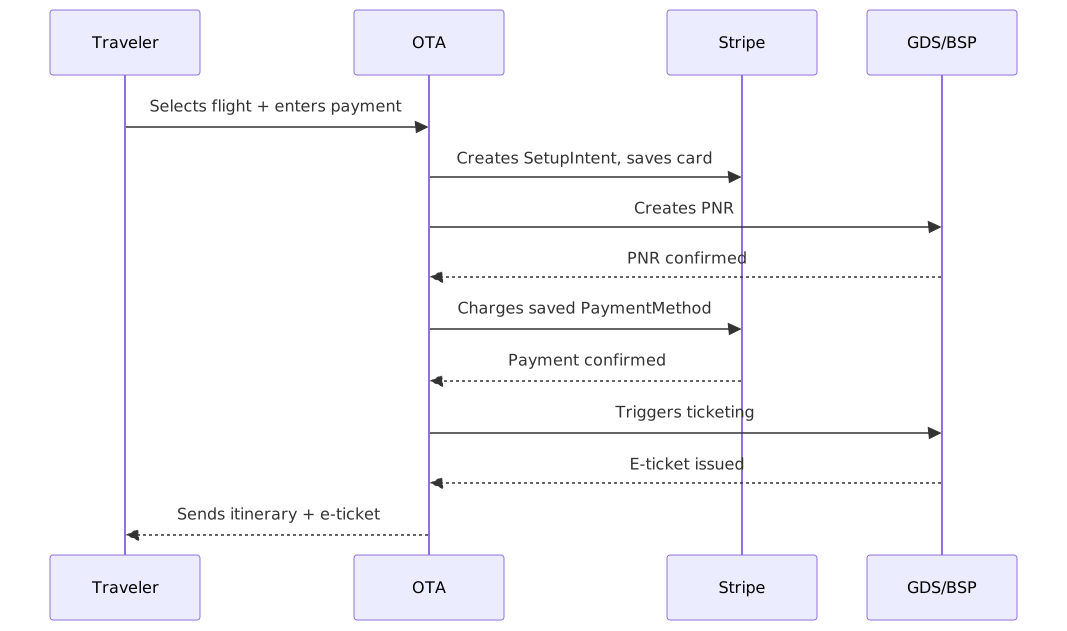
Traditional airline bookings involve a time gap between PNR creation (seat reservation) and ticketing (payment). During this window, your OTA must:
- Tokenize and store the card via SetupIntent
- Hold the booking in a "pending ticketing" state
- Charge via the saved PaymentMethod once the PNR is confirmed and ticketing is triggered via IATA BSP or ARC
5.2 Low-Cost Carrier (LCC) Instant Payment Flow
LCCs bypass BSP/ARC and require immediate payment before confirming a seat. This creates a risk: if the booking fails after payment, you must initiate a refund. An internal wallet buffer can minimize this friction.

Refund API example:
const refund = await stripe.refunds.create({
  payment_intent: 'pi_xxxxx',
  reason: 'duplicate',
  metadata: {
    booking_ref: 'TEN-LCC-5532',
    reason_detail: 'LCC booking confirmation failed'
  }
});
5.3 Hotel Payment Flows
Hotels present the most varied payment logic of any travel vertical. Your Stripe integration must handle:
- Instant non-refundable charges — charge PaymentIntent immediately on booking
- Guaranteed holds — SetupIntent to store card; hotel charges via its own POS at checkout
- Partial refund on cancellation — Stripe Refunds API with amount proportional to cancellation policy
- No-show fees — timed charge on saved PaymentMethod if guest does not arrive

5.4 Debit Card Flows (Middle East & High-Debit Markets)
In markets like Saudi Arabia, Kuwait, and the UAE, a large share of transactions are made with debit cards due to religious restrictions on credit. Debit card charges are instant and non-reversible from a bank processing standpoint — meaning a failed booking triggers a full refund cycle with associated fees and delays.
Recommended architecture for debit-heavy markets:
- Tokenize card via Stripe + supplementary tokenization layer (e.g., PCI Proxy)
- Credit funds to an internal OTA digital wallet
- Charge suppliers from the wallet, not directly from the debit card
- Return cancellation refunds to the wallet (instant) rather than the card (5–10 days)
This approach protects margin, reduces chargeback exposure, and improves the customer experience significantly.
5.5 NDC Ancillary Payment Flows
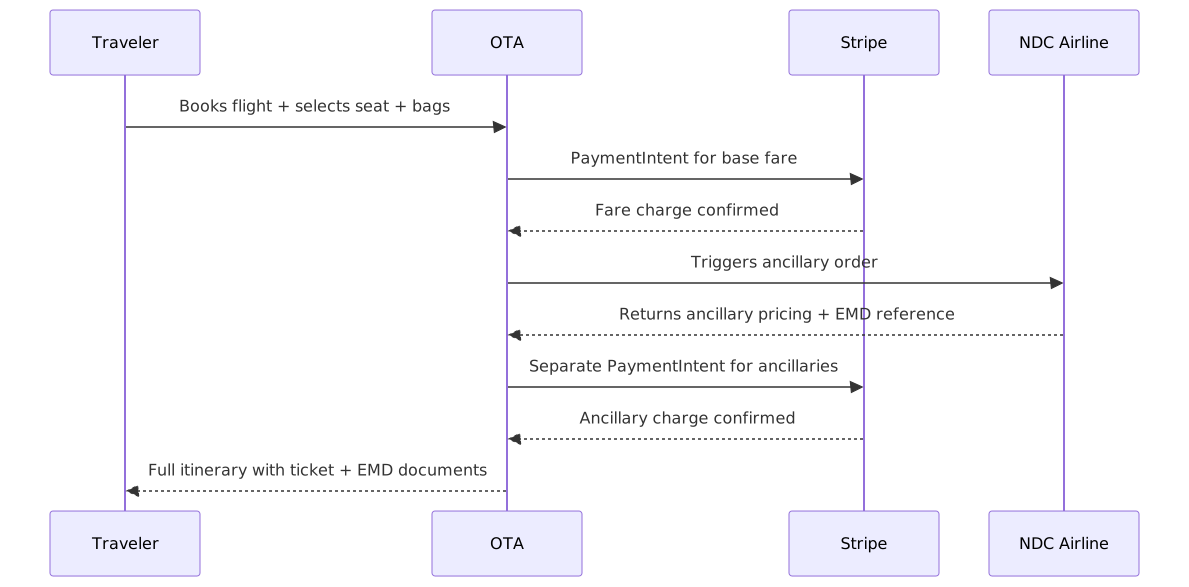
NDC-enabled airlines allow OTAs to sell ancillaries (seat upgrades, baggage, meals) via third-party channels. However, each ancillary may generate a separate transaction — billed under an Electronic Miscellaneous Document (EMD) rather than the primary ticket receipt.
Your Stripe integration must therefore support:
- Multiple PaymentIntents per booking reference
- EMD-level metadata tagging for reconciliation
- Asynchronous charge timing (ancillaries may be charged post-booking or post-ticketing)
Step 6: Multi-Currency and Global Payment Considerations
Stripe supports 135+ currencies, making it well-suited for OTAs with international traveler bases. However, currency handling requires deliberate design:
- Presentment currency — the currency shown to the traveler at checkout
- Settlement currency — the currency deposited into your Stripe merchant account
- Supplier currency — the currency your GDS or hotel supplier invoices in
Stripe handles conversion automatically when presentment and settlement currencies differ, applying its standard FX rate plus a conversion fee. For high-volume international OTAs, consider opening multi-currency Stripe accounts to hold balances in key currencies and reduce conversion costs.
Buy Now Pay Later (BNPL): Stripe supports BNPL via Affirm, Afterpay, and Klarna — an increasingly important payment option for leisure travel bookings where the purchase value is high. Enabling BNPL can measurably improve conversion, particularly for family vacation packages and long-haul itineraries.
Step 7: Webhooks and Async Event Handling
Travel bookings are inherently asynchronous — confirmation from a GDS, airline, or hotel may take seconds or minutes. Stripe's webhook system is essential for building reliable event-driven payment flows.
Critical webhook events for OTA integrations:
| Event | Trigger | OTA Action |
|---|---|---|
payment_intent.succeeded |
Payment confirmed | Trigger ticketing / booking confirmation |
payment_intent.payment_failed |
Payment declined | Notify traveler, release held inventory |
charge.refunded |
Refund processed | Update booking status, notify traveler |
payment_intent.requires_action |
3DS authentication required | Redirect traveler to complete auth |
setup_intent.succeeded |
Card saved successfully | Store Stripe Customer ID, proceed with PNR |
Webhook endpoint example (Node.js):
app.post('/webhooks/stripe', express.raw({ type: 'application/json' }), (req, res) => {
  const sig = req.headers['stripe-signature'];
  let event;

  try {
    event = stripe.webhooks.constructEvent(req.body, sig, process.env.STRIPE_WEBHOOK_SECRET);
  } catch (err) {
    return res.status(400).send(`Webhook Error: ${err.message}`);
  }

  switch (event.type) {
    case 'payment_intent.succeeded':
      handlePaymentSuccess(event.data.object);
      break;
    case 'payment_intent.payment_failed':
      handlePaymentFailure(event.data.object);
      break;
    case 'charge.refunded':
      handleRefund(event.data.object);
      break;
    default:
      console.log(`Unhandled event type: ${event.type}`);
  }

  res.json({ received: true });
});
Stripe Limitations to Note for OTA Use Cases
While Stripe is a strong fit for most OTA contexts, some nuances require attention:
- High-risk category restrictions: Stripe classifies airlines, cruises, timeshares, and travel reservation clubs as elevated-risk. Onboarding and certification for these categories may require additional documentation and review time.
- No native BSP/ARC connectivity: Stripe does not integrate directly with IATA BSP or ARC. Your middleware layer must manage this bridge.
- Refund fee non-recovery: Stripe does not return transaction fees on refunded payments. For OTAs in high-cancellation markets, this can be a meaningful margin cost — factor it into your commercial model.
- Radar add-on cost: Fraud screening adds $0.05/transaction. At scale, this becomes a significant line item and should be modeled in unit economics.
Summary: Integration Checklist for OTA Teams
- Determine Merchant of Record position before scoping the integration
- Use Stripe.js / Stripe Elements to keep card data off your servers
- Implement PaymentIntents for standard charges; SetupIntents for deferred / guarantee flows
- Build separate payment flow logic for FSC, LCC, hotel, and NDC ancillary scenarios
- Configure Stripe Radar with custom rules relevant to your traveler segments
- Handle debit card markets with internal wallet architecture
- Set up webhooks for all critical async payment events
- Model refund fee costs into margin projections for cancellation-heavy product lines
- Review Stripe's high-risk travel category requirements before going live
Build Your OTA Payment Layer with Teenva AI
Teenva AI specializes in travel portal and booking engine development — including payment infrastructure design for OTA platforms. Whether you need to integrate Stripe from scratch, architect multi-supplier payment flows, or implement tokenization for PCI DSS compliance, our team can help.
Get in touch:
- Email: sales@teenvaai.com
- Phone: +91 9572020107
- Website: teenvaai.com