
Case Study: Flight Booking Platform Using Amadeus API
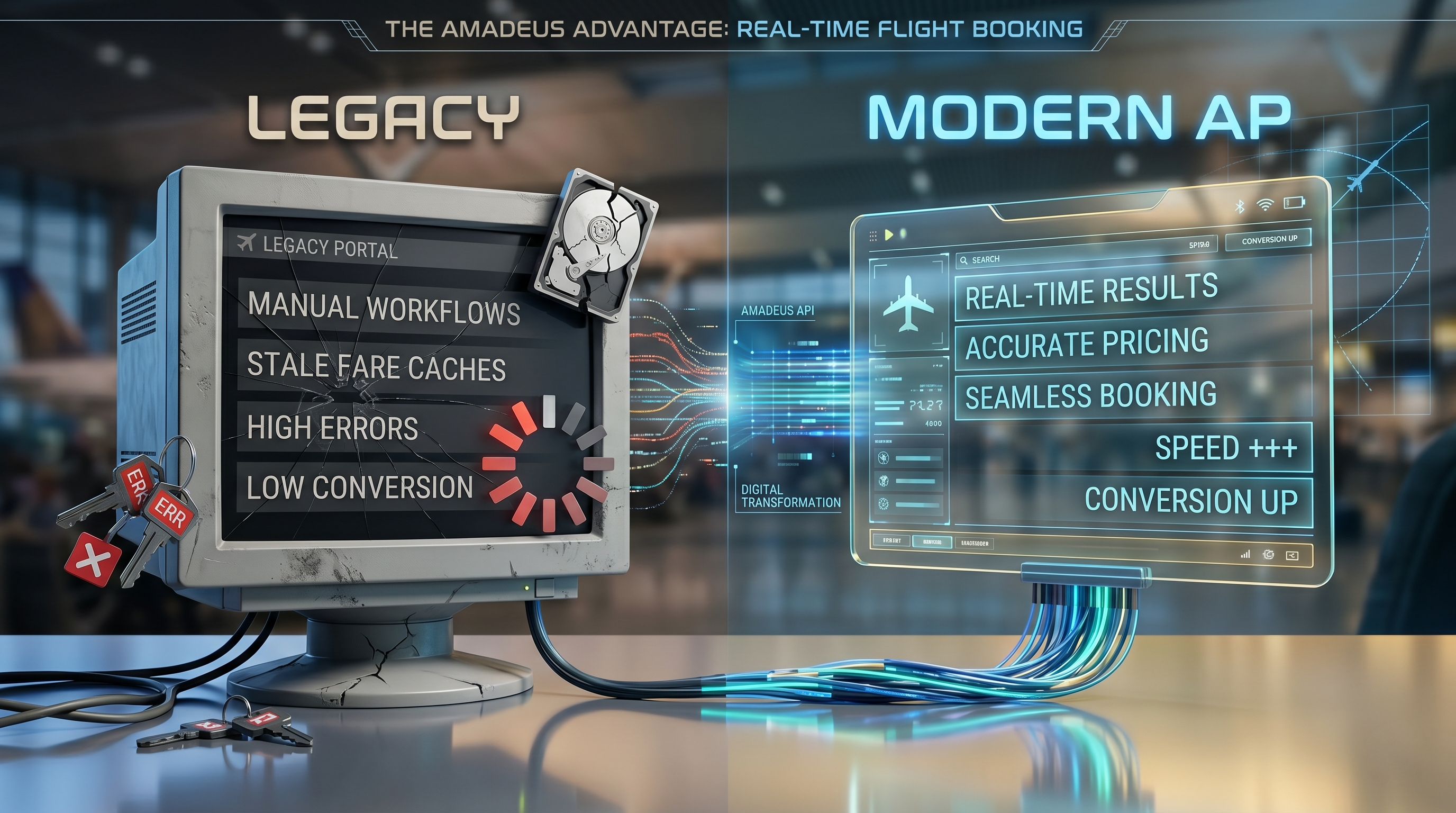
The travel industry runs on speed, accuracy, and trust. When a traveller searches for a flight, they expect real-time results, accurate pricing, and a seamless booking experience — all within seconds. Legacy travel portals that rely on manual workflows and stale fare caches simply cannot meet this bar. This case study walks through how a modern Amadeus API flight booking platform was architected to solve exactly these challenges, delivering measurable gains in speed, conversion, and operational efficiency.
The Challenge: Why Traditional Travel Portals Fall Short
Non-integrated or poorly integrated travel platforms share a common set of pain points that directly impact revenue and user retention:
Inconsistent fare caching: Displayed prices often differ from actual airline fares at checkout, leading to friction and abandoned bookings.
Slow search results: Manually queried or cached inventory can take 8–10 seconds to return results — an eternity in a mobile-first world.
High manual workload: Without automation, agents must manually handle Passenger Name Record (PNR) creation, ticketing queues, and itinerary verification.
No real-time inventory access: Failing to connect directly to airline systems means missing live seat availability and dynamic pricing windows.
The objective was clear: build a standardised, API-first flight aggregator platform that eliminates these inefficiencies at scale.
The Solution: Amadeus Self-Service API Integration
The Amadeus for Developers platform provides a suite of Self-Service APIs that give OTAs (Online Travel Agencies) direct access to Global Distribution System (GDS) data from over 400 airlines worldwide. The platform was rebuilt around a three-step booking engine using three core Amadeus APIs, creating a clean, error-resistant flow from search to confirmed booking.
Core Technology Stack
The implementation was grounded in a modern, scalable tech stack:
Backend: Node.js or Django (Python) for API orchestration and business logic
Frontend: Flutter (cross-platform) or Swift (iOS native) for mobile-optimised interfaces
Database: MongoDB for storing search logs, user profiles, and session histories
API Layer: RESTful JSON payloads over OAuth 2.0 authentication
This combination ensures lightweight data handling, fast rendering on mobile devices, and secure, token-based API access.
The 3-Step Booking Engine Architecture
The entire booking lifecycle is governed by three sequentially structured API calls. Each step is a gate — no step can be skipped without risking billing errors, invalid bookings, or price mismatches.

Step 1 — Search: Flight Offers Search API
The entry point of the booking flow. The platform sends a structured payload containing IATA airport codes, travel dates, cabin class, and passenger counts. The API returns the cheapest available fares with associated baggage rules and fare family details.
For simple one-way or round-trip searches, a GET request is sufficient. Multi-city or complex itineraries use a POST payload for richer configuration. Results are returned in lightweight JSON, which the frontend parses and renders without delay.
Step 2 — Validation: Flight Offers Price API
Airfares are dynamic. A fare returned in Step 1 may expire in seconds due to demand fluctuations, seat availability changes, or airline yield management rules. Before any payment is processed, the selected itinerary is passed through the Flight Offers Price API.
This step performs three critical functions:
Live fare verification: Confirms the selected price is still valid at the time of checkout.
Segment-level pricing breakdown: Provides detailed fare and penalty rules per flight leg.
Ancillary calculation: If the user adds extra baggage or seat selection, the total is dynamically recalculated here.
Step 3 — Execution: Flight Create Orders API
The final step converts a validated offer into a confirmed reservation. The API accepts the verified itinerary along with passenger identity data and returns a structured Passenger Name Record (PNR) directly from the airline's reservation system. The ticket is then held and queued for issuance according to automated ticketing guidelines.
This three-step sequence is non-negotiable. Skipping the price validation step is the leading cause of post-booking fare discrepancies and refund disputes in OTA platforms.
Business and Operational Outcomes
The impact of the Amadeus API integration was measurable across every key performance indicator:
Performance Metric | Pre-Integration | Post-Integration | Impact |
|---|---|---|---|
Search Load Time | 8–10 seconds | 1.8 seconds | 75% faster query delivery |
Booking Conversion Rate | Baseline | +40% growth | Frictionless checkout reduced drop-off |
Mobile Conversions | Baseline | 2× increase | Clean JSON parsing enabled lightweight UI |
Operational Workflow | High manual effort | Fully automated | PNR mapping eliminated manual agency work |
The 75% reduction in search load time alone had a direct downstream effect on conversion. Research consistently shows that every additional second of load time reduces conversion rates — cutting from 10 seconds to under 2 seconds moved the platform into a fundamentally different performance tier.
Key Technical Pitfalls and How to Resolve Them
1. Volatile Pricing Exceptions
Fares can expire between the moment a user selects a flight and when they complete checkout. The correct defensive programming approach:
Catch
400and409HTTP error responses from the Flight Offers Price APIPresent a user-friendly message explaining the price has changed
Redirect to a refreshed search canvas with the same parameters pre-filled
Never silently retry with a stale offer — this leads to booking errors and potential overcharges.
2. Sandbox Limitations in Development
The Amadeus Developer Sandbox operates on a limited, pre-cached dataset. Results in the sandbox environment do not reflect live airline inventory. For production deployments, teams must:
Establish contracts with local consolidators to ensure real-time global booking coverage
Validate all API flows end-to-end in the production environment before go-live
Account for IATA accreditation requirements depending on the target market

3. OAuth Token Management
Amadeus APIs use OAuth 2.0 with short-lived access tokens. A common pitfall is allowing tokens to expire mid-session, causing failed API calls. Implement automatic token refresh logic that re-authenticates before expiry, and cache tokens securely server-side — never expose them to the client.
Platform Architecture: Multi-City and Configuration Considerations
For teams extending beyond basic one-way or round-trip searches, the architecture scales accordingly:
Multi-city search: Use
POSTpayloads to the Flight Offers Search API with multiple origin-destination pairsFare family display: Request branded fares to show users tiered options (Economy, Flex, Business) with clear ancillary differentiation
Self-Service vs Enterprise tier: Self-Service APIs are ideal for startups and growing OTAs. Enterprise distribution contracts unlock higher rate limits, ATPCO NDC content, and dedicated support SLAs
The choice of backend framework also matters. Node.js is preferred for high-concurrency search request handling. Django (Python) suits teams that need richer data processing pipelines or integration with machine learning recommendation engines.
How Teenva AI Builds Travel Platforms Like This
At Teenva AI & Digital Ventures, Bangalore, we specialise in building end-to-end travel technology solutions — from GDS-connected flight booking engines to hotel CRS integrations, multi-modal travel portals, and custom OTA platforms with native mobile apps.
Our engineering teams have hands-on experience with Amadeus Self-Service and Enterprise API integrations, and we bring together backend expertise, mobile development, and UI/UX design to deliver platforms that are fast, reliable, and built to convert.
Whether you are a startup entering the OTA space or an established travel business modernising a legacy system, we build the infrastructure that powers your growth.
Ready to Build Your Flight Booking Platform?
If you are planning a travel portal, booking engine, or GDS-connected OTA platform, our team can help you architect, build, and launch it — end to end.
Talk to the Teenva AI travel tech team:
Email: sales@teenvaai.com
Phone: +91 9572020107
Website: teenvaai.com
Tell us your preferred backend stack, whether you need multi-city search or a simpler one-way/round-trip setup, and whether you are targeting the Self-Service or Enterprise distribution tier. We will tailor the architecture and get you to production faster.