
Inventory Management: How It Works, Key Techniques and Tools
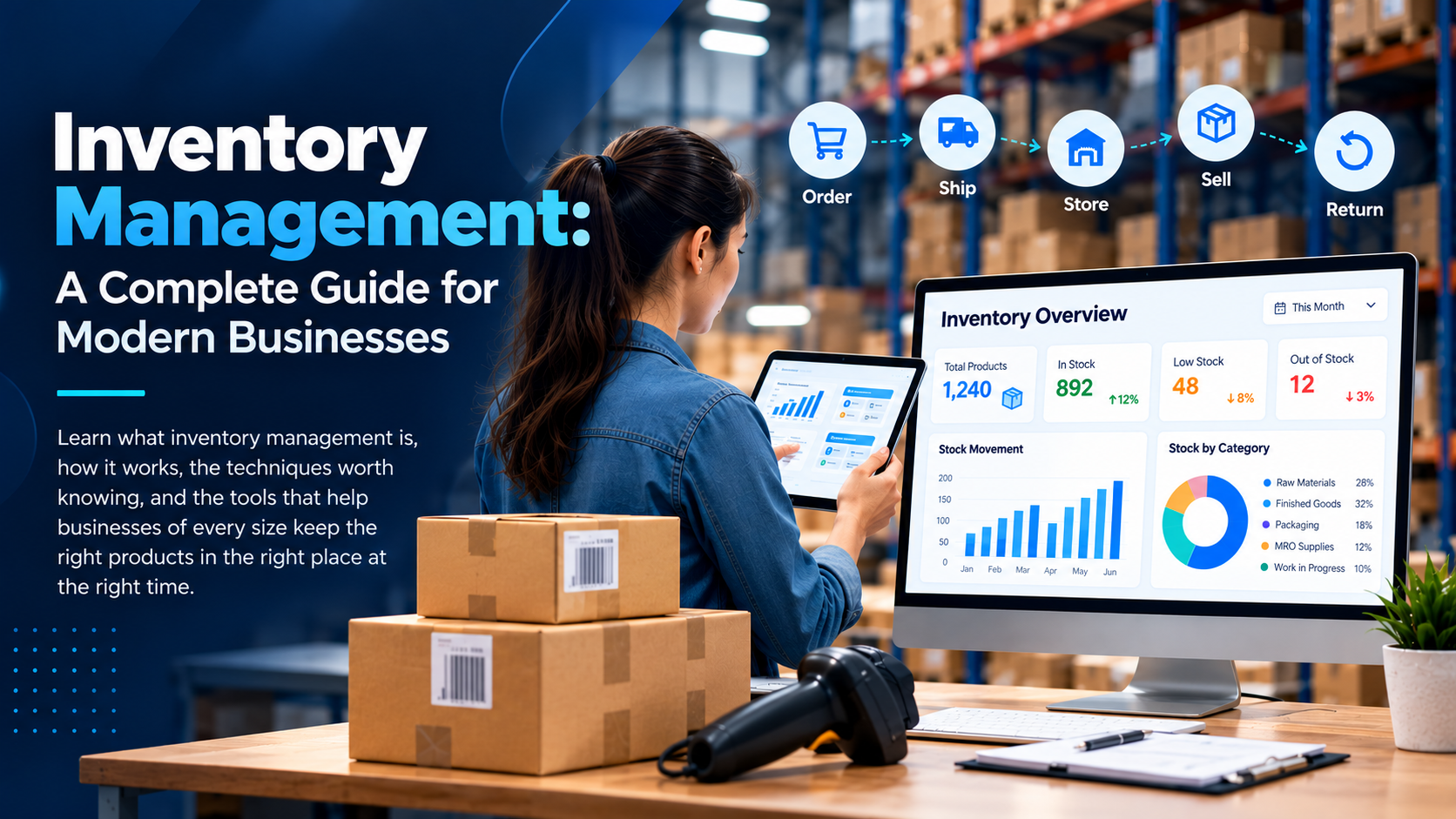
Every product you sell has a story before it reaches the customer: it is ordered, shipped, stored, counted, sold and sometimes returned. Inventory management is the discipline of keeping that journey under control. Get it right and you have the right products in the right place at the right time. Get it wrong and you either tie up cash in stock that never moves or lose sales because bestsellers run out.
This guide explains what inventory management is, how it works, the techniques worth knowing, and the tools that help businesses of every size put it into practice.
What Is Inventory Management?
Inventory management is the process of tracking, organizing and controlling the goods a business holds, from the moment they are purchased or produced until the moment they are sold. The goal is simple: keep enough stock to meet demand while keeping the cost of holding that stock as low as possible.
Businesses typically deal with four kinds of inventory:
- Raw materials: the inputs used to make a product, such as fabric, metal or plastic.
- Work in progress (WIP): items that are partly finished and still moving through production.
- Finished goods: products that are ready to sell.
- MRO supplies: maintenance, repair and operations items such as packaging, cleaning supplies and protective equipment that support the business but are not part of the product.
How Inventory Management Works
Today, inventory management is largely handled by software. A modern inventory management system (IMS) is usually cloud-based, so everyone from the warehouse team to the store manager to the finance team works from the same live numbers.
When a sale happens online or in a physical store, stock levels update automatically. When new stock arrives or a customer returns an item, the system records that too. This single source of truth prevents overselling, reduces manual reconciliation and gives your team the data needed to decide what to reorder and when.
Platforms like Shopify build this directly into the store. Merchants can track quantities by product, variant and location, and stock adjusts as orders move through fulfillment, returns and point-of-sale transactions.
Why Inventory Management Matters
Good inventory control pays off across the business:
- Lower costs: you avoid paying to store excess stock or rushing emergency shipments.
- Better cash flow: money is not locked up in slow-moving products.
- Happier customers: popular items stay available and orders ship on time.
- Reduced risk: safety stock protects you from demand spikes, supplier delays and shipping disruptions.
- Less waste: perishable or seasonal items are sold before they expire or go out of style.
- Stronger supplier relationships: predictable, well-timed orders make you a reliable partner.
- Clearer financial reporting: accurate stock data feeds straight into purchasing decisions and accounting.
Key Inventory Management Techniques
You do not need to use every technique. Pick the ones that match your products, sales channels and supplier setup.
Economic Order Quantity (EOQ)
EOQ calculates the ideal order size by balancing how much you sell, what it costs to place an order and what it costs to store items. Order too much and storage costs rise. Order too little and you face stockouts and rush shipping.
Demand Planning
Forecasting future sales means looking at last year's performance, seasonality, planned promotions and committed contracts. Many tools now use machine learning to improve these predictions.
FIFO and LIFO
First in, first out (FIFO) assumes the oldest stock sells first, which suits perishable products or items that go out of fashion quickly. Last in, first out (LIFO) assumes the newest stock sells first and can be used for costing when prices are rising. Availability of LIFO depends on local accounting rules, so confirm with your accountant.
ABC Analysis
ABC analysis ranks products by value. A items are a small share of your products but a large share of your inventory value, so they deserve the tightest control. C items are numerous but low in value and can be managed more loosely. B items sit in between.
Safety Stock and Reorder Points
Safety stock is a buffer that protects you from surprises. A reorder point is the stock level at which you place a new order, based on average sales and supplier lead time. Together they help you restock before you run out.
Just-in-Time (JIT)
JIT keeps inventory as lean as possible and replenishes just before products sell out. It works best when demand is predictable and suppliers are fast and reliable.
Barcodes and RFID
Barcode scanning and RFID tags automate stock tracking and reduce manual errors. RFID goes a step further by reading tags without direct line of sight, which speeds up counting and receiving.
Cycle Counts and Audits
Regular physical counts confirm that what your system shows matches what is on the shelf. Differences point to theft, damage, miscounts or process gaps that you can then fix.
Dropshipping and 3PL Fulfillment
With dropshipping, your supplier ships directly to the customer, so you never hold stock. With a third-party logistics (3PL) partner, an outside company stores, packs and ships your products. Both reduce the burden of running your own warehouse.
How to Manage Inventory Step by Step
- Assess your needs. Review the last six to twelve months of sales to spot fast movers, seasonal products and slow-moving SKUs.
- Choose your methods. Match techniques to products. For example, FIFO for perishables, JIT for steady sellers and EOQ for items with high ordering costs.
- Evaluate suppliers. Compare lead times, reliability and communication, and keep a backup supplier for critical items.
- Categorize your stock. Use ABC analysis, group similar items together and give every product a clear SKU and label.
- Track levels in real time. Monitor available, incoming and committed stock across every channel and location.
- Set reorder points and alerts. Automate low-stock notifications so your team can act before shelves empty.
- Audit regularly. Schedule counts and investigate every discrepancy.
- Forecast demand. Use sales analytics to prepare for seasons, campaigns and launches.
- Review and refine. Track turnover, days of supply and carrying costs, then adjust your process as the business grows.
Common Inventory Challenges and How to Solve Them
Overstocking and understocking. Refresh forecasts monthly, recalculate reorder points seasonally and hold extra safety stock only for high-velocity or high-margin products.
Returns and damaged goods. Separate returned items quickly, label each one as resell, rework or write-off, and update your system right away so counts stay accurate. Tracking return reasons also reveals problems with fit, quality or packaging.
Seasonal swings. Combine historical sales with your marketing calendar, negotiate flexible supplier terms, schedule markdowns before demand drops and line up temporary 3PL capacity ahead of peak periods.
Inefficient warehouse space. Place fast-moving products in easy-to-reach locations, use vertical storage, label clearly and use barcodes or RFID with a location map so staff spend less time searching.
Inventory Management Tools
Inventory software is either a standalone product or part of your ecommerce platform. For businesses on Shopify, inventory tracking is already built in. You can set up tracking, adjust quantities, review adjustment history and run inventory reports from the admin, including sell-through rate, days of inventory remaining and ABC analysis by product.
Shopify Flow can add automation on eligible plans. For example, it can notify your purchasing manager when stock is low, tag products that need replenishing or hide items that have sold out.
When you outgrow built-in features, apps and platforms can extend what you can do:
- Prediko: AI-assisted demand forecasting and purchase order automation.
- Thrive Inventory Management: supports multiple Shopify accounts with automated purchase orders.
- ShipHero: forecasting, purchasing automation and fulfillment tools.
- Zoho Inventory: connects with Zoho CRM and Zoho Books.
- EasyScan SKU and Barcode: barcode scanning and bin tracking for high-volume operations.
The Future of Inventory Management
Several technologies are reshaping how businesses manage stock:
- Predictive analytics uses historical data and machine learning to forecast demand and improve replenishment.
- Artificial intelligence can automate inventory decisions and respond to changes in demand in real time.
- The Internet of Things (IoT) gives live location and condition data for connected items.
- Blockchain can create a tamper-resistant record of each hand-off in the supply chain, improving traceability for recalls and compliance.
Building an Inventory System That Fits Your Business
Off-the-shelf tools work well for many businesses, but growing companies often need more: custom dashboards, integrations with ERP, accounting or logistics systems, multi-warehouse sync, or AI-driven forecasting built around their own data. This is where an experienced technology partner makes the difference.
At Teenva AI & Digital Ventures, we help retail, e-commerce, travel, healthcare and other businesses design and build the systems behind their operations, from software development and system integrations to AI solutions and managed IT services.
Ready to Get Your Inventory Under Control?
If you want to implement inventory management software, connect your store with your warehouse and ERP, or build AI-powered forecasting, our team can help you plan it and get it built. Reach out to Teenva AI at sales@teenvaai.com, call +91 9572020107, or visit teenvaai.com to talk about your inventory management needs.