
Hotel Technology in 2026: Systems, Software, Solutions & Trends
Hotels don't run on beds and bandwidth alone anymore — they run on software. A single reservation today can touch a property management system, a channel manager, a payment gateway, a revenue engine, and two or three APIs before a guest ever reaches the front desk. For hoteliers and the developers who build for them, understanding how these systems fit together is no longer optional. It's the foundation of every profitable, scalable property.
This guide breaks down the modern hotel technology stack: what it's made of, how the pieces connect, and where the industry is headed in 2026.
What Counts as "Hotel Technology" Today
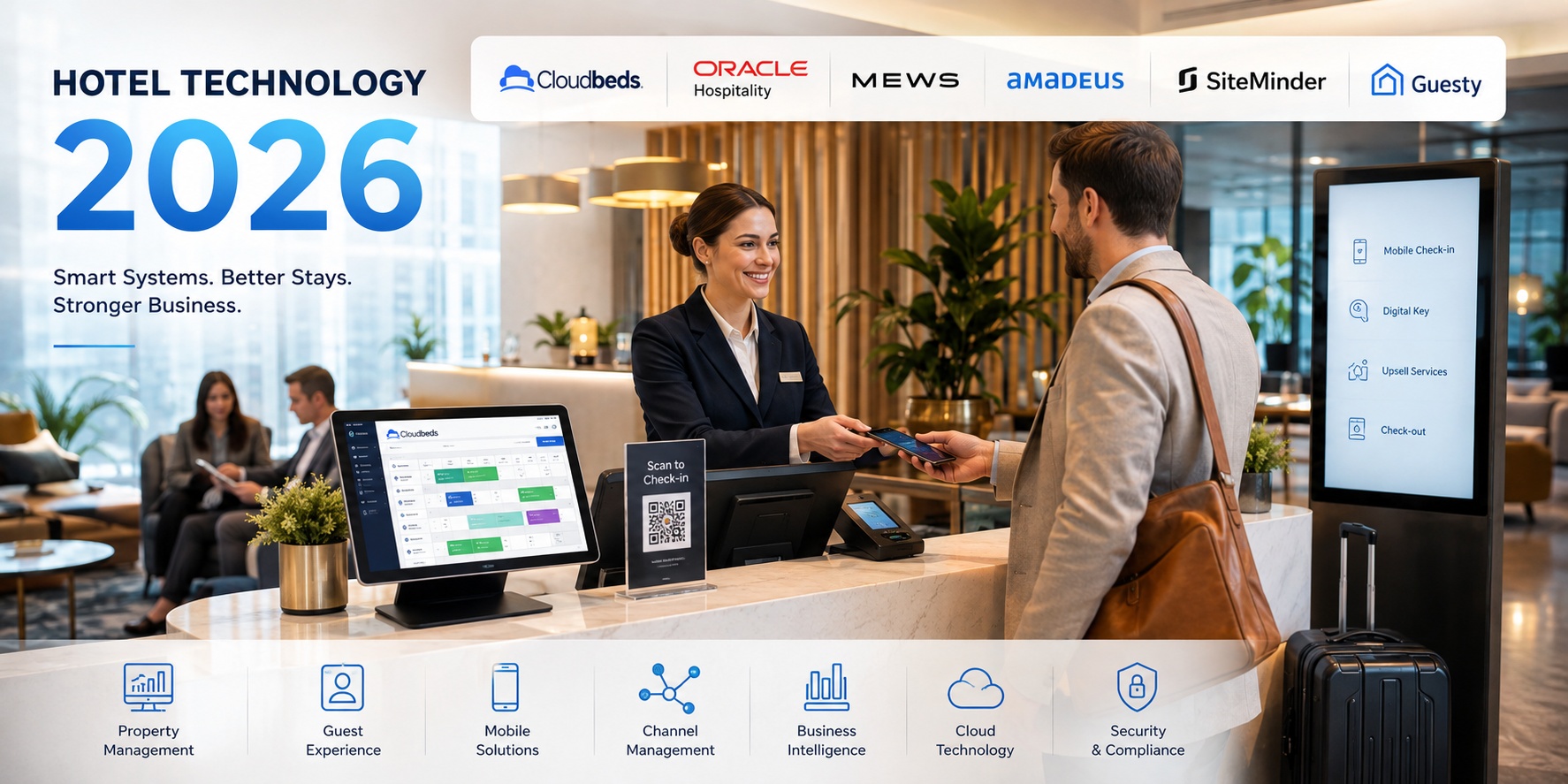
Hotel technology spans every system a property uses to manage operations, sell inventory, and serve guests — from the property management system (PMS) at the core, to the channel manager pushing rates across OTAs, to the booking engine converting website visitors, to the guest-facing apps controlling room temperature or unlocking doors. What used to be a handful of disconnected tools has consolidated into an interoperable stack, largely because cloud infrastructure and open APIs made real-time data sharing between systems the default rather than the exception.
The shift that matters most for 2026 isn't any single tool — it's connectivity. A PMS that can't talk to a channel manager, or a booking engine that can't sync with a payment processor, creates manual work and revenue leakage. The properties pulling ahead are the ones treating their tech stack as one integrated system rather than a pile of separate subscriptions.
The Core Systems Every Hotel Tech Stack Needs
Property Management System (PMS)
The PMS is the operational hub — reservations, housekeeping status, guest profiles, folios, and night audit all live here. Cloud-based PMS platforms have largely displaced on-premise servers because they remove the need for local IT infrastructure and let staff manage the property from any device. The critical technical detail for integrators: a PMS is only as valuable as its API. A PMS with a well-documented, rate-limited, and reliably versioned API becomes the anchor that every other system connects to.
Channel Manager
A channel manager keeps availability, rates, and inventory synchronized across every OTA and GDS a hotel sells through. The two-way sync between the channel manager and the PMS is where overbooking risk either gets eliminated or quietly creeps back in — pooled inventory models (where every channel draws from the same live pool) have become the standard over allocated inventory, which splits stock statically across channels and creates the exact overbooking gaps hoteliers are trying to avoid.
Booking Engine
Direct bookings bypass OTA commissions, which is why a fast, mobile-optimized booking engine embedded on the hotel's own website is one of the highest-ROI pieces of the stack. The best-performing engines complete a reservation in two steps or fewer and integrate rate parity logic so direct rates never accidentally undercut — or lose to — the OTA listing.
Revenue Management System (RMS)
RMS tools ingest historical booking data, competitor rates, and demand signals to recommend or automate pricing changes. Adoption is still uneven — dynamic pricing delivers measurable RevPAR gains, but plenty of independent properties still price manually because RMS tools have historically required data volume and integration effort smaller hotels don't have. That gap is exactly where lighter, API-first RMS products are gaining ground in 2026.
Central Reservation System (CRS)
For multi-property groups, a CRS sits above individual PMS instances, giving chains a single view of inventory and rates across every location and centralizing distribution logic instead of managing it property-by-property.
Why API Architecture Is the Real Differentiator in 2026
The technology itself — PMS, channel manager, RMS — hasn't changed conceptually in years. What has changed is how these systems connect. Properties and OTAs alike are moving toward architectures built around a few recurring patterns:
Supplier abstraction layers that normalize data from multiple PMS or channel providers behind one internal API, so a booking platform doesn't need custom logic for every property it connects to.
Caching layers (commonly Redis) in front of availability and rate queries, since real-time inventory checks at scale would otherwise hammer downstream systems with redundant calls.
Circuit breakers that detect a failing supplier connection and fail gracefully instead of taking an entire booking flow down with it.
OAuth 2.0 as the standard for secure, scoped API access between systems, replacing static API keys shared over email or shared drives.
PCI DSS–compliant tokenization for payment data, so card details never sit in plaintext across the systems that touch a reservation.
These patterns matter because hotel technology in 2026 isn't judged on features alone — it's judged on whether the integration holds up under real booking volume, peak season traffic, and multi-supplier complexity.
Cloud, AI, and the Trends Shaping Hotel Technology in 2026
Cloud-native is now the default, not the upgrade. Independent hoteliers without dedicated IT staff benefit most, since cloud platforms hand off infrastructure maintenance, security patching, and uptime to the provider instead of an on-site server closet.
AI is moving from novelty to infrastructure. Dynamic pricing engines, AI-assisted guest messaging, and automated housekeeping scheduling are increasingly built into core PMS and RMS products rather than sold as bolt-on add-ons. The practical impact for integrators: expect more AI-driven endpoints inside standard hotel APIs, not separate AI platforms bolted onto the stack.
Contactless is consolidating, not disappearing. Mobile check-in, digital keys, and app-based guest communication have moved past pilot programs into standard expectations, particularly among business and younger leisure travelers.
Open ecosystems are outcompeting closed ones. Hotels increasingly favor PMS and channel manager providers with open, well-documented APIs over locked-down, monolithic systems — because the ability to plug in a niche upsell tool, a local payment processor, or a regional OTA connector without a six-month integration project has become a competitive necessity, not a nice-to-have.
Security expectations have risen with the stack's complexity. More connected systems means more surface area, which is why tokenized payments, multi-factor authentication for staff access, and scoped API credentials are now baseline requirements rather than premium features.
Choosing and Integrating Hotel Technology: What Actually Matters
For hoteliers evaluating new systems, and for the developers building the integrations behind them, a few questions consistently separate technology that delivers ROI from technology that becomes shelfware:
Does it have a real, documented API? Not a PDF spec from three years ago — active documentation, versioning, and support for the OAuth flows modern integrations expect.
Does it support pooled inventory, not allocated inventory? This single architectural choice is the difference between eliminating overbookings and merely reducing them.
How does it fail? Every system goes down eventually. What matters is whether a channel manager outage silently desyncs inventory or fails safely with clear alerts.
Can it scale with multi-supplier complexity? A hotel or OTA connecting to five suppliers today may need fifty next year — the underlying architecture needs headroom, not just a working demo.
Is guest and payment data protected by design? PCI DSS tokenization and encrypted data handling shouldn't be an afterthought bolted on after a security review flags it.
Building on Top of the Hotel Technology Stack
For travel platforms, OTAs, and TMCs building their own booking experiences, the hotel technology landscape described above isn't just background context — it's the integration surface. Every PMS, channel manager, and payment system in this stack needs to be connected, normalized, and kept in sync reliably, at scale, without breaking when one supplier changes their API mid-quarter.
That's the layer Teenva AI & Digital Ventures works in. We build the API integrations and booking infrastructure — supplier abstraction layers, caching, circuit breakers, secure payment tokenization — that let OTAs, TMCs, DMCs, and travel agencies connect to hotel technology providers without reinventing the architecture each time.
If you're building or scaling a hotel booking platform and need integration work done right, reach out to Teenva AI & Digital Ventures at sales@teenvaai.com or +91 9572020107.