

B2B vs B2C Travel Portal: Which Is Right for Your Business?
Most travel businesses ask the same opening question: “Should we build a B2B vs B2C travel portal?” That’s the wrong place to start. The real question is who owns the customer relationship, and how inventory moves through your business before it ever reaches them. Once that’s answered, the B2B vs B2C travel portal decision mostly answers itself.
A B2B travel portal and a B2C travel portal are built around different distribution models, customer relationships, and revenue strategies. Understanding those differences first makes it much easier to decide which approach fits your travel business.You're Asking the Wrong Question
Ask ten travel-tech vendors which is better, and most will hand you a feature table — net rates versus retail pricing, agent logins versus guest checkout, wallets versus credit cards. None of that is wrong, exactly. It's just shallow.
A B2B portal isn't simply a website built for travel agents. A B2C portal isn't simply a website built for travelers. They're two different distribution systems, built on different assumptions about who does the selling, who carries the risk, and who keeps the customer once the booking closes. If you're choosing between them based on a vendor's feature list, you're looking at the wrong layer of the decision — features are downstream of a business-model choice you haven't made explicit yet.
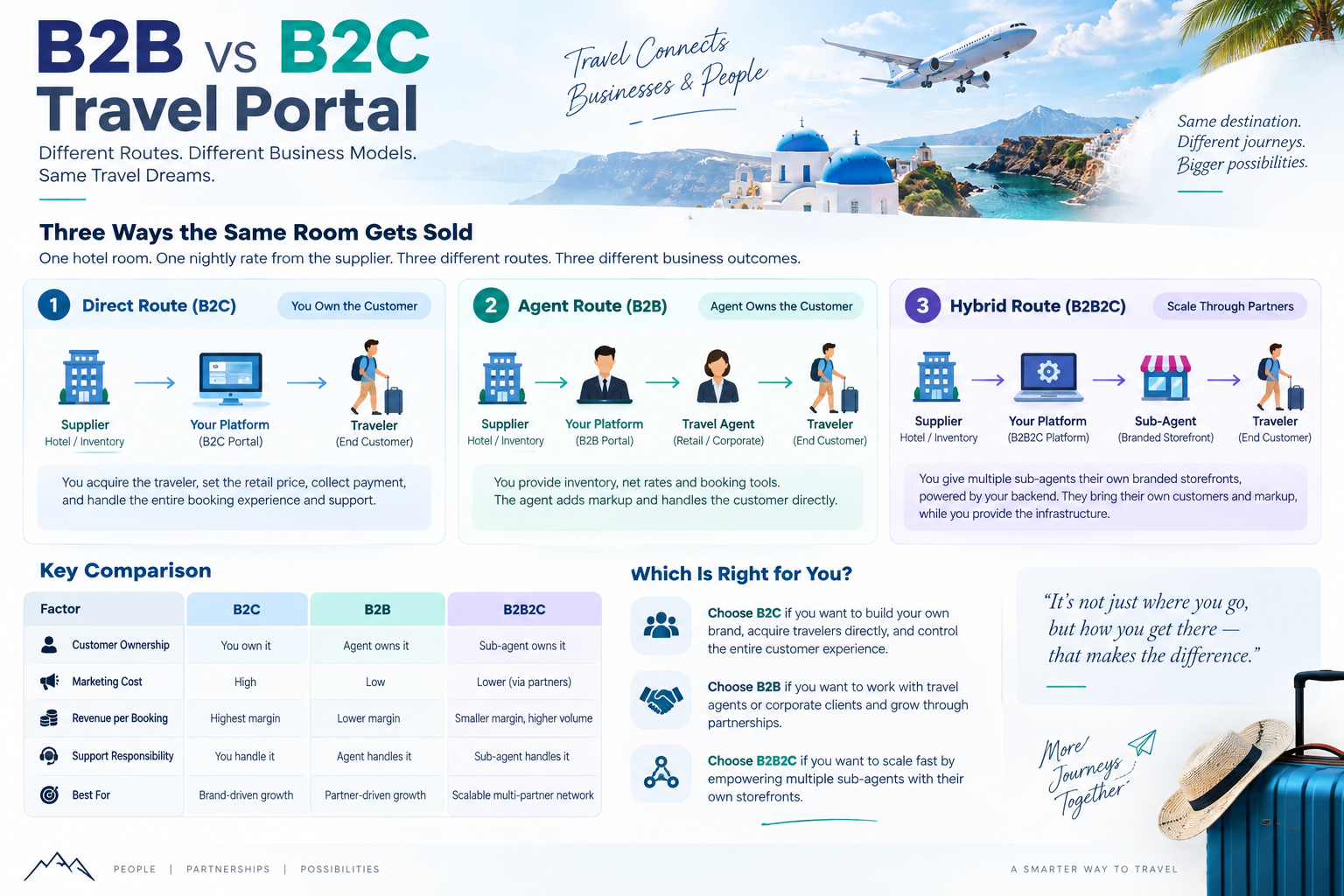
Three Ways the Same Room Gets Sold
Picture one hotel room, one nightly rate from the supplier. It can reach a traveler through three different routes, and each route rewrites the economics.
The direct route — Supplier → your platform → traveler. This is the model behind Booking.com or Expedia. You acquire the traveler yourself through search, ads, or brand recognition, set the retail price, collect payment, and handle support.
The agent route — Supplier → your platform → travel agent → traveler. Here you never meet the traveler. Your customer is the agent — a retail agency, a corporate travel desk, a wholesaler. You expose net rates, the agent applies a markup, and the agent owns the relationship.
The hybrid route (B2B2C) — Supplier → your platform → sub-agent → traveler. You're not selling to one agent; you're giving many smaller businesses their own branded storefront, powered by your backend. Each sub-agent gets their own customers and markup while you provide the infrastructure underneath all of them.
It isn't the room that changes across these three routes. It's who sits in the middle — and that one variable rewrites your revenue model, your support burden, and your growth strategy. Sell the same $150-a-night room through all three: on the direct route you keep the full margin but paid to acquire the traveler; on the agent route you gave up part of the margin as commission but the agent brought the customer at near-zero acquisition cost; on the hybrid route a sub-agent you've never met brought the traveler, kept their own markup, and you earned a smaller slice on volume instead of a larger slice on one transaction. None of this is objectively better — they're different bets on where you want to spend money: marketing, partnerships, or infrastructure that scales across partners you don't manage individually.
The Fault Line Nobody Puts on the Homepage: Who Owns the Customer
Strip away the interface and B2B versus B2C comes down to one fault line — who owns the customer relationship, and what does owning it actually cost.
B2C: You Own the Relationship and the Cost of Getting It
In a B2C model you acquire the traveler directly, run the marketing, and own the booking experience end to end — search through confirmation email. You also own every support ticket, every refund request, and every retention campaign trying to win the next booking.
Global online travel bookings are on track to represent roughly two-thirds of all travel purchases by 2026, with mobile now accounting for more than half of OTA bookings — a signal of where acquisition cost and UX pressure really sit in B2C. That mobile figure isn't a side detail: it means a B2C travel portal is a UX and conversion product first, and a booking engine second. Page load speed, checkout friction, and mobile-first design decide whether the acquisition spend behind a traveler actually converts. Get the interface wrong and you pay twice — once to bring the traveler to the site, and again in abandoned carts.
B2B: The Agent Owns It, You Own the Infrastructure
In a B2B model, the agent owns the traveler relationship. You provide inventory, pricing infrastructure, credit terms, and booking tools; the agent adds their markup and handles the customer directly.
This is a bigger business than the "B2B is niche" framing suggests. The global B2B travel software market was valued at roughly $32 billion in 2025 and is projected to grow past $160 billion by 2035 — a pace that outstrips a lot of consumer-facing travel tech. Corporate and agent-mediated bookings carry a quieter advantage too: research cited by travel-tech analysts has linked corporate booking through B2B channels to double-digit percentage savings over retail B2C channels, largely through negotiated net rates and volume pricing.
None of that is visible to a traveler — it's infrastructure built entirely for the business sitting between you and them. Credit-based booking lets agents book now and settle on a weekly or fortnightly cycle instead of paying at the point of sale, removing a major friction point for high-volume agents. Multi-branch and hierarchy controls let a large agency manage dozens of sub-users under one account, each with their own permissions and markup rules. This is also why B2B platforms tend to demand deeper GDS integration than their B2C counterparts — agents expect access to negotiated fares and wholesale rates that never surface on a public-facing site, and that access has to come through proper Global Distribution System connectivity rather than a single retail API.
B2B2C: You Own Neither Directly — You Own the Rails
B2B2C usually gets flattened into a single bullet point in comparison articles, but it's arguably the most commercially interesting of the three. You're not acquiring the traveler and you're not managing one agent relationship — you're providing the connectivity layer, the pricing rules, and the white-label storefront that let smaller businesses run their own travel operation without building any of it themselves.
Every sub-agent under that structure can rebrand the interface as their own — their logo, their domain, their customers — while your infrastructure quietly powers all of it underneath. You don't own the customer. You own the system the customer moves through.
This is also why B2B2C tends to be the model companies grow into rather than start with. It requires enough platform maturity to let outside businesses white-label your interface safely — their own logo, domain, and markup rules — without your infrastructure buckling under dozens of semi-independent storefronts running on it at once.
The Travel Distribution Ladder
Once you see B2B, B2C, and B2B2C as distribution architectures rather than website templates, it helps to place your own business on a simple spectrum:
Model | You primarily control | Main growth lever |
|---|---|---|
B2C | The traveler relationship | Customer acquisition, brand, conversion |
B2B | The agent network | Agent acquisition, booking volume per agent |
B2B2C | The distribution infrastructure | Network growth + downstream bookings across all sub-agents |
Level one, B2C, is about owning a customer. Level two, B2B, is about owning a network of businesses who sell to customers. Level three, B2B2C, is about owning the infrastructure that lets other businesses own their own customers while you scale underneath all of them at once.
Most travel businesses don't consciously pick a rung on this ladder — they back into one based on whatever inventory and technology they happened to build first. Naming the rung you're actually on tends to clarify decisions that otherwise get debated as "features."
One API, Three Different Businesses
Here's the part that trips up a lot of otherwise sound technology decisions: a hotel API, a flight API, or any supplier connection doesn't come pre-labeled "B2B" or "B2C." The commercial layer wrapped around that API determines how the inventory actually gets distributed.
That same connectivity layer can sit underneath a consumer storefront, an agent portal, or a network of white-label sub-agent sites — the routing logic and pricing rules on top of it decide which one it becomes.
Where Bookings Actually Break
Anyone who has run a multi-supplier travel platform has hit the same handful of failure points, regardless of business model:
Duplicated hotel inventory — the same property appears twice across two suppliers at two different prices, undermining traveler trust
Inconsistent cancellation policies — one supplier allows free cancellation up to 24 hours, another doesn't, and the interface doesn't make that clear until a customer disputes it
Supplier-specific booking rules — a supplier requires a field or format your standard booking flow was never built to send
Rate mismatches — the price confirmed at booking time doesn't match what the customer was quoted seconds earlier
Markup errors — pricing rules stack incorrectly across agent tiers, so a sub-agent ends up seeing a lower price than the agent above them
API timeouts — supplier connections slow down or fail during peak search volume, especially across GDS-connected inventory
Sudden availability changes — a cached search result shows a room or fare that's gone by the time the booking request reaches the supplier
Settlement and reconciliation gaps — commission structures vary by supplier, turning reconciliation into a manual process instead of an automated one
None of these are B2B problems or B2C problems. They surface regardless of which storefront sits on top — which is exactly why they're connectivity problems.
Where Different Businesses Actually Land on This
The travel agency with an existing customer base is usually already living in the B2B world without calling it that. Most of the value in formalizing a B2B portal is replacing manual quote-and-book processes with something an agent's own sub-agents can use directly.
The travel technology entrepreneur starting from zero faces the widest set of options. Starting with one clear model, one clear customer, tends to outperform trying to launch B2B, B2C, and B2B2C simultaneously before any of the three has traction.
The existing OTA looking to add suppliers very often isn't choosing a model at all — the actual need is connectivity to inventory it doesn't currently have, a narrower and more solvable problem than it first appears.
The wholesaler, DMC, or consolidator is almost always operating in B2B or B2B2C by definition. The relevant decision is less "B2B or B2C" and more how many layers of sub-agents the platform needs to support cleanly.
Maybe the Platform Isn't the Problem
A lot of travel businesses assume the fix is a whole new portal — a full B2B rebuild, or a fresh B2C storefront. Often that's not actually the gap. If your existing OTA already handles customers, bookings, and payments reasonably well, the real problem may simply be that a specific supplier or content source isn't connected to it yet. That's a narrower, cheaper, and faster problem to solve than replacing the platform.
This is exactly the kind of connectivity and integration work Teenva AI & Digital Ventures does for travel businesses — plugging a missing GDS or supplier feed into a platform that already works, or building the booking, pricing, and hierarchy logic from scratch for a new B2B, B2C, or B2B2C build. Whether you're patching a gap or starting from zero, the underlying architecture decisions are the same ones covered above.
The Short Answers, for the Record
What is B2B and B2C in travel? B2B travel refers to transactions between your platform and another business — a travel agent, wholesaler, or corporate buyer. B2C travel refers to transactions directly with the end traveler.
What is a B2B travel portal? A platform that lets travel agents, sub-agents, or wholesalers search, price, and book travel inventory using net rates, credit terms, and markup controls set by the platform operator — rather than retail pricing shown to the public.
What's the main difference between B2B and B2C? The core difference isn't the interface — it's who owns the customer relationship and who absorbs acquisition and support costs. In B2C, you do. In B2B, the agent does, and you operate the infrastructure behind them instead.
What should you actually look for in a B2B travel portal? Look at the mechanics, not the vendor name: how markup and net-rate visibility are controlled, how deep the credit and hierarchy management goes for multi-branch or sub-agent structures, how many supplier APIs are already integrated, and how the white-label layer holds up once agents start customizing it. A few sharper questions cut through faster than any spec sheet: Can a large agency give ten branches ten different markup rules without manual overrides? Can an agent see a booking's status without calling support? Does the platform hide net rates completely at every stage of the agent-facing flow?
Where This Leaves You
B2B versus B2C was never really a design decision. It's a decision about who owns the customer, how inventory moves through your business, and where your margin actually gets created.
Before buying a new travel portal, it's worth asking a narrower question first: do you actually need a new portal, or do you need better connectivity to the supplier you're missing? If you're an agency, name which rung of the distribution ladder you're actually operating on today — not which one sounds most ambitious. If you're a technology entrepreneur, resist launching all three models before any one has proven customers. And if you're an existing OTA staring at a missing supplier, treat it as a connectivity problem before treating it as a platform problem — the fix is usually smaller and cheaper than it first looks.
Need help figuring out which model fits, or connecting a missing supplier to a platform you already run? Teenva AI & Digital Ventures builds and integrates B2B, B2C, and B2B2C travel booking systems — GDS connectivity, multi-supplier architecture, and white-label sub-agent infrastructure included. Reach out at sales@teenvaai.com or +91 9572020107, or visit teenvaai.com to get your travel platform built or connected.
