

RateHawk SDK Explained: Faster Hotel Booking Development for Agencies
Most agencies that integrate RateHawk never touch the raw REST endpoints directly for long. Within the first sprint, someone on the team ends up writing a thin wrapper around authentication, request signing, and response parsing — and that wrapper is the SDK, whether anyone calls it that or not. The question isn't whether you need an SDK layer. It's whether you build one yourself or use one that's already been hardened by other agencies' production traffic.
This article breaks down what a RateHawk SDK actually needs to handle, why skipping that layer slows agencies down, and how Teenva AI packages a ready-made SDK layer inside its multi-supplier booking platform so agency dev teams can skip the plumbing and get to shipping.
What a RateHawk SDK Actually Wraps
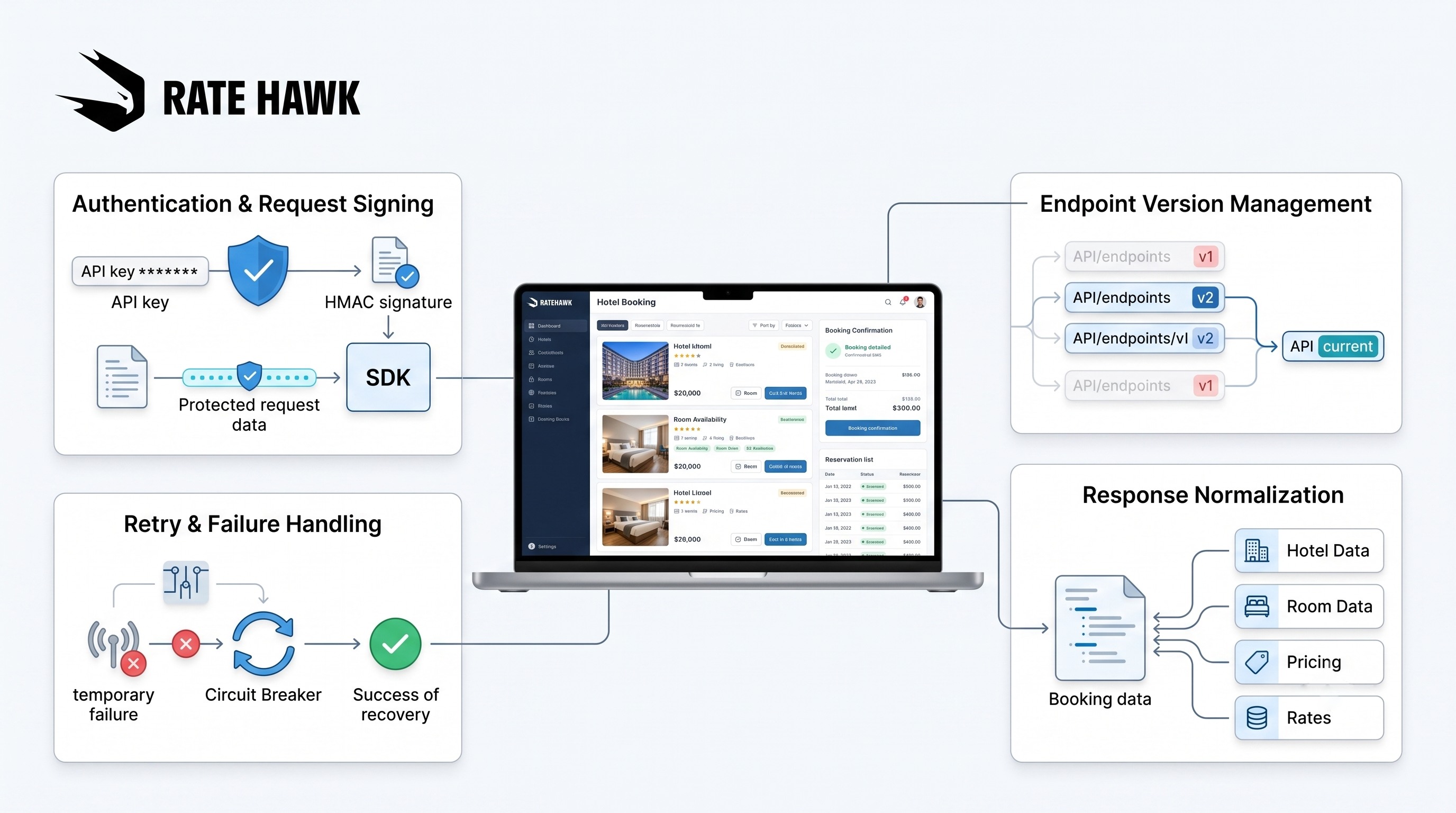
RateHawk's B2B API is a REST/JSON interface, but "REST/JSON" undersells how much groundwork sits between a raw HTTP call and a working booking flow. An SDK — whether it's an official library or an internal one your team maintains — typically wraps four layers:
1. Authentication and request signing. Some RateHawk endpoints require HMAC signature verification on top of API key auth. That means generating a signature from the request payload and a secret key, then attaching it to the correct header, on every single call. Get the signing logic wrong and you don't get a helpful error — you get silent rejections that are painful to debug at 2 a.m.
2. Endpoint version management. RateHawk has shipped multiple API versions over the years, and older paths still resolve for legacy partners. An SDK pins your integration to the current version so nobody on the team accidentally builds against a deprecated endpoint they found in an old Stack Overflow thread.
3. Response normalization. Raw supplier responses are shaped around the supplier's internal data model, not your booking engine's. An SDK maps RateHawk's hotel, room, and rate objects into a consistent internal schema — ideally one that looks the same whether the booking came from RateHawk, a bedbank, or a GDS feed.
4. Retry and failure handling. Search and availability calls fail intermittently under load, and a naive integration either surfaces that failure straight to the customer or hangs indefinitely. An SDK builds retry logic and circuit breaking in once, centrally, instead of scattering try/catch blocks across every screen that calls a supplier.
Why Agencies Underestimate This Layer
The RateHawk API documentation itself is only available after a partner agreement is signed, which means most agencies scope their integration timeline before they've seen the actual endpoint contracts. Development teams frequently plan for "a few weeks of API work" and then discover the SDK layer — signing, versioning, normalization, retries — is actually the majority of the effort, not the booking screens sitting on top of it.
The Design Patterns That Make an SDK Reliable
Teams that have built and maintained a RateHawk SDK layer in production tend to converge on the same handful of patterns, regardless of language or stack:
Adapter pattern — RateHawk's response objects get mapped into a supplier-agnostic internal model at the SDK boundary, so the booking engine never has to know which supplier a rate came from.
Factory pattern — a request factory constructs correctly signed, correctly versioned requests for each endpoint, so signing logic lives in exactly one place.
Circuit breaker — when RateHawk's search endpoint starts timing out or erroring above a threshold, the circuit opens and the SDK fails over to other suppliers in the stack rather than hanging the customer's search.
Caching layer (typically Redis) — hotel content (names, images, amenities, descriptions) changes far less often than rates. Caching content responses avoids re-fetching static data on every search and meaningfully cuts latency and API call volume.
A Simplified Look at SDK-Level Code
The exact implementation varies by stack, but the shape of a well-built RateHawk SDK call looks roughly like this in pseudocode:
class RateHawkClient:
    def __init__(self, api_key, secret, cache, circuit_breaker):
        self.signer = RequestSigner(secret)
        self.cache = cache
        self.breaker = circuit_breaker

    def search(self, params):
        if self.breaker.is_open():
            return self.fallback_supplier.search(params)

        request = self.signer.sign("hotel/search", params)
        response = http.post(RATEHAWK_V3_SEARCH, request)
        return ResponseNormalizer.to_unified_schema(response)

    def get_content(self, hotel_id):
        cached = self.cache.get(hotel_id)
        if cached:
            return cached
        content = http.get(RATEHAWK_V3_CONTENT, hotel_id)
        self.cache.set(hotel_id, content, ttl=86400)
        return content
Notice what the booking engine never has to think about: signature generation, cache invalidation windows, or which API version is current. That separation is the entire point of an SDK layer — it lets product and booking-flow developers move fast without needing to become RateHawk protocol experts.
Where PCI and Payment Handling Fit In
RateHawk's commercial model runs on net rates against a partner credit line rather than per-booking card payments to the supplier, but agencies still need to handle guest-facing payment capture on their own booking engine. Any SDK layer sitting near payment data — even indirectly, through booking confirmation flows that pass card tokens — should keep cardholder data out of logs, out of the normalization layer, and out of any cache, in line with PCI DSS scope-reduction practices. Tokenizing payment details upstream, before they ever reach the supplier-facing SDK, keeps that layer out of PCI scope entirely.
Build In-House or Use a Pre-Built SDK Layer?
Building a RateHawk SDK from scratch isn't a bad decision — plenty of agencies do it well. But it's worth being honest about what it actually costs: signing logic that has to stay correct across API version changes, a caching strategy that has to be tuned and monitored, a circuit breaker that has to be tested under real failure conditions, and a normalization schema that has to be maintained as RateHawk's response shapes evolve. That's ongoing engineering overhead, not a one-time build.
Teenva AI's integration platform ships this SDK layer already built — signing, versioning, content caching, circuit breaking, and response normalization handled centrally, with RateHawk's 2.5M+ properties arriving in the same unified schema as every other supplier in the stack. Agencies bring their RateHawk partner agreement; Teenva AI activates it inside the platform, and the booking engine calls one consistent interface regardless of which supplier actually filled the request.
Frequently Asked Questions
Is there an official RateHawk SDK? RateHawk's own documentation is REST/JSON-based and accessed after partnership approval. Most "SDKs" in the ecosystem are wrapper libraries — either built in-house by agencies or provided by integration platforms — rather than an official client library maintained by RateHawk itself.
Does an SDK layer slow down access to new RateHawk features? Not if it's designed well. A properly abstracted SDK isolates version-specific logic in one place, so adding support for a new endpoint or field is a contained change rather than a rewrite across the booking engine.
Can an SDK layer work across multiple hotel suppliers, not just RateHawk? Yes — this is the main advantage of the adapter pattern. The SDK's normalization layer can map RateHawk, Hotelbeds, or any other supplier's response into the same internal schema, so the booking engine treats all suppliers identically.
How much development time does a RateHawk SDK layer typically save? Agencies that skip building their own wrapper and use an existing SDK layer generally report integration timelines measured in days rather than the 4–8 weeks typically needed to build, test, and harden signing, caching, and failover logic from scratch.
Get RateHawk Live Faster with Teenva AI
If your team has a RateHawk partner agreement and wants to skip the SDK-building phase entirely, Teenva AI & Digital Ventures can activate it inside a platform that already handles signing, caching, and cross-supplier normalization.
Reach out at sales@teenvaai.com or call +91 9572020107 to talk through your booking engine architecture and timeline.