

RateHawk API Integration for Travel Agencies: Complete Guide
Building a proprietary hotel booking engine from the ground up is expensive, slow, and requires ongoing investment in supplier relationships, rate management, and inventory upkeep. For most OTAs, TMCs, DMCs, and independent travel agencies, RateHawk API integration offers a faster, lower-risk path to the same result: a fully functional hotel booking product backed by a global supplier network.
This guide breaks down how RateHawk's API works, the integration models available, and what travel agencies need to know before connecting to it.
What Is the RateHawk API?
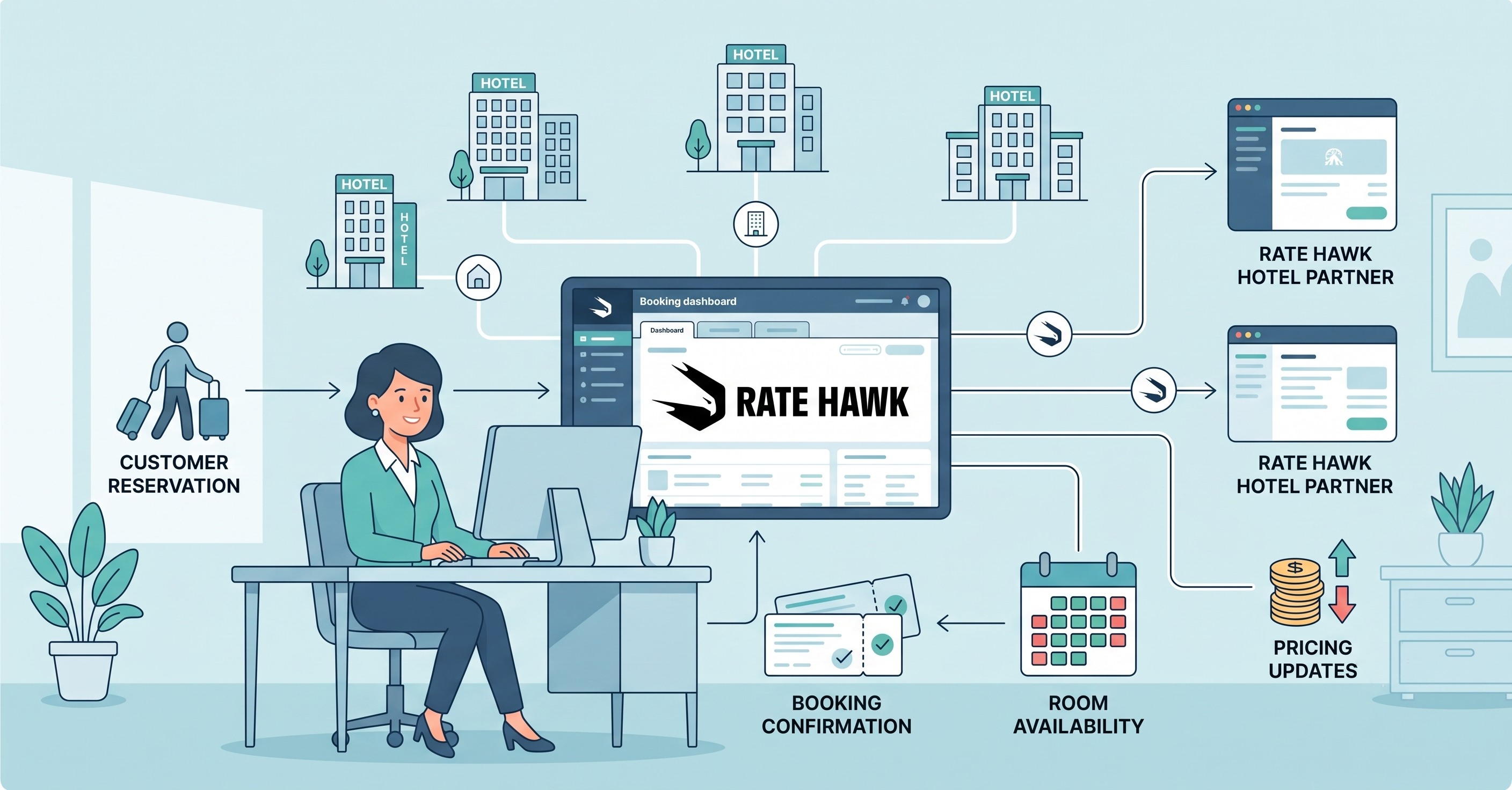
The RateHawk API is a hotel booking API that acts as a digital bridge between a travel agency's platform and RateHawk's inventory of hotels, guest houses, hostels, and apartments. Rather than negotiating directly with thousands of individual properties, agencies query a single API endpoint and receive real-time search results, rates, and availability across RateHawk's supplier base.
At its core, the integration follows a familiar request-response pattern common to most travel distribution APIs:
A search request is sent with destination, dates, and guest details
RateHawk's system queries its aggregated hotel inventory
Results are returned with pricing, availability, and room-level details
A booking request confirms the reservation in real time
Why Agencies Choose API Integration Over In-House Development
Three factors typically drive the decision to integrate rather than build:
Lower upfront investment — no need to negotiate hundreds of individual hotel contracts
Faster time to market — RateHawk states that integration can be completed in just a few hours for straightforward use cases
Immediate scale — access to over 1,400,000 properties worldwide from day one, with multilingual content across 18 languages
For agencies weighing build-vs-buy, this shifts engineering effort away from supplier management and toward differentiation — pricing strategy, UX, and customer service.
Integration Architecture Overview
A typical RateHawk integration sits between the agency's booking platform and RateHawk's API layer, with a thin adapter handling authentication, request formatting, and response normalization.
The adapter layer is worth calling out specifically. Rather than hard-wiring an agency's booking engine directly to RateHawk's endpoints, most implementations introduce a translation layer that normalizes RateHawk's response format into the agency's internal data model. This keeps the integration maintainable if the agency later adds a second or third supplier — a common pattern once agencies move from single-supplier to multi-supplier redundancy.
Booking Flow: Search to Confirmation
The sequence below illustrates the standard flow from an end-traveler's search through to a confirmed booking, including the CRM sync step that many agencies rely on for downstream reporting.
Two Ways to Connect
RateHawk supports two integration paths, and the right choice depends on an agency's existing technology stack.
Direct API integration — the agency receives an API key and documentation, and gains access to the full inventory through a single integration. RateHawk's support team guides partners through setup and certification.
Platform-based integration — agencies already using a connected technology platform (such as TravelgateX, DCS Plus, WBE, Juniper, or ANIXE) can access RateHawk inventory through that existing platform connection, without a separate direct build.
Agencies already running a multi-supplier setup often favor platform-based integration since it avoids maintaining a separate adapter for every bed bank they connect to.
SDK-Based Development
For teams integrating directly, RateHawk provides an SDK rather than requiring integration against raw endpoints from scratch. This has a few practical benefits:
Shorter integration code compared to building request/response handling manually
Predictable behavior, since shared libraries follow a consistent pattern across implementations, which simplifies debugging
Documented methods and structures, reducing the guesswork typically involved in external API development
This is comparable to how other RESTful travel APIs are typically consumed — the SDK abstracts repetitive plumbing so development teams can focus on business logic like pricing markups or loyalty integration.
Business Model Flexibility
Agencies aren't locked into a single commercial arrangement. RateHawk supports several models:
Net pricing — agencies apply their own markup
Commission-based — bookings earn a set commission
Affiliate — a lighter-weight model suited to referral-style booking flows
This flexibility matters for agencies serving different client segments — a corporate TMC and a leisure-focused OTA will typically want different pricing structures from the same underlying inventory.
Multiroom Bookings and Upsells
The API supports selecting multiple rooms within a single order, along with add-ons like early check-in and late check-out at the point of booking. For agencies serving group travel or corporate clients booking multiple rooms per stay, this avoids the need to manage several separate reservations for what is functionally one trip.
What to Confirm Before Integrating
Before starting integration, agencies should verify with their account manager:
Whether direct API integration or platform-based access better fits their existing stack
Which pricing model (net, commission, affiliate) aligns with their business
Whether their CRM system will need custom mapping for booking data sync
Language and currency requirements for their target markets
Access to the RateHawk API itself is free, though agencies should plan engineering time for the adapter layer, testing, and certification process regardless of which integration path they choose.
Final Thoughts
RateHawk API integration gives travel agencies a way to launch or expand a hotel booking product without the capital investment of building a supplier network from scratch. Whether an agency chooses direct integration or connects through an existing technology platform, the core value is the same: broad inventory, flexible commercial terms, and a documented, SDK-backed path to production.
Need help planning your RateHawk or multi-supplier API integration? Teenva AI & Digital Ventures builds and supports API integrations for OTAs, TMCs, DMCs, and travel agencies.
sales@teenvaai.com | +91 9572020107