
How AI Enables Real-Time Decision Making in Manufacturing
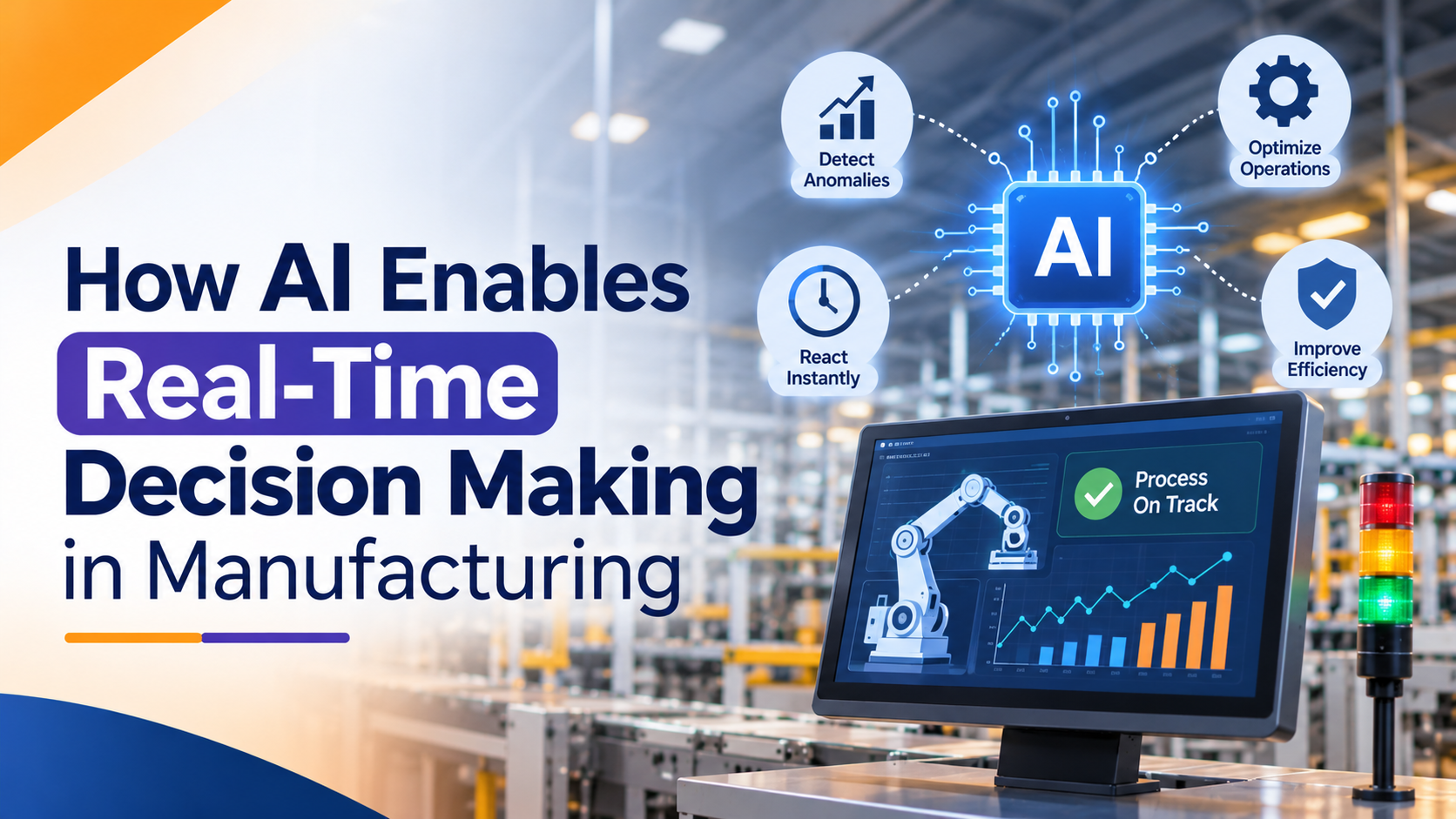
On a factory floor, timing is everything. A machine drifting out of tolerance, a late supplier delivery, a sudden rush order, or a quality defect that starts to repeat can each cost money within minutes. Traditionally, many of these situations are caught by an operator walking past, a report that arrives at the end of the shift, or a lab result that comes back hours later. By then the damage is done. AI changes the timing. It lets manufacturers sense what is happening as it happens, evaluate options quickly, and act while there is still time to make a difference. This guide explains how AI enables real-time decision making in manufacturing, what the technology stack looks like, which decisions benefit most, and how to introduce it responsibly.
What Does "Real-Time" Mean in Manufacturing?
Real-time does not always mean microseconds. It means fast enough for the decision to still matter. Different decisions have different time windows.
Decision Type | Typical Time Window | Example |
|---|---|---|
Machine-level control | Milliseconds | Adjusting a motor drive or stopping a machine to prevent damage |
Inline quality decisions | Milliseconds to seconds | Rejecting a defective item on a moving conveyor |
Process adjustments | Seconds to minutes | Tuning temperature or speed as material properties shift |
Operational decisions | Minutes to hours | Re-sequencing jobs after a machine fault |
Tactical decisions | Hours to days | Adjusting production plans after a demand change |
The key is matching the technology to the time window. Very fast control stays in dedicated control systems, while AI often supports the seconds-to-hours layers by detecting, predicting, and recommending or triggering actions.
Why Traditional Decision Making Falls Behind
Data arrives late: reports and lab tests describe the past, not the present.
Information is siloed: machine data, quality data, maintenance records, and orders sit in different systems.
Humans cannot watch everything: a plant may have thousands of signals, and no one can monitor all of them continuously.
Decisions depend on individual experience: results vary between people and shifts.
Too many variables: real situations involve trade-offs among cost, speed, quality, and availability that are hard to weigh quickly.
How AI Enables Real-Time Decisions
1. Continuous Sensing
Sensors, cameras, PLCs, and machine controllers stream data constantly. AI models read this stream rather than waiting for a daily export.
2. Instant Pattern Recognition
Models trained on historical data recognize patterns linked to good and bad outcomes, such as a vibration signature that precedes a bearing failure or a combination of settings that tends to produce defects.
3. Prediction, Not Just Detection
Instead of reporting that something has gone wrong, AI can estimate what is likely to happen next, such as when a machine may fail, whether a batch will meet specification, or whether an order will ship on time.
4. Option Evaluation
Optimization techniques can compare possible actions against goals and constraints, for example which job sequence minimizes delays or which setpoint combination keeps quality on target with the least energy.
5. Recommended or Automated Action
The system either recommends an action to a person or, within strict limits, triggers it automatically, such as diverting a defective item, adjusting a setpoint, or creating a maintenance request.
6. Learning From Outcomes
Results feed back into the system. Over time, models improve as they see what actually happened after each decision.
The Real-Time Decision Loop
Technology Behind Real-Time AI Decisions
Edge Computing
Running AI close to machines reduces delay, keeps working if network connections fail, and limits how much raw data must travel to the cloud. Edge devices are well suited to tasks like visual inspection and quick anomaly detection.
Data Streaming and Event-Driven Architecture
Streaming platforms and messaging protocols move data as events happen, so systems can react immediately instead of in batches. Standard industrial protocols help connect machines from different vendors.
Time-Series Databases and Data Historians
These store sensor data efficiently and make it easy to compare current behavior with history.
Machine Learning and Computer Vision Models
Models for prediction, classification, and anomaly detection analyze signals and images. They are trained offline, then deployed for fast inference.
Optimization and Rules Engines
These combine business rules, constraints, and goals to select the best action. Rules keep decisions predictable and aligned with safety and policy.
Integration With Operational Systems
Decisions only matter if they lead to action. Integration with PLCs, SCADA, MES, ERP, and maintenance systems lets AI trigger alerts, work orders, schedule changes, or setpoint adjustments.
Dashboards and Alerts
Clear, timely interfaces present recommendations in context, so operators understand what is happening and why a suggestion is made.
Where Real-Time AI Decisions Create the Most Value
Quality Control
Vision systems inspect items as they move and trigger immediate rejection or alerts. Process models can warn that quality is drifting before defective output piles up.
Predictive Maintenance Triage
When a model flags a developing fault, the system can estimate urgency, check production schedules, and recommend the best time and priority for maintenance.
Dynamic Production Scheduling
When a machine goes down, a rush order arrives, or materials run late, AI can quickly propose a revised schedule that limits delays and changeovers.
Line Balancing and Throughput Management
Real-time data on cycle times and bottlenecks helps rebalance work across stations and keep flow smooth.
Inventory and Material Flow
AI can update replenishment signals, reroute materials, and predict shortages based on live consumption and supplier updates.
Energy Management
Systems can adjust loads or shift energy-intensive tasks in response to demand patterns and price signals, where operations allow.
Safety Monitoring
Cameras and sensors can detect hazards such as missing protective equipment or people entering restricted zones, and alert supervisors immediately. These tools support, but never replace, certified safety systems.
Supply Chain Responsiveness
Linking plant data with supplier and logistics information helps plants adapt when deliveries change.
An Illustrative Scenario
Imagine a bottling line. A camera notices that labels are sitting slightly crooked on a small share of bottles. The AI model correlates the pattern with a gradual temperature rise in the label adhesive unit and predicts that defect rates will grow within the next 20 minutes. It alerts the operator with a suggested adjustment and automatically diverts the affected bottles for inspection. The operator confirms the change, defects stop, and the system logs the event so the model learns from it. Without real-time analysis, the problem might only have been discovered at the end of the shift, with a large batch to rework.
Human in the Loop: Deciding Who Decides
Not every decision should be automated. A practical way to assign responsibility is by risk and reversibility.
Level | Who Decides | Suitable For |
|---|---|---|
Inform | Human decides alone | Complex, high-stakes decisions |
Recommend | AI suggests, human approves | Most operational decisions at the start |
Act within limits | AI acts, human supervises | Low-risk, frequent, reversible decisions |
Autonomous | AI acts independently | Well-understood, thoroughly tested scenarios only |
Start at the "recommend" level, measure accuracy and operator acceptance, then expand automation only where results justify it. Always provide a way to override and a safe fallback.
Benefits of Real-Time AI Decision Making
Faster response to problems: issues are caught and handled while they are still small.
Less downtime and scrap: earlier warnings reduce unplanned stops and waste.
More consistent decisions: the same data and logic are applied across shifts and sites.
Higher agility: plants adapt faster to rush orders, delays, and demand swings.
Better use of expertise: experts spend time on exceptions rather than routine monitoring.
Improved visibility: managers see what is happening now, not yesterday.
Results vary by plant, so measure them against a baseline.
Challenges and How to Handle Them
Challenge | Why It Matters | Practical Approach |
|---|---|---|
Data quality and latency | Poor or delayed data leads to poor decisions | Check sensors, timestamps, and data pipelines |
Legacy equipment | Older machines may not stream data | Add gateways and retrofit sensors |
Integration complexity | Decisions must reach control and planning systems | Use standard protocols and phased integration |
False alarms | Too many alerts cause fatigue | Tune thresholds, rank by impact, and gather operator feedback |
Trust and transparency | Operators need to understand recommendations | Show reasons and predicted outcomes |
Cybersecurity | Real-time connectivity widens exposure | Segment networks, control access, and monitor continuously |
Safety and compliance | Wrong actions can be costly or dangerous | Keep safety functions on certified systems and add guardrails |
Model drift | Conditions change over time | Monitor performance and retrain regularly |
Skills and change management | Teams must adopt new ways of working | Train staff, involve operators early, and show quick wins |
How to Get Started
Choose a decision, not a technology. Pick one recurring decision where speed matters, such as rejecting defects or rescheduling after a breakdown.
Map the current decision process. Note who decides, what data they use, and how long it takes.
Define the time window. Decide how fast the decision must be made to matter.
Check data readiness. Confirm the needed data is available, accurate, and timely.
Pilot in recommendation mode. Compare AI suggestions with human decisions and outcomes.
Add guardrails. Define limits, approvals, overrides, and fallbacks.
Integrate with operations. Connect recommendations to MES, maintenance, or control systems.
Measure against a baseline. Track speed, quality, downtime, and acceptance.
Scale carefully. Replicate on similar lines and sites, adapting to local conditions.
Keep improving. Review decisions regularly and update models and rules.
Metrics to Track
Time from event to decision, and from decision to action
Unplanned downtime and mean time to repair
Defect and scrap rates
On-time delivery and schedule adherence
Overall equipment effectiveness (OEE)
Alert accuracy (true versus false alarms)
Operator acceptance rate of recommendations
Energy and material use per unit
Common Mistakes to Avoid
Chasing "real-time" everywhere when some decisions do not need it
Automating decisions before validating accuracy
Overwhelming operators with alerts
Ignoring data timing and quality issues
Leaving operators and engineers out of design
Treating deployment as the end instead of the start of maintenance
What Is Next
Expect more intelligence at the edge, tighter links between plant-floor data and planning systems, digital twins that test decisions in simulation before applying them, and assistants that let people ask questions about live operations in plain language. Manufacturers that invest in good data, clear decision rules, and trusted human-machine collaboration will gain the most.
Frequently Asked Questions
How does AI enable real-time decision making in manufacturing? It analyzes streaming data from machines and systems, predicts what is likely to happen, evaluates options against goals and rules, and recommends or triggers actions quickly enough to matter.
Is real-time AI the same as real-time control? No. Hard real-time control of machines stays in PLCs and dedicated control systems. AI typically supports faster detection, prediction, and decision support around them.
Do I need edge computing? Not always, but it helps when decisions must be fast, connectivity is limited, or data volumes are large, such as in camera-based inspection.
Can AI make decisions without humans? In low-risk, well-tested situations, yes, within strict limits. Most manufacturers start with recommendations and keep humans in charge of higher-impact decisions.
What data do I need? Reliable, timely data from machines, sensors, quality systems, maintenance records, and orders, with clear timestamps and context.
What is a good first use case? Visual defect detection, maintenance prioritization, or rescheduling after disruptions are common starting points because outcomes are easy to measure.
How do I avoid alert fatigue? Rank alerts by impact, tune thresholds, combine related signals, and use operator feedback to improve accuracy.
The Bottom Line
AI enables real-time decision making in manufacturing by connecting live data, predictive models, and clear decision rules to the systems that run the plant. It helps teams catch problems earlier, respond faster to change, and apply consistent logic across shifts and sites. Success depends on picking the right decisions, matching technology to the time window, keeping humans in control where it counts, and maintaining the system over time. Start with one decision, prove the value, and expand step by step.