
How AI Improves Industrial Process Optimization in 2026
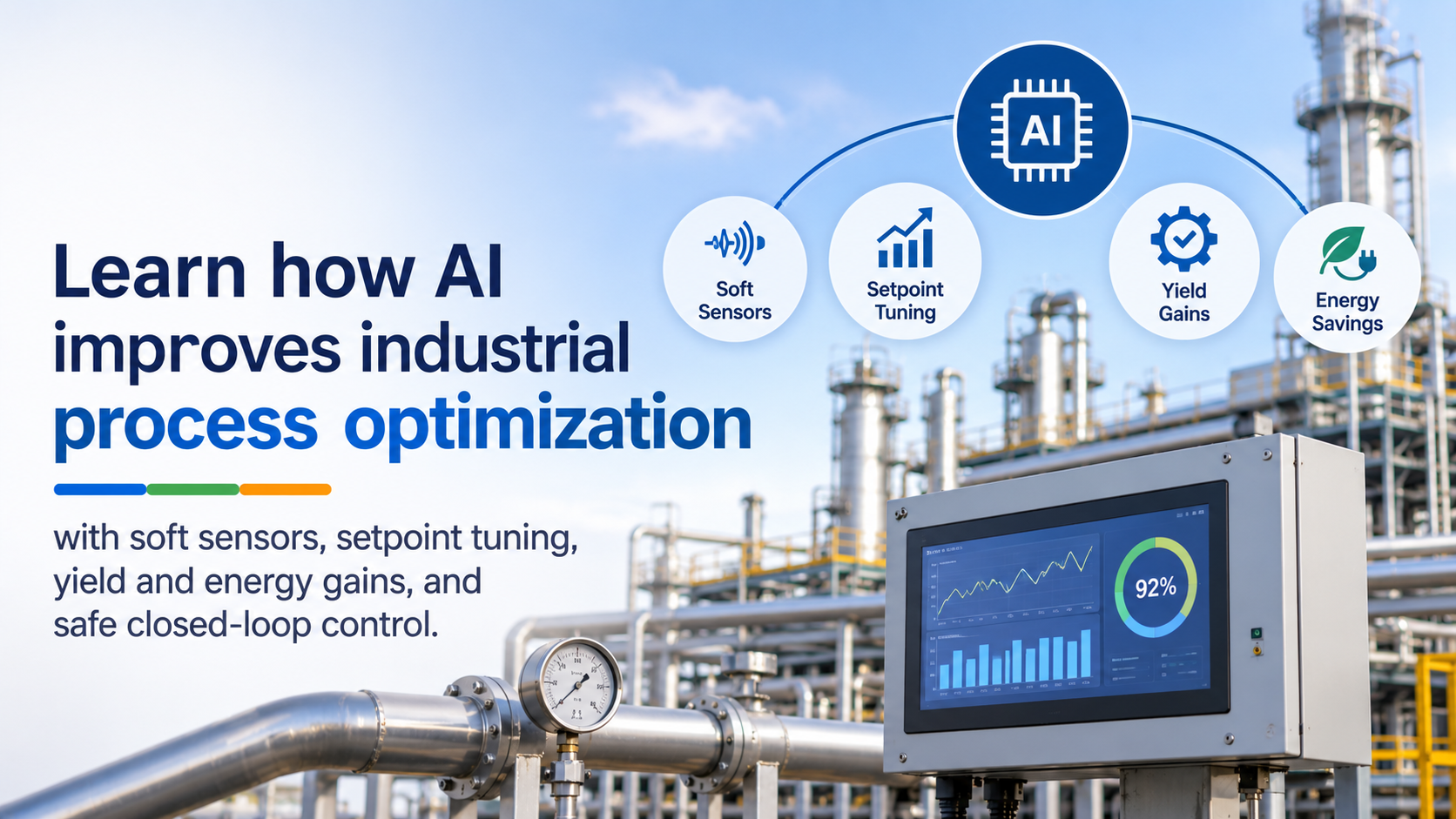
Every industrial process has a "sweet spot": the combination of temperatures, pressures, flow rates, speeds, and material inputs that delivers the best balance of yield, quality, energy use, and throughput. Finding and holding that sweet spot is hard. Raw materials vary, equipment ages, weather changes, and operators on different shifts make different choices. Traditional control keeps processes stable, but it rarely keeps them optimal. This guide explains how AI improves industrial process optimization, which techniques are used, where they work best, and how to adopt them safely.
What Is Industrial Process Optimization?
Industrial process optimization is the practice of adjusting how a process runs to improve a chosen goal, such as higher yield, lower energy use, less waste, better quality, or greater throughput, while staying within safety, quality, and equipment limits.
It matters most in continuous and batch processes where many variables interact, including chemicals, oil and gas, food and beverage, pharmaceuticals, metals, cement, paper, water treatment, and power generation. It also applies to discrete manufacturing lines, where speeds, schedules, and settings affect output and quality.
Why Traditional Approaches Hit a Ceiling
Fixed setpoints: many plants run on setpoints chosen years ago, even though conditions have changed.
Single-loop thinking: basic controllers regulate one variable at a time, while real performance depends on how many variables interact.
Manual tuning: engineers and operators adjust settings based on experience, which is valuable but varies between people and shifts.
Delayed information: quality results often arrive hours later from the lab, long after conditions have changed.
Hidden relationships: nonlinear effects and time delays are hard to see in spreadsheets and trend charts.
What AI Adds to Process Optimization
AI techniques can learn relationships directly from historical and live data, then use them to predict outcomes and recommend better operating conditions. Compared with purely rule-based or first-principles approaches, AI can:
Capture complex, nonlinear relationships among many variables
Update as conditions and equipment change
Predict outcomes before they happen
Search large numbers of possible settings quickly
Combine data types such as sensor signals, lab results, images, and schedules
AI works best when combined with engineering knowledge. Process engineers define constraints, validate results, and decide what is safe and sensible.
Key AI Techniques Used
Technique | What It Does | Typical Use |
|---|---|---|
Soft sensors | Estimate hard-to-measure values from easy-to-measure ones | Predict quality or composition before lab results arrive |
Predictive models | Forecast outputs such as yield, quality, or energy use | "What will happen if we change this setting?" |
Optimization algorithms | Search for the best settings within constraints | Recommend setpoints that maximize yield or minimize energy |
Model predictive control (MPC) with learning | Adjust multiple controls together using predictions | Stabilize and optimize multivariable processes |
Reinforcement learning | Learns control strategies through trial in simulation or controlled settings | Complex control problems with clear reward signals |
Anomaly detection | Flags abnormal process behavior | Early warning of upsets or drift |
Computer vision | Reads images from process equipment or products | Flame, froth, color, and surface analysis |
Digital twins and simulation | Test changes virtually | Evaluate scenarios without risking production |
Scheduling and planning optimization | Sequences jobs and resources | Reduce changeovers and idle time |
Ways AI Improves Industrial Process Optimization
1. Higher Yield and Less Waste
By learning which combinations of conditions produce the most good product, AI can recommend adjustments that cut off-spec material, reprocessing, and raw-material loss.
2. Lower Energy and Resource Use
Heating, cooling, compression, pumping, and drying are major energy consumers. AI can find settings and schedules that keep quality on target while using less energy, steam, water, or chemicals.
3. More Consistent Quality
Soft sensors and predictive models let operators see quality trends in near real time instead of waiting for lab tests. Early correction reduces variability and batch-to-batch differences.
4. Faster Response to Changing Conditions
When feedstock properties, ambient temperature, or equipment performance shift, AI can adapt recommendations sooner than periodic manual retuning.
5. Higher Throughput Within Safe Limits
Many plants run conservatively to avoid risk. With better prediction and constraint handling, they can safely operate closer to true limits and unlock extra capacity.
6. Reduced Variability Between Shifts
Capturing best-practice settings in models helps every shift operate more like the best shift, and helps newer operators learn faster.
7. Earlier Detection of Process Drift and Upsets
Anomaly detection can identify subtle changes that precede fouling, catalyst decay, filter clogging, or instability, giving teams time to act.
8. Better Batch Processes
In batch operations, AI can optimize recipes, timing, and endpoints, helping reduce cycle times and improve consistency from one batch to the next.
9. Smarter Scheduling and Changeovers
Optimizing production sequences and cleaning or changeover steps reduces idle time and material waste.
10. Faster Root-Cause Analysis
Models can highlight which variables most likely contributed to a quality problem, saving engineers hours of investigation.
How a Closed-Loop AI Optimization System Works
From Advice to Autonomy: Levels of Deployment
Most successful projects grow in stages as trust builds.
Level | Description | Human Role |
|---|---|---|
1. Monitoring | AI shows predictions and alerts | Operators decide and act |
2. Advisory | AI recommends setpoint changes | Operators approve each change |
3. Supervised automation | AI adjusts setpoints within strict limits | Operators supervise and can override |
4. Higher autonomy | AI manages broader decisions in well-understood areas | Engineers set goals, limits, and review performance |
Safety-critical functions should remain on certified safety systems, whatever the level.
Illustrative Examples
These examples are hypothetical and show how the ideas apply.
Chemical reactor: a model predicts product purity from temperature, pressure, and feed data. Operators see predicted purity continuously and adjust earlier, reducing off-spec batches.
Cement kiln: an optimizer recommends fuel and airflow adjustments that keep clinker quality stable while reducing fuel use as raw-material properties change.
Food dryer: a soft sensor estimates moisture content in real time, and the system tunes temperature and belt speed to avoid over-drying and wasted energy.
Water treatment plant: forecasting models adjust chemical dosing to match changing inflow quality, reducing chemical use while maintaining compliance.
What You Need to Get Started
Good Process Data
Reliable sensors with sensible calibration and sampling rates
A data historian or platform that stores time-series data
Lab and quality results linked to the right time periods
Context such as product grades, batches, shifts, and maintenance events
Process Knowledge
Engineers and operators who understand the process, its constraints, and its failure modes
Clear definition of objectives and trade-offs, such as yield versus energy
Technical Foundation
Secure connectivity between control systems and analytics platforms
Integration with DCS, PLC, SCADA, or MES systems
Tools for model development, deployment, and monitoring
Governance
Defined limits for what AI may recommend or change
Approval and override procedures
Change management and documentation
Step-by-Step Implementation Roadmap
Pick a process and objective. Choose one unit or line and a clear goal such as reducing off-spec product or energy per unit.
Record a baseline. Measure current performance over a representative period.
Assess data readiness. Identify gaps, noise, and missing context.
Build and validate models. Test predictions against historical and new data, with process engineers reviewing results.
Run in advisory mode. Compare AI recommendations with operator decisions and outcomes.
Define constraints and safeguards. Set limits, alarms, and fallback behavior.
Move to supervised control where justified. Allow limited automatic adjustments with clear override options.
Measure benefits honestly. Compare against the baseline and account for external factors.
Scale to similar units. Reuse data pipelines, model structures, and lessons learned.
Maintain the system. Monitor model performance, retrain, and update as the process changes.
Metrics to Track
Yield and first-pass quality
Off-spec production and reprocessing
Energy, steam, water, and chemical consumption per unit
Throughput and cycle time
Process variability, for example standard deviation of key variables
Number of upsets or trips
Time spent on manual adjustments and investigations
Operator acceptance of recommendations
Challenges and How to Handle Them
Challenge | Why It Happens | Practical Approach |
|---|---|---|
Noisy or missing data | Sensor faults, gaps, and inconsistent labeling | Clean data, add sensors where needed, and document data sources |
Time delays and slow dynamics | Effects of changes appear much later | Use models that account for delays and test in simulation first |
Changing conditions | Feedstock, equipment, and seasons change | Monitor drift and retrain regularly |
Operator trust | Recommendations may seem opaque | Show reasons, predicted outcomes, and allow feedback |
Safety and constraints | Optimization can push toward limits | Hard-code limits, use certified safety systems, and review changes |
Integration complexity | Legacy control systems and silos | Integrate in phases using standard protocols |
Cybersecurity | Connected systems create new risks | Segment networks, control access, and monitor activity |
Unclear ROI | Benefits are spread across many variables | Define metrics early and compare with a baseline |
Common Mistakes to Avoid
Optimizing one metric while ignoring trade-offs that hurt another
Skipping the baseline, which makes benefits impossible to prove
Pushing for full autonomy before building trust
Treating AI as a replacement for process knowledge
Neglecting model maintenance after go-live
Ignoring operators' feedback, which often reveals real-world constraints
What Is Next
Expect more use of hybrid models that combine physics and data, wider adoption of digital twins for testing changes, edge deployment for faster response, and assistants that help engineers explore process data and troubleshoot using natural language. The core principle will remain the same: good data, sound engineering, clear limits, and people who understand the process.
Frequently Asked Questions
How does AI improve industrial process optimization? It learns relationships from process data, predicts outcomes such as yield and quality, and recommends or applies setpoint changes that improve targets like yield, energy use, and consistency within safe limits.
How is this different from traditional process control? Traditional control keeps variables near fixed setpoints. AI helps decide which setpoints are best as conditions change and can consider many interacting variables at once.
Does AI replace PID controllers or MPC? Usually not. AI typically sits on top of existing control layers, recommending or adjusting setpoints, while the control system handles real-time regulation.
What is a soft sensor? It is a model that estimates a hard-to-measure variable, such as product quality, from other measurements that are available continuously.
Is it safe to let AI adjust setpoints automatically? It can be, when limits are enforced, safety systems remain independent and certified, performance is monitored, and humans can override. Many teams start in advisory mode first.
What kinds of plants benefit most? Processes with many interacting variables, significant energy or material costs, and measurable quality outcomes, such as chemicals, food, metals, cement, and utilities.
How long before results appear? It depends on data readiness and scope. Advisory pilots can show early insights in a few months, while closed-loop deployment takes longer.
The Bottom Line
AI improves industrial process optimization by turning process data into predictions and better decisions. From soft sensors and setpoint tuning to anomaly detection and scheduling, it helps plants raise yield, cut energy and waste, and keep quality steady as conditions change. Success depends on good data, strong process knowledge, clear safety limits, and gradual trust-building from advisory use to supervised control. Start with one process, measure against a baseline, and scale what works.