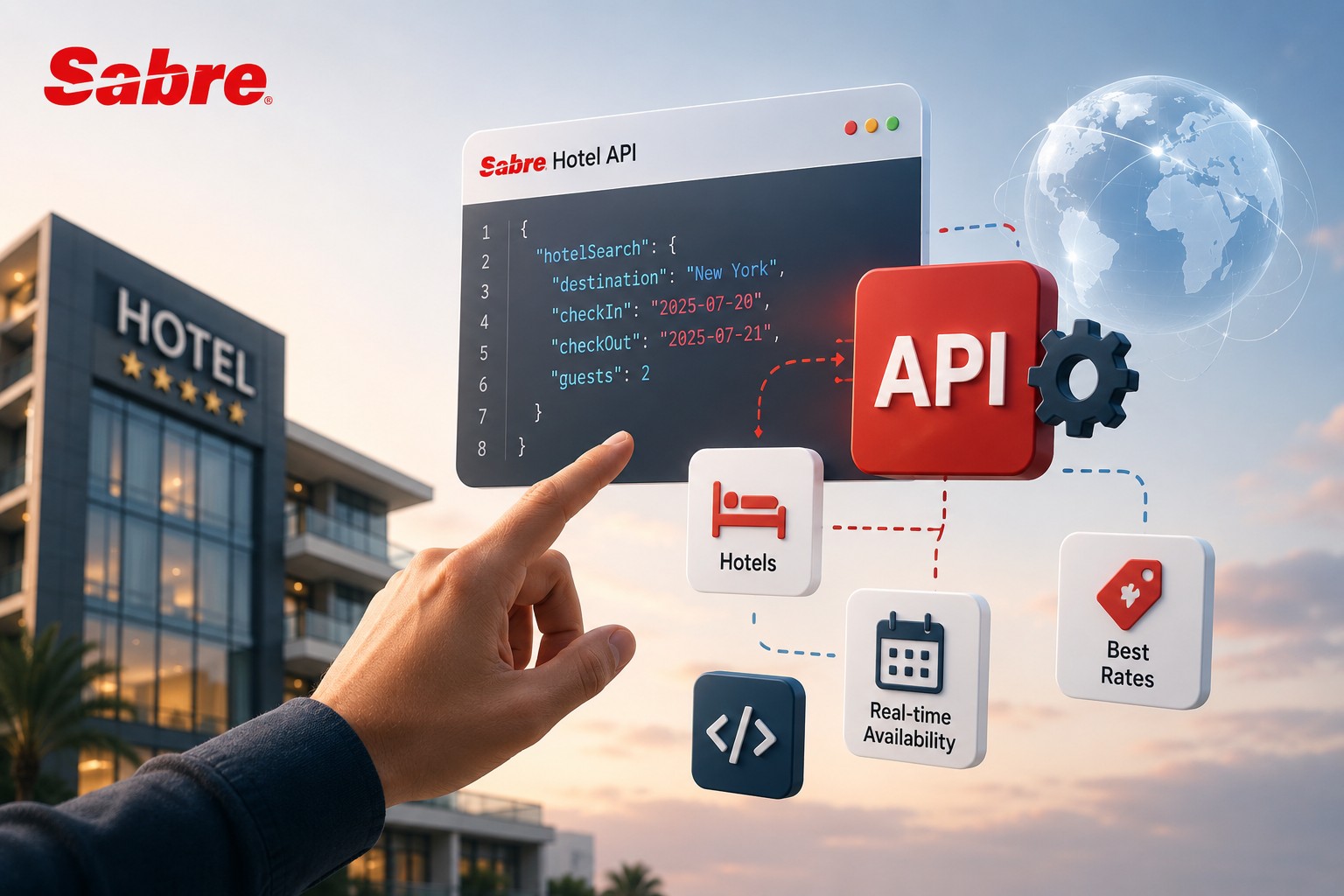


What Is Sabre? A Complete Guide to Sabre for Travel Businesses
If you've spent any time around airline reservations, hotel distribution, or travel agency technology, you've almost certainly run into the name Sabre. It's one of the three major global distribution systems (GDS) that quietly power a huge share of the world's flight, hotel, and car rental bookings — the other two being Amadeus and Travelport.
But for travel businesses evaluating their technology stack, "What is Sabre?" is really two separate questions. There's the legacy question — what is the Sabre GDS, and how does a travel agent use it to book a flight? And there's the modern question — how does Sabre work as an API layer that OTAs, TMCs, and booking platforms can build products on top of? This guide covers both, with an emphasis on the second, since that's where most travel technology decisions are actually made today.
What Is Sabre, Exactly?
Sabre began in the 1960s as a joint venture between American Airlines and IBM, built to automate airline seat inventory that was, until then, tracked largely by hand. That origin matters, because it explains why Sabre's data model still reflects decades of airline-industry conventions — PNRs, fare basis codes, and ATPCO-style pricing logic — even as the platform has expanded far beyond airline seats.
Today, Sabre operates as a global distribution system: a real-time marketplace that connects travel suppliers (airlines, hotel chains, car rental companies) with buyers (travel agencies, corporate booking tools, online travel platforms). Instead of every travel seller negotiating a direct connection with every airline and hotel chain, Sabre acts as the intermediary, normalizing inventory, availability, and pricing into a single system agents and applications can query.
For a retail travel agent, that experience shows up as Sabre Red 360, a desktop and browser-based workspace for searching fares, building itineraries, and issuing tickets. For a travel technology company building a booking platform, product, or OTA, that same underlying inventory is exposed through the Sabre APIs — a set of REST and SOAP services that let software query and book the same content programmatically.
Sabre GDS vs. Sabre API: Two Ways to Access the Same Network
This is the distinction that trips up a lot of people evaluating Sabre for the first time.
Sabre Red 360 (the GDS terminal) is built for human agents. It's a UI-driven workspace with command-line shortcuts, queue management, and PNR tools designed around an agent's daily workflow.
Sabre APIs are built for software. They expose the same underlying content — air shopping, hotel availability, car rentals, seat maps, ancillary services — as structured JSON or XML that a booking engine, OTA, or internal tool can consume directly.
A travel agency using Sabre Red 360 and a travel-tech company building a white-label booking platform on Sabre APIs are drawing from the same supplier network, but the integration effort, the technical skill set required, and the products you can build look completely different.
Key Sabre API Capabilities for Travel Businesses
For a travel business deciding whether to build on Sabre, the relevant question isn't "what can an agent do in Sabre Red 360" — it's "what can I build with the Sabre API." The core capabilities that matter most are:
Air shopping and booking. Low-fare search, availability, fare rules, seat maps, and ancillary bundling (bags, seats, priority boarding) across Sabre's airline content, including both traditional GDS fares and NDC-sourced offers where airlines have enabled them.
Hotel content. Property search, rate plans, and booking across Sabre's hotel supply, which can be combined with direct hotel APIs or a secondary hotel aggregator depending on how much coverage a platform needs.
Car rental. Availability and booking across major car rental brands, typically bundled into the same itinerary as flights for corporate and leisure trip packages.
Queue and PNR management. Programmatic access to booking records, ticketing status, and servicing actions — critical for TMCs and OTAs that need to modify or cancel bookings without manual agent intervention.
Sabre Dev Studio and sandbox access. A developer portal with API documentation, sandbox credentials, and testing tools, which is where most integration work actually begins before a business moves to production traffic.
What a Sabre Integration Actually Looks Like
Sabre's APIs are powerful, but they were not built with a single, modern, unified design philosophy — they've accreted over more than a decade, which means integration work benefits from the same architectural discipline you'd apply to any multi-supplier travel platform:
Supplier abstraction layer — wrapping Sabre alongside Amadeus, Travelport, or NDC-direct connections behind a common internal interface, so your booking engine isn't hard-wired to Sabre's specific request/response shapes.
Adapter pattern — translating Sabre's XML/JSON structures into your platform's normalized data model at the edge, rather than letting Sabre-specific formats leak into your core booking logic.
Circuit breakers and retry logic — Sabre, like any GDS, has rate limits and occasional latency spikes; production systems need graceful degradation rather than cascading failures.
Caching layers (commonly Redis) — for relatively static content like fare rules or hotel property details, to reduce redundant calls and stay within API quotas.
OAuth 2.0 token management — Sabre's REST APIs use token-based authentication with expiry windows that need to be handled centrally rather than per-request.
This layered approach isn't Sabre-specific busywork — it's what makes it realistic to later add Amadeus, Travelport, or NDC-direct airline connections without rebuilding your booking engine from scratch.
Sabre vs. Amadeus vs. Travelport
Travel businesses rarely pick a single GDS in isolation; the decision usually comes down to supplier coverage in target markets, existing agency relationships, and API maturity.
Sabre has particularly strong North American airline and corporate travel coverage, and Sabre Red 360 remains widely used among U.S. travel agencies and TMCs.
Amadeus tends to have deeper penetration in European and international markets, with a developer-friendly API platform that's often the first stop for travel-tech startups outside the U.S.
Travelport sits between the two in market share but maintains strong relationships with specific airline and hotel groups, making it relevant for businesses with particular regional or supplier needs.
In practice, many mid-size and enterprise travel platforms don't choose just one — they integrate multiple GDS providers behind a supplier abstraction layer (as shown above) and route bookings based on price, availability, or supplier reliability at query time.
Is Sabre Still Relevant in an NDC World?
Airlines' push toward NDC (New Distribution Capability) direct connections has raised real questions about the long-term role of traditional GDS platforms. But rather than displacing Sabre, NDC content is increasingly being distributed through Sabre itself — the GDS has repositioned as an aggregator of both traditional fares and NDC offers, giving travel businesses a single integration point for both content types instead of forcing a choice between GDS and NDC-direct connections.
For most travel businesses, that means Sabre isn't a legacy system to be replaced — it's one node in a broader multi-source distribution strategy that also includes NDC, hotel aggregators, and direct supplier APIs.
Getting Started with Sabre for Your Travel Platform
For a travel business evaluating Sabre, the practical starting point is Sabre Dev Studio: register for developer access, review the API documentation for the specific content types you need (air, hotel, car), and begin sandbox testing before requesting production credentials. Certification requirements and commercial terms vary depending on transaction volume and the type of business (OTA, TMC, DMC, or agency), so it's worth scoping those requirements early rather than after development is underway.
Whether Sabre becomes your primary GDS or one of several suppliers behind an abstraction layer, the integration effort is significant enough that most travel businesses benefit from planning the architecture — adapter layer, caching, failover to secondary suppliers — before writing the first line of integration code, rather than retrofitting it after launch.