
Travel CRM Development for Agencies: Build Smarter, Retain More
Travel CRM Development for Agencies: Build Smarter, Retain More
In the fiercely competitive travel industry, relationships are everything. A traveller who books once and never returns is an opportunity lost. A traveller who trusts your agency, refers friends, and keeps coming back year after year — that is the foundation of a sustainable travel business. The difference between these two outcomes often comes down to one thing: how well you manage customer relationships across the complete booking lifecycle.
That is exactly what travel CRM development is designed to solve. Whether you run a solo travel consultancy, a mid-size agency, or a large travel management company, a purpose-built CRM for travel agencies can transform how you capture leads, follow up with prospects, service existing clients, and grow revenue — all from a single platform built specifically for the travel industry.
In this guide, Teenva AI breaks down what travel CRM is, why generic tools fall short, what features to look for, and which businesses benefit most.
Table of Contents
- What Is Travel CRM Software?
- Why Generic CRM Falls Short for Travel Businesses
- Key Features of Travel CRM Software
- Top Benefits of Using a Travel CRM
- Who Needs a Travel CRM?
- Real-World Use Cases
- Travel CRM Dashboard — What You Should See
- Custom vs. Ready-Made Travel CRM Development
- How to Choose the Right Travel CRM
- FAQs
1. What Is Travel CRM Software?
Travel CRM (Customer Relationship Management) is a specialised software platform designed to help travel agencies, tour operators, travel management companies (TMCs), and independent agents manage every client interaction — from the first enquiry through booking, travel, and post-trip follow-up.
Unlike a generic CRM, travel CRM software is built around the unique workflows of the travel industry. It understands concepts like itinerary management, booking pipelines, visa follow-ups, passport tracking, group departures, and seasonal lead nurturing — workflows that simply do not exist in off-the-shelf sales tools designed for generic B2B environments.
In practical terms, a travel CRM is the central nervous system of a travel business. It stores every customer detail, tracks every quote, manages every follow-up, and ensures no lead slips through the cracks — whether you handle five enquiries a day or five hundred.
| Dimension | Detail |
|---|---|
| What it is | Purpose-built CRM software for the travel industry |
| What it manages | Leads, enquiries, quotes, bookings, documents, follow-ups, supplier coordination |
| Who uses it | Travel agencies, tour operators, OTAs, TMCs, DMCs |
| Core goal | Convert more leads, retain more clients, reduce manual work, grow revenue |
2. Why Generic CRM Falls Short for Travel Businesses
Many travel agencies begin their CRM journey by adapting Salesforce, Zoho, or HubSpot for their operations. The appeal is understandable — these are well-known platforms with large user bases. But travel businesses quickly hit a fundamental problem: these tools were designed for product-based B2B sales, not for the complex, document-heavy workflows that define travel and tourism.
The result is months of expensive customisation, disconnected data, and — most damagingly — lost leads during the gaps.
Here is what a generic CRM cannot do out of the box:
- Passport and visa deadline tracking — Generic CRMs have no concept of document expiry alerts. A travel CRM automatically flags clients whose passports expire within six months of a planned trip, preventing last-minute cancellations.
- Itinerary and quotation generation — No generic CRM includes a day-by-day itinerary builder connected to live hotel and flight supplier APIs. Agents using generic tools build quotes manually — a process taking 45–60 minutes per quote and prone to pricing errors.
- Group booking management — Managing 40 passengers on a corporate incentive trip, with individual passport tracking, rooming lists, and visa requirements, is practically impossible in a generic CRM without significant custom development.
- Seasonal pipeline management — Travel has pronounced seasonal demand patterns: Hajj season, school holidays, summer peaks. A travel booking CRM is designed to handle these fluctuations; generic tools are not.
- Native GDS and hotel API integration — Connecting a generic CRM to GDS platforms like Amadeus or Galileo requires custom development at significant cost.
- Post-trip retention automation — Automated anniversary reminders, birthday travel offers, and loyalty communications require travel-specific triggers that generic CRM automation engines simply do not support.
3. Key Features of Travel CRM Software
Not all travel CRM systems are equal. When evaluating the best CRM for travel agents and agencies, these are the core features that separate an enterprise-grade platform from a basic contact database.
3.1 Lead & Enquiry Management
The foundation of any effective travel agency CRM is how it handles the initial lead. Strong lead management captures every enquiry the moment it arrives and immediately routes it to the right consultant.
- Multi-channel capture from web forms, phone, email, WhatsApp Business API, Instagram DMs, and Facebook Lead Ads — all into a single inbox
- Automated lead assignment by destination expertise, product type, or current workload
- Lead source tracking and attribution — identifying which marketing channels generate the highest conversion rates
- Follow-up reminders and escalation rules — if a lead goes untouched for 24 hours, the system alerts the team manager
3.2 Customer Profile & History
Every client in a travel CRM has a rich, 360-degree profile — the foundation of genuine personalisation at scale.
- Complete travel history: past trips, destinations visited, preferred airlines, cabin class, accommodation category
- Document storage: passport copies, visa records, travel insurance certificates, loyalty card numbers
- Family and group profiles with shared booking history
- Dietary preferences, accessibility requirements, VIP flags, and custom notes
- Customer lifetime value tracking and booking frequency analysis
3.3 Quotation & Itinerary Builder
A travel agency CRM with a built-in itinerary and quotation builder transforms a 45-minute manual process into a 10-minute streamlined workflow.
- Drag-and-drop itinerary creation with day-by-day trip structure, hotel options, transfers, and activities
- Real-time pricing drawn from connected hotel booking APIs and GDS systems — no manual rate lookup
- Multiple quote versions per enquiry (budget, standard, luxury) — giving clients meaningful choice
- Branded PDF quote generation in seconds — client-ready, professional output
- Client-facing quote approval portal with one-click acceptance
3.4 Booking & Workflow Automation
Workflow automation is where travel CRM development delivers the most tangible competitive advantage — freeing agents from administrative tasks to focus on high-value advisory work.
- Automated email and WhatsApp sequences triggered by booking stage changes
- Payment reminder workflows for deposit due dates, balance payments, and final payment deadlines
- Visa application tracking with destination-specific document checklists and automated client alerts
- Pre-departure communication: packing lists, check-in reminders, airport transfer confirmations
- Post-trip follow-up: review requests, feedback surveys, and next trip suggestions
3.5 Document & Compliance Management
- Centralised secure storage for all travel documents — passports, visas, travel insurance
- Automated passport expiry alerts at 6-month, 3-month, and 1-month intervals
- Destination-specific visa requirement checklists per nationality
- Secure client portal for document uploads and retrieval
3.6 Integration Capabilities
A travel CRM integrated with your booking engine, travel portal, and accounting platform becomes a genuine growth engine.
- GDS integration: Amadeus, Galileo, Sabre for real-time flight availability and live fares
- Hotel API connectivity: Hotelbeds, Expedia, RateHawk, and 150+ hotel suppliers
- Accounting system synchronisation for GST-compliant invoicing and payment reconciliation
- WhatsApp Business API for conversational follow-ups — the preferred enquiry channel across India and the Middle East
- White-label travel solutions for sub-agents and franchise partners
4. Top Benefits of Using a Travel CRM
Implementing the right CRM for travel agencies delivers measurable results across every area of the business.
Higher Lead Conversion Rates
Most travel enquiries are lost not because the price was wrong, but because the follow-up was late or inconsistent. A travel booking CRM automates sales sequences, sends agent reminders, and ensures every prospect receives timely, personalised communication — typically lifting conversion rates by 20–35% within the first 90 days.
Improved Customer Retention
Acquiring a new travel client costs five to seven times more than retaining an existing one. Travel CRM software enables proactive retention through anniversary trip reminders, birthday greetings, early-bird offers for returning travellers, and loyalty programme management. Agencies using CRM-driven retention report repeat booking rates 40% higher than those relying on manual outreach.
Reduced Manual Work & Agent Burnout
Travel agents spend a disproportionate amount of time on administrative tasks: writing emails, updating spreadsheets, chasing documents, building quotes manually. A travel CRM system automates all of this through workflow automation, freeing agents to focus on advisory conversations. Agencies report saving an average of 12–18 hours per agent per week after full CRM adoption.
Complete Business Visibility
Without a CRM, agency owners rely on WhatsApp threads and gut instinct to understand their pipeline. With a travel CRM dashboard, every metric is visible in real time: active leads, agent performance, top-selling destinations, and confirmed revenue expected next month.
Faster Quotation & Reduced Error Rate
A travel agency CRM with an integrated quotation generator powered by live supplier API pricing reduces quote preparation time from 45–60 minutes to under 10 minutes, while eliminating pricing errors that damage client trust.
Scalability Without Adding Headcount
The best travel CRM solutions are built to scale — from a 2-person boutique agency to a 500-agent travel management company — without changing platforms or rebuilding workflows. Industry data shows businesses using CRM software report an average 29% increase in sales.
5. Who Needs a Travel CRM?
Travel CRM software is not a luxury reserved for large enterprises. Any travel business managing client relationships and a sales pipeline will benefit.
| Business Type | How Travel CRM Helps |
|---|---|
| Independent Travel Agents | Manage all client contacts, quotes, and follow-ups from one platform — no spreadsheets, no missed follow-ups |
| Travel Agencies (SME) | Coordinate team pipelines, assign leads intelligently, track agent performance, automate client communication |
| Tour Operators | Manage group bookings, multi-passenger itineraries, departure logistics, and supplier coordination |
| Travel Management Companies (TMC) | Handle corporate travel accounts, policy compliance, and multi-department reporting |
| DMCs (B2B) | Track B2B partner enquiries, group requests, and supplier coordination for the wholesale market |
| Online Travel Agencies (OTA) | Integrate with booking engine to convert online enquiries into managed relationships |
| Luxury & Niche Specialists | Maintain detailed VIP client profiles and personalise every interaction |
6. Real-World Use Cases
Use Case 1: The Forgotten Follow-Up (Solved)
A potential client enquires about a Maldives honeymoon package in March. The agent sends a quote but the client asks for more time. Two weeks pass. Without a CRM, the agent forgets. With a travel CRM, an automated reminder fires on day 7 and day 14 with a personalised follow-up message. The client books — a conversion that would have been lost to a competitor without the system's sales automation.
Use Case 2: The Returning Traveller (Retained)
A family completes a Europe trip in July. The travel CRM records everything — hotels they loved, preferred airline, children's ages. In January, the CRM triggers an automated message: "Your Europe adventure was six months ago! Ready to explore Southeast Asia as a family?" Personalised, timely, relevant. This is customer retention through automated customer lifecycle management.
Use Case 3: The Group Booking Nightmare (Organised)
A corporate client requests a 40-person incentive trip to Dubai. Passports, visa applications, rooming lists, dietary requirements — managing this in email threads is a recipe for errors. In a travel management system powered by a travel CRM, every passenger has a profile, every document is tracked with deadline alerts, and every milestone triggers an automated notification. The trip runs flawlessly — and the corporate client books again next year.
Use Case 4: The Seasonal Rush (Managed)
Summer holidays create a flood of simultaneous enquiries that overwhelm agencies without systems. A CRM for travel agencies distributes incoming leads automatically based on agent availability and expertise, ensures every enquiry is worked in priority order, and prevents multiple agents contacting the same client. Peak season becomes manageable and profitable instead of chaotic.
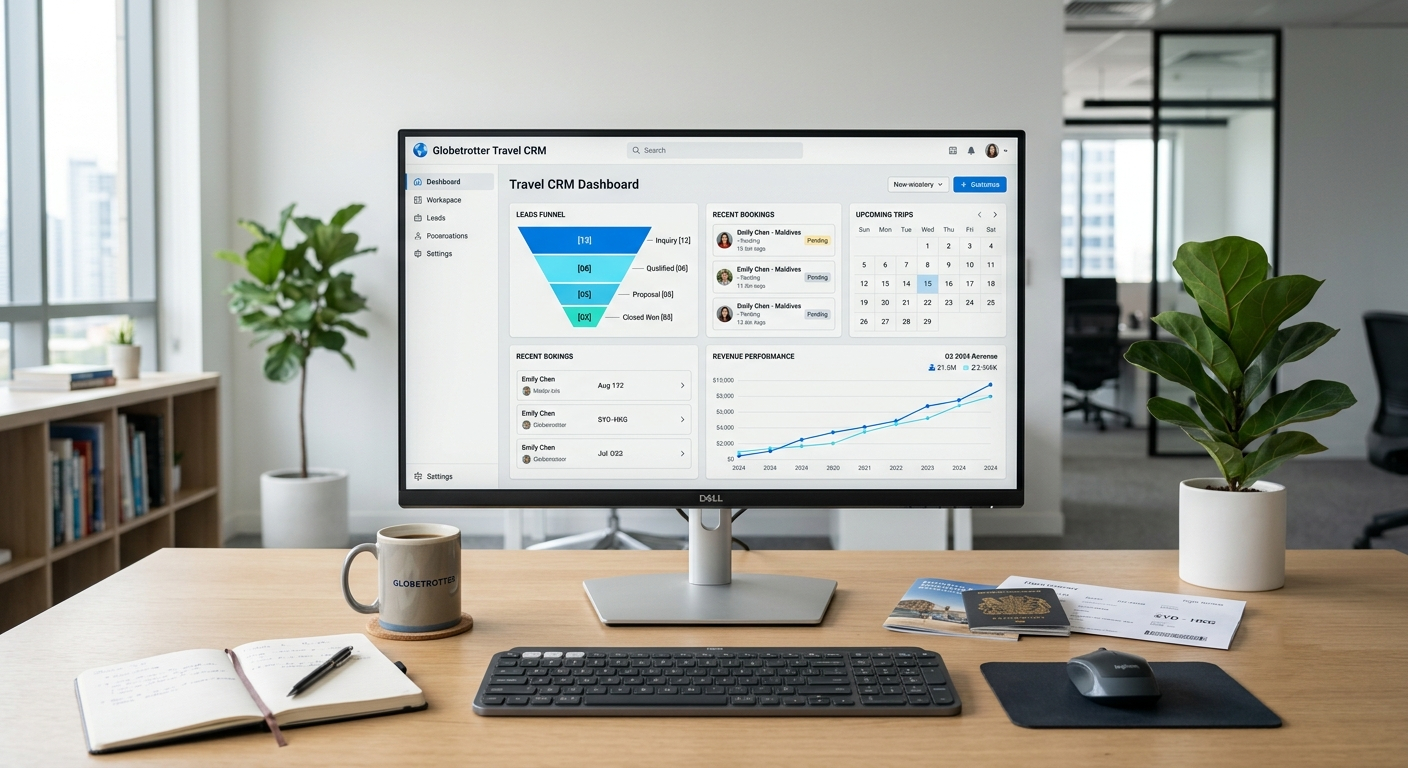
7. Travel CRM Dashboard — What You Should See
The travel CRM dashboard is the real-time command centre of your travel business. A well-designed dashboard eliminates the need for daily status meetings, manual reports, and WhatsApp group updates. Here is what the best travel CRM solutions display:
- Pipeline overview — Total leads by stage (New → Quoted → Negotiating → Booked → Completed) with conversion rates at every stage
- Today's tasks — All follow-ups, calls, and document submissions due today, prioritised by urgency
- Revenue tracker — Confirmed bookings this month versus target, pipeline value, and trend charts
- Agent performance — Leads handled, quotes sent, bookings confirmed, and revenue generated per consultant
- Lead source breakdown — Which channel is driving the most valuable enquiries this week
- Upcoming departures — All trips departing in the next 7, 14, and 30 days
- Overdue actions — Enquiries with no follow-up in the last 48 hours, flagged for manager attention
- Document alerts — Clients with passports expiring within 6 months
A good travel CRM dashboard should answer three questions in under 30 seconds: How is my pipeline performing? What does my team need to do today? Are we on track to hit our monthly revenue target?
8. Custom vs. Ready-Made Travel CRM Development
For travel companies with unique operational requirements, off-the-shelf solutions may not meet every need. Custom travel CRM development — building a bespoke platform — is a growing trend among larger agencies, DMCs, and travel technology companies that need to differentiate their customer experience or offer white-label capabilities to partner networks.
When to Consider Custom Travel CRM Development
- Your business has complex, non-standard booking workflows not supported by any ready-made tool
- You need deep integration with proprietary internal systems or legacy platforms
- You operate across multiple countries with different currencies, languages, and compliance requirements
- You want to offer white-label CRM capabilities to sub-agents or franchise partners as a revenue stream
- You require AI-driven lead scoring or unique reporting tailored to your specific market
Custom vs. Ready-Made — Comparison
| Factor | Custom CRM Development | Ready-Made Travel CRM |
|---|---|---|
| Time to deploy | 4–12 months | Days to 2–4 weeks |
| Upfront cost | High (development investment) | Low to medium (SaaS subscription) |
| Flexibility | Unlimited customisation | Configuration within platform limits |
| Maintenance | Internal team or partner | Vendor-managed |
| Best for | Large agencies, DMCs, TMCs with complex needs | SME and growing travel agencies |
9. How to Choose the Right Travel CRM
With dozens of options available — from generic tools to purpose-built travel agency software platforms — choosing the best travel CRM requires evaluating criteria that go beyond feature lists.
Evaluation Checklist
| Evaluation Criteria | What to Look For |
|---|---|
| Travel-specific workflows | Lead-to-booking pipeline designed for travel — not generic sales stages |
| Itinerary & quotation builder | Built-in, branded, with API-connected live pricing |
| Document management | Passport tracking, visa alerts, and secure client portal |
| Automation capabilities | Email, WhatsApp, and task automation triggered by booking events |
| API integrations | GDS, hotel suppliers, payment gateways, accounting tools |
| Mobile access | Full functionality on mobile — not stripped-down |
| Reporting & dashboard | Real-time pipeline, agent performance, and revenue reporting |
| Scalability | Works for 2 agents today and 200 agents in two years |
| Support & training | Dedicated onboarding, training materials, and ongoing support |
| India-specific features | GST invoicing, INR currency, WhatsApp integration, local compliance |
Red Flags to Avoid
- No travel-specific fields out of the box — requires expensive customisation before the system is useful
- No API integration with hotel and flight suppliers — agents will still build quotes manually in parallel systems
- Per-user pricing that scales poorly — always check total cost of ownership at 10x your current team size
- No mobile app or limited mobile functionality — travel agents are not always at a desk
- Long implementation timelines and poor support — a CRM that takes six months to deploy is a liability, not an asset
10. Frequently Asked Questions
What is the difference between a travel CRM and a generic CRM? A generic CRM is built for product-based B2B sales. A travel CRM is built specifically for the travel industry — with pre-configured workflows for itinerary building, passport tracking, group booking management, GDS integration, seasonal pipeline management, and post-trip retention. Using a generic CRM for travel requires months of expensive customisation to approximate what a travel-specific platform provides on day one.
How long does travel CRM development take? A ready-made travel CRM can be deployed in days to two to four weeks. Custom travel CRM development — building a bespoke platform with unique integrations, white-label capabilities, or complex workflows — typically takes four to twelve months depending on scope and complexity.
Which travel businesses benefit most from a CRM? Any travel business managing client relationships and a sales pipeline benefits from a travel CRM. This includes independent travel agents, SME agencies, tour operators, DMCs, TMCs, OTAs, and luxury travel specialists. The ROI is strongest for agencies handling more than 20–30 enquiries per month, where manual follow-up systems break down.
Can a travel CRM integrate with GDS platforms like Amadeus or Sabre? Yes. Purpose-built travel CRM platforms — including Teenva AI's solutions — support native integration with major GDS platforms and 150+ hotel and activity supplier APIs, enabling agents to generate live-priced quotes directly within the CRM without switching systems.
Does a travel CRM support WhatsApp for client communication? Yes. Modern travel CRM platforms support WhatsApp Business API integration, enabling automated follow-up sequences, booking confirmations, pre-departure communications, and document requests via WhatsApp — the preferred enquiry channel across India and the Middle East.
Ready to Build or Upgrade Your Travel CRM?
Teenva AI specialises in travel technology development — including purpose-built travel CRM software, B2B booking engines, B2C travel portals, and white-label travel solutions for agencies across India and globally.
Whether you need a ready-to-deploy CRM or a fully custom travel CRM development engagement, our team brings over a decade of travel technology expertise to every project.
Get in touch with the Teenva AI team:
- 📧 sales@teenvaai.com
- 📞 +91 9572020107
- 🌐 teenvaai.com