

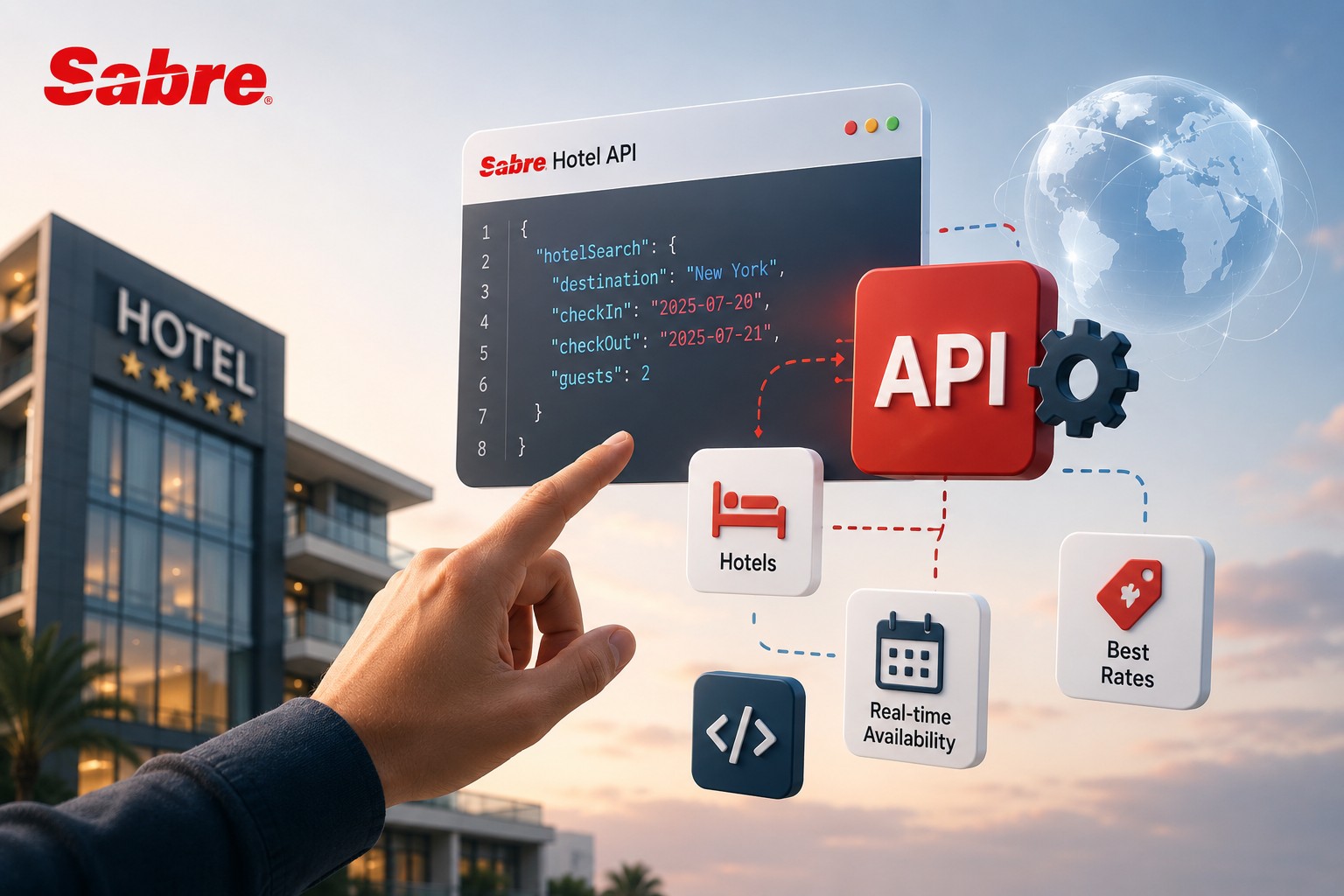
Sabre Hotel API: Complete Guide for Developers
Hotel distribution is a different animal from flight distribution. Rates change by the minute, room inventory is fragmented across thousands of independent properties and chains, and a single search can return dozens of rate plans for the same room. The Sabre Hotel API exists to bring that complexity into one predictable interface, giving OTAs, TMCs, DMCs, and travel agencies programmatic access to hotel content, live availability, and booking functionality from a single GDS connection.
If your team already integrates with Sabre for flights, extending into hotels feels familiar — the same OAuth2 foundation, the same REST conventions — but hotel-specific workflows around content caching, rate shopping, and multi-property search introduce their own set of design decisions. This guide walks through what the Sabre Hotel API actually does, how the core endpoints fit together, and the integration practices that keep a hotel booking platform fast, accurate, and cost-efficient.
What the Sabre Hotel API Actually Covers
The Sabre Hotel API isn't a single endpoint — it's a family of services that together cover the full hotel booking lifecycle:
Hotel Content APIs return static, slow-changing property data: hotel name, address, geolocation, star rating, amenities, images, and descriptive text. This data is ideal for local caching since it rarely changes intraday.
Hotel Availability / Shop APIs return live, dynamic data: which rooms are sellable for a given date range, at what rate, under which rate plan or negotiated fare. This data must always be fetched fresh at or near the point of booking.
Hotel Booking APIs create, retrieve, modify, and cancel a hotel reservation (a PNR segment), and typically also confirm the final rate and cancellation policy before commit.
Separating "what a hotel is" from "what a hotel currently costs" is the single most important mental model for building against this API efficiently — it directly shapes your caching strategy.
Authentication: The Same OAuth2 Foundation
Like the rest of the Sabre REST platform, hotel endpoints authenticate through OAuth2 using the client credentials grant. You exchange your client ID and secret for a bearer token, and that token is attached to every subsequent request.
A few practices matter more for hotel workloads specifically:
Cache the token, don't refetch it. A token is typically valid for 30–60 minutes, so requesting a new one before every hotel search call adds unnecessary latency and pushes you closer to rate limits. Store it in memory or a fast cache like Redis and reuse it until it expires or a request returns a 401.
Separate CERT and PROD credentials cleanly. Sabre's certification (CERT) environment lets you validate hotel search, pricing, and booking flows without touching live inventory. Only move to production credentials after your team has completed internal QA and passed certification.
Rotate and store secrets securely. Use environment variables in development and a secrets manager (like AWS Secrets Manager or HashiCorp Vault) in production — never commit hotel API credentials to a repository.
Core Workflow: Search to Book
A typical hotel booking flow through the API follows a predictable sequence, but each step depends on the previous one returning valid, unexpired data — hotel rates in particular can change or sell out between the search and the final booking call.
The re-confirmation step before final booking is not optional. Hotel inventory and rates shift far more frequently than flight fares, so always re-price the selected room immediately before charging the guest, and surface a clear message if the rate has changed rather than silently booking a different price.
Optimizing Hotel Search Performance
Hotel search is the highest-traffic, highest-cost endpoint in most integrations, so efficiency here has a direct impact on both user experience and your Sabre usage bill.
Cache static content aggressively. Hotel descriptions, images, and amenities can be refreshed on a daily or weekly cycle rather than pulled on every search.
Never cache live rates and availability. Prices and room status must be fetched fresh for every search and re-verified before booking.
Paginate and progressively load results. Return an initial batch of hotels sorted by relevance or price, then fetch additional results as the user scrolls or adjusts filters, instead of requesting everything upfront.
Validate inputs before calling the API. Check that check-in is before check-out, dates aren't in the past, and city or property codes are valid — this avoids wasted calls that fail downstream.
Batch and stagger multi-property searches. If you're shopping many hotels in a destination, spread the calls rather than firing them all simultaneously, which helps you stay within your commercial rate limits.
Error Handling and Rate Limits
Hotel APIs fail for reasons unique to the vertical — a room sells out between search and booking, a rate plan is withdrawn, or a property temporarily stops returning content. Your integration should treat these as expected, not exceptional, events:
Retry 5xx server errors with exponential backoff.
On a sold-out or repriced room, prompt the user to select an alternative rather than showing a generic failure.
Log booking failures with the hotel ID, rate plan, and error code so you can spot patterns — certain chains or markets are often more failure-prone than others.
Monitor your call volume against Sabre's commercial rate limits using response headers, and alert your team before you approach the ceiling.
Data Normalization for a Better Booking Experience
Raw hotel API responses carry far more detail than any front end needs, and presenting it well matters as much as fetching it correctly:
Normalize amenity codes and room type descriptions into consistent, human-readable labels across every supplier your platform touches.
Break fares down clearly — base rate, taxes, resort fees, and any markup — so guests understand exactly what they're paying for at checkout.
Display cancellation policies prominently, since hotel rate plans vary widely between refundable and non-refundable terms.
Use city and property autocomplete to reduce mistyped destinations, which is one of the most common sources of empty search results.
Building It the Right Way
Structure your integration into clear modules — content retrieval, availability/shop, pricing confirmation, and booking — rather than one large service. This keeps token-refresh logic, error handling, and response parsing reusable across each part of the flow, and makes it far easier to isolate issues when Sabre changes a response field or deprecates an endpoint version.
Before going live, confirm that:
Content, shop, and booking flows are all tested end-to-end in the CERT environment.
Token caching and refresh logic behave correctly under load.
Bookings have been tested across multiple hotel chains and rate plan types.
Rate re-confirmation happens immediately before every booking call.
Logging, monitoring, and failure alerting are active.
Sensitive data — payment details and guest information — is masked in logs.
Final Thoughts
The Sabre Hotel API gives travel platforms direct access to a vast, constantly shifting hotel inventory, but the real engineering work lies in how you separate static content from live pricing, handle the inevitable rate changes between search and booking, and keep your integration resilient under real-world traffic. Get those fundamentals right, and hotel search stops being your platform's weakest link and becomes one of its strongest conversion points.
At Teenva AI & Digital Ventures, we build API integrations and booking platform architecture for OTAs, TMCs, DMCs, and travel agencies — including Sabre-certified hotel integrations from initial sandbox setup through production deployment. If you're planning to build or scale a hotel booking engine on Sabre, reach out to our team at sales@teenvaai.com or +91 9572020107 for architecture guidance and implementation support.