
Sabre APIs: Complete Guide for Developers
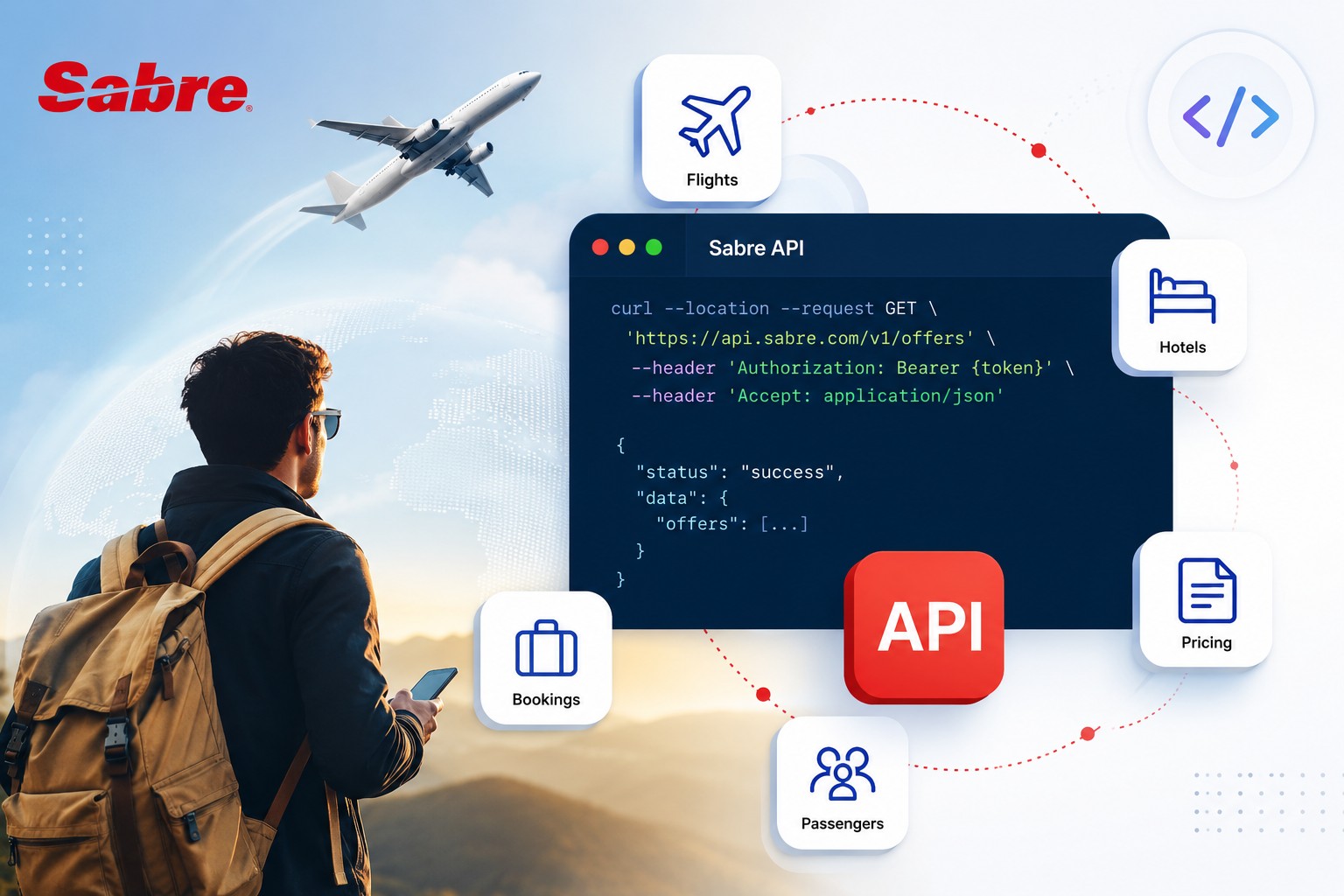
Sabre is one of the "Big Three" global distribution systems, alongside Amadeus and Travelport, and together these three GDSs handle the vast majority of global airline and hotel distribution. For OTAs, TMCs, DMCs, and travel agencies, connecting to Sabre APIs opens access to airline inventory, hotel content, car rentals, and rail options through a single integration point — rather than negotiating hundreds of individual supplier contracts.
But Sabre is also a legacy platform built up over more than six decades, and that history shows in its API catalog. Developers who go into a Sabre integration expecting a lightweight, modern REST experience are often surprised by how much SOAP infrastructure, business negotiation, and certification work stands between "we want to integrate" and "we're live."
This guide walks through what a Sabre API integration actually involves in 2026: the business prerequisites, the credentialing process, the API architecture choices, the core booking flows, and the certification gate you'll need to pass before going live.
What Sabre APIs Cover
Sabre's API catalog is organized around four major content verticals:
Air APIs — flight content from hundreds of airlines, including low-cost carriers and NDC-enabled carriers
Hotel APIs — access to a large global inventory of lodging options
Car APIs — car rental shopping across dozens of rental brands and tens of thousands of pickup locations
Rail APIs — ticketing access to numerous rail operators, primarily in Europe
Beyond raw content access, Sabre also packages many of its APIs into predefined workflows — documented sequences of calls that implement common processes like air booking, low-cost-carrier booking, or NDC shopping and servicing end-to-end. Using these workflows where available can meaningfully shorten development time compared to composing the same sequence from individual endpoints.
Business Prerequisites Before You Write a Line of Code
Sabre integration doesn't start in a code editor — it starts with a business relationship. Before your team gets meaningful API access, your company needs to satisfy Sabre's eligibility requirements.
At a minimum, expect to provide:
Proof that you operate as a legitimate, registered business entity
Evidence of past operating performance, if you're an established agency
Relevant industry accreditation
On accreditation specifically, ticketing agencies selling air travel in the US typically need an Airline Reporting Corporation (ARC) number, while agencies operating outside the US need an IATA number tied to IATA's Billing and Settlement Plan. Agencies without either can often still operate by booking under a host agency's or consolidator's credentials. Depending on your state or country, you may also need additional regional licensing — in the US, for instance, California, Florida, Washington, and Hawaii each maintain their own Seller of Travel requirements.
Once your credentials are in order, the typical path to production access looks like this:
Submit an intake request through Sabre's developer contact channel, including your company details, accreditation numbers, and projected booking volumes.
Negotiate your API scope and target region. Sabre configures accounts around specific APIs and geographic markets — searching outside your negotiated region can return incomplete or stale content, so scope this carefully upfront.
Sign a commercial contract covering pricing, liability, and usage terms.
Receive your account credentials and a dedicated account manager to guide setup.
Expanding your access later — a new API, a new region — means going back through steps 2–4, which can take additional weeks to months. It pays to think through your full roadmap before the initial negotiation rather than treating access as something you can casually expand later.
Understanding Sabre's Credential Model
Sabre's credentialing system is more layered than a typical REST API's single API key. The core identifiers you'll work with are:
Credential | Purpose |
|---|---|
PCC / iPCC | Pseudo City Code — defines your organization's permissions, region, and Sabre environment. iPCCs are typically issued to OTAs for API-only access. |
EPR (Employee Profile Record) | An individual profile tied to a PCC/iPCC that governs what a specific user or system can do |
Client ID | A unique identifier for applications consuming Sabre APIs, used for usage tracking |
Client Secret | The private key controlling access to a given Client ID |
Client ID and Client Secret are technically optional in many setups, but Sabre recommends using them, particularly if multiple applications share a single PCC — they make it much easier to isolate performance issues and monitor usage per application.
If you're not ready to formalize a business relationship yet, Sabre Dev Studio lets you register for a free account and get test credentials for a sandbox environment. This is enough to prototype against publicly available REST APIs with mock data, though you'll eventually need a signed contract to move past the sandbox stage.
SOAP vs REST: A Less Obvious Choice Than It Looks
Most developers today default to REST, and Sabre does offer a substantial REST catalog. But Sabre's SOAP APIs still significantly outnumber its REST APIs, and SOAP APIs often come with more mature, better-documented SDKs.
This has practical implications for your team composition:
PHP, .NET, and Java developers tend to have an easier time with Sabre's SOAP APIs, since these ecosystems have strong native SOAP tooling.
JavaScript and TypeScript developers can absolutely work with Sabre, but should expect more custom handling, since these languages have less out-of-the-box support for older SOAP conventions.
The right choice usually comes down to which APIs your target functionality actually requires — for some Air content, SOAP may still be your only or best-supported option — rather than a blanket architectural preference.
The Skills Your Development Team Actually Needs
Programming language proficiency matters less for Sabre integration than most teams expect — Sabre supports a wide range of languages. What matters more is a combination of API fluency and travel domain knowledge. Developers who understand concepts like:
Passenger Name Records (PNR)
Ticketing and interlining
Connecting flights and codeshares
Dynamic pricing and ancillary services
...will move through Sabre's documentation and error messages far faster than generalist API developers. Sabre maintains a Developer Partner Directory of certified integration partners specifically because this domain expertise materially shortens time-to-launch and reduces costly early architectural mistakes.
Expect some amount of trial-and-error regardless of team experience. Not every edge case is documented, and Sabre support response times can range from hours to a few days for non-trivial issues.
Automating the Flight Booking Flow
A production flight booking integration typically chains together several API calls in sequence:
A few details worth planning for:
Bookings are usually held for 24 hours before payment and ticketing are required by default, though this window can sometimes be negotiated (some agencies secure 48 hours).
If your organization isn't accredited for air ticketing directly, bookings are typically made under your own credentials while ticketing runs through a host agency's IDs — this requires specific configuration so the host agency can view and modify PNRs your system creates.
Changes and cancellations require a separate set of APIs to modify PNRs, remove segments, and calculate penalties. Because these events happen far less often than new bookings, many teams start by handling them manually through the Sabre agent portal and only automate later.
Automating the Hotel Booking Flow
Hotel booking is structurally simpler than flight booking since there's no ticketing step involved. The bigger challenge tends to be content quality rather than process complexity. GDSs generally weren't built with rich, consumer-grade hotel content as a priority — expect limited descriptions and lower-resolution property images compared to dedicated hotel content providers. Many teams supplement Sabre's hotel content with imagery and descriptions from other suppliers to meet modern user expectations.
Working With NDC Content Through Sabre
For airlines offering New Distribution Capability (NDC) content, Sabre provides an end-to-end workflow covering NDC shopping, order creation, and post-booking servicing. This includes operations like updating passenger details, displaying seat maps, adding or removing ancillaries, reshopping itineraries, exchanging tickets, and cancelling orders. As more airlines expand their NDC partnerships with Sabre, this workflow's coverage continues to grow, making it worth revisiting periodically even after your initial integration is complete.
Certification: The Final Gate Before Going Live
Passing functional testing in your own environment isn't the finish line. Before you can process real transactions, Sabre requires a formal certification process, during which Sabre specialists review your test environment to confirm that your request/response sequences behave correctly across the full shopping-to-booking flow.
Plan for this phase to take four to eight weeks. Once certification is complete, Sabre issues production credentials and you can begin live operations.
Taking the full picture into account — from intake form submission to production launch — a Sabre integration commonly spans anywhere from several months to a full year, depending on API scope and team experience.
Key Takeaways
Sabre integration starts with a business relationship, not a code repository — budget time for accreditation, contracting, and credential provisioning before development begins.
The credential model (PCC/iPCC, EPR, Client ID/Secret) is more layered than a typical single-key REST API, and it's worth understanding before you architect your auth layer.
SOAP still dominates Sabre's catalog numerically and often has better SDK support, so don't assume REST-only tooling covers everything you'll need.
Domain expertise in travel concepts like PNRs and interlining shortens development time as much as raw API familiarity does.
Certification is a mandatory four-to-eight-week gate before go-live — build it into your project timeline from day one, not as an afterthought.
For businesses building or scaling GDS-connected booking platforms, having a technology partner who has navigated Sabre's certification process before can meaningfully shorten this timeline and reduce avoidable rework.
Need help architecting your Sabre API integration? Teenva AI & Digital Ventures builds API integrations and booking platform architecture for OTAs, TMCs, DMCs, and travel agencies. Reach out at sales@teenvaai.com or +91 9572020107 to discuss your project.