
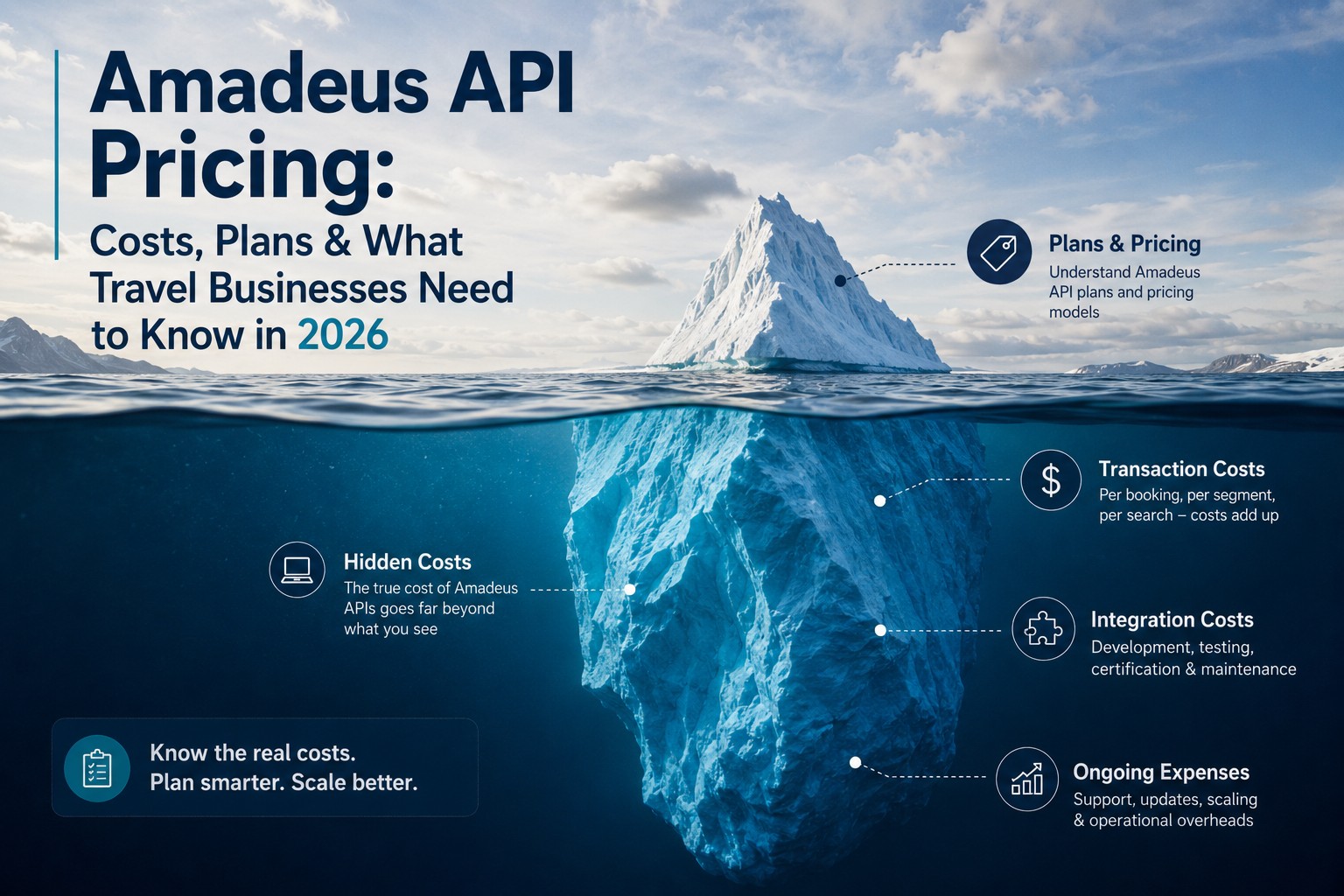
Amadeus API Pricing: Costs, Plans & What Travel Businesses Need to Know in 2026
If you're building or scaling a travel platform, you've probably run into the same wall every OTA, TMC, and DMC hits eventually: Amadeus doesn't publish a price list. There's no pricing page, no calculator, no "starts at" figure you can drop into a budget spreadsheet. Amadeus API pricing is negotiated, tiered, and shaped by dozens of variables — which makes it genuinely hard to plan around if you haven't been through the process before.
This guide breaks down what actually drives Amadeus API pricing in 2026, what a realistic budget looks like at different business stages, and where the hidden costs tend to hide.
Why Amadeus Doesn't Publish a Price List
Amadeus operates on a traditional GDS commercial model, which has always worked differently from typical SaaS pricing. Instead of flat subscription tiers, contracts are built around your expected transaction volume, the specific APIs you need, your target markets, and your negotiating position. A five-person startup validating an MVP and a 200-agent TMC processing thousands of PNRs a month are simply not quoted the same way — and Amadeus prefers to structure that difference through direct negotiation rather than a public rate card.
That said, the components that make up an Amadeus contract are fairly consistent across the industry, even if the numbers attached to each one vary.
The Core Components of Amadeus API Pricing
1. Setup and Onboarding Fees
Most traditional GDS agreements include a one-time setup or provisioning fee, covering sandbox access, account configuration, and certification support. This is typically a smaller line item relative to ongoing costs, but it's rarely waived entirely for full production access.
2. Monthly or Annual Minimums
This is the part that catches new platforms off guard. Amadeus contracts commonly include a commercial floor — a minimum fee you pay whether or not you hit that volume in bookings. It exists to protect Amadeus's revenue from low-activity accounts, and it means your actual monthly cost rarely drops below a baseline, even in a quiet season.
3. Per-Segment Booking Fees
The variable core of Amadeus API pricing is the per-segment fee charged on each ticketed flight segment (not searches, not abandoned carts — confirmed segments). This is tiered: lower-volume accounts pay more per segment, and the rate improves as your booking volume scales. This tiering is the single biggest lever you have for improving unit economics as your platform grows.
4. Certification Fees
Traditional GDS APIs require Amadeus-administered certification before you go live in production — essentially a technical and operational review to confirm your integration behaves correctly. This is usually a one-time cost, though re-certification can apply after major platform changes. Amadeus's newer, more modern API tier (built for REST-based, self-service integration) often carries lighter or no certification requirements, which is worth factoring into your tier decision.
5. Support and Development Fees
Standard support is generally bundled into the commercial agreement, but premium support — faster response times, a dedicated technical contact — usually costs extra. Custom development assistance from Amadeus's engineering team, if you need it for a complex use case, is typically billed hourly or per project.
Diagram: Where Your Amadeus Costs Actually Come From
Pricing Models: Pay-Per-Use vs. Subscription-Style Contracts
Amadeus contracts generally fall into one of two shapes:
Pay-per-use / transaction-based — you're charged per segment or per confirmed booking, with a minimum floor. This tends to suit platforms still validating volume, since costs scale (roughly) with activity.
Volume-committed / subscription-style — you commit to a minimum volume or multi-year term upfront in exchange for a lower per-segment rate. This suits established platforms with predictable, growing booking volume, since the discount on unit economics usually outweighs the commitment risk.
Neither model is universally "cheaper" — the right one depends on how predictable and how large your booking volume already is.
Traditional GDS API vs. Amadeus's Modern API Tier
Amadeus offers both its legacy GDS API (the traditional, certification-heavy route most established agencies are already on) and a newer REST-based API tier aimed at platforms that want faster, lighter integration. The modern tier generally involves:
Shorter integration timelines (weeks rather than months)
Lighter or no certification burden
Commercial terms that are often more accessible for newer or smaller platforms
If you're starting fresh and don't have a legacy dependency on the traditional GDS stack, it's worth explicitly asking your Amadeus contact which tier fits your use case — the pricing conversation can look quite different depending on which one you land on.
The Hidden Costs Nobody Puts in the Budget
The quoted Amadeus contract price is rarely the full story. The costs that tend to get underestimated:
Engineering time. Traditional GDS integration is a genuine multi-month engineering project, not a weekend API key setup. Certification alone typically involves several test cycles before you clear production access.
Ongoing maintenance. GDS APIs evolve, and someone on your team needs to own keeping the integration current — this is an ongoing capacity commitment, not a one-time build.
Infrastructure. Hosting, monitoring, logging, and caching infrastructure to support a production travel booking flow adds up, especially at scale.
Compliance. PCI-DSS compliance for payment handling and periodic security review are recurring costs tied to running a live booking platform, not to Amadeus specifically — but they're triggered by going live with real transactions.
Any realistic Amadeus API pricing conversation should be framed as total cost of ownership over a multi-year horizon, not just the number on the contract.
How to Get an Accurate Quote
Because pricing isn't published, the fastest way to a real number is to go into the conversation with Amadeus (or an integration partner) with clear answers to:
What's your expected monthly/annual segment volume, realistically — not aspirationally?
Which specific APIs do you need — flights only, or hotels and cars too?
Which markets are you serving, since regional terms can differ?
Are you a good fit for the traditional GDS tier or the modern API tier?
Vague volume estimates tend to produce vague quotes. Precise ones get you a contract that actually reflects your business.
Ways to Keep Amadeus API Costs Under Control
Negotiate volume tiers proactively. Don't wait for a renewal to raise your actual volume growth — bring it to the account team as leverage.
Cache aggressively. Reducing duplicate search calls for popular routes can meaningfully cut your effective API spend.
Improve search-to-booking conversion. Since minimums and segment fees are tied to bookings, a better-converting funnel directly improves your unit economics.
Revisit your tier choice periodically. As Amadeus's modern API tier matures, it's worth re-checking whether it now fits a use case that previously required the traditional GDS path.
Benchmark against alternatives at renewal. Even if you stay with Amadeus, having a current view of what modern aggregators or other GDS providers would charge strengthens your negotiating position.
Frequently Asked Questions
Is Amadeus API pricing the same for every business? No. Pricing is negotiated based on volume, API scope, market, and contract term — there's no fixed public rate.
What's the minimum I should budget to get started? Budget for a setup fee, a recurring monthly minimum regardless of volume, and per-segment fees on top. Exact figures depend on your negotiated contract, but plan for a real commercial floor, not just usage-based costs.
Is the modern Amadeus API tier cheaper than the traditional GDS API? It's often more accessible for smaller or newer platforms, with lighter certification requirements and faster integration — but "cheaper" depends on your specific volume and use case.
Do per-segment fees ever go down? Yes — this is the main lever. Higher confirmed volume moves you into better pricing tiers, so the fee typically decreases as your platform scales.
Should I compare Amadeus to modern flight API aggregators before committing? It's worth doing, even if you ultimately choose Amadeus. Understanding alternative pricing structures gives you a clearer picture of what you're trading off, and stronger footing in negotiations.
Planning an Amadeus integration and want help scoping the real cost of ownership? Teenva AI & Digital Ventures works with OTAs, TMCs, DMCs, and travel agencies on GDS and NDC integration architecture — reach out at sales@teenvaai.com or +91 9572020107.