
How to Build a Scalable OTA Platform
Introduction
The online travel industry processes billions of search queries and millions of bookings every year. Behind every seamless flight search or hotel booking lies a carefully architected Online Travel Agency (OTA) platform — one that can handle massive concurrency, integrate with dozens of third-party suppliers, and return results in milliseconds.
Building a scalable OTA platform is one of the most technically demanding challenges in software engineering. It combines real-time data aggregation, high-throughput transaction processing, complex pricing logic, and strict availability requirements — all under the pressure of an impatient traveler clicking "Search."
This guide walks you through the architecture, key components, API integration strategies, and engineering best practices you need to build an OTA platform that scales.
What Is an OTA Platform?
An OTA (Online Travel Agency) platform is a software system that aggregates travel inventory — flights, hotels, car rentals, vacation packages, and activities — from multiple suppliers, presents it to end users, and processes bookings in real time.
Well-known examples include Booking.com, Expedia, MakeMyTrip, and Cleartrip. What they share under the hood is a complex stack of:
Supplier connectivity layers (GDS, direct NDC connections, hotel APIs)
Search and aggregation engines
Pricing and availability caches
Booking and reservation management systems
Payment and fraud detection pipelines
Customer-facing web and mobile frontends
Building any of this at scale demands deliberate architectural decisions from day one.
Core Architectural Principles
1. Design for Microservices from the Start
Monolithic OTA backends collapse under the weight of growth. A microservices architecture lets you scale individual components independently — your flight search service will have very different load profiles from your hotel booking service.
Key service domains to separate:
Search Service — handles user queries, fan-out to suppliers, result aggregation
Availability & Pricing Service — real-time or cached rate retrieval
Booking Service — PNR creation, reservation management, itinerary handling
Payment Service — payment gateway integration, refunds, fraud scoring
Notification Service — booking confirmations, alerts, reminders
User & Auth Service — profile management, authentication, loyalty
Each service should own its own database, communicate via well-defined APIs (REST or gRPC), and be independently deployable.
2. Embrace Asynchronous Processing
Travel API calls are slow. A supplier might take 3–8 seconds to return flight availability. If your architecture is synchronous end-to-end, you'll hit cascading timeouts at scale.
Design your search pipeline to be asynchronous:
Fan out search requests to all connected suppliers in parallel
Use a pub/sub message queue (Kafka, RabbitMQ) to collect results as they arrive
Stream progressive results back to the frontend using WebSockets or SSE (Server-Sent Events)
Set aggressive timeouts — show users what arrived within 2–3 seconds; don't wait for slow suppliers
3. Cache Aggressively (But Smartly)
The most expensive operation in an OTA is a live supplier search call. Most OTAs significantly reduce supplier load and latency through multi-layer caching:
Cache Layer | What It Stores | TTL |
|---|---|---|
L1 – In-Memory (Redis) | Recent search results by route + date | 3–10 minutes |
L2 – Distributed Cache | Popular route availability | 30–60 minutes |
L3 – Pre-fetched / Warmed Cache | Top 500 routes, upcoming weekends | 2–6 hours |
The challenge is cache invalidation — fares change constantly. Use a hybrid strategy: serve cached results immediately, then trigger a background refresh and update the UI if prices changed.
Supplier Integration Architecture
One of the most complex parts of OTA development is connecting to travel suppliers. These come in several flavors:
GDS (Global Distribution Systems)
Systems like Amadeus, Sabre, and Travelport are the backbone of flight distribution. They provide access to most of the world's airline inventory via EDIFACT or modern REST/JSON APIs.
Use their SDK or REST APIs to send availability requests (Low Fare Search / ATPCO fares)
Handle PNR (Passenger Name Record) creation, ticketing, and post-booking changes
Be prepared for rate limits — GDS connections are expensive; cache results and use quota management
NDC (New Distribution Capability)
NDC is IATA's modern XML-based standard that allows airlines to distribute rich content and ancillaries directly. Many airlines (Emirates, Lufthansa, British Airways) now offer NDC APIs.
NDC integrations require airline-by-airline certification
They offer access to airline-specific deals, seat maps, and upsells not available via GDS
Use an NDC aggregator (Duffel, Verteil, Travelfusion) if you want multi-airline NDC without individual certifications
Hotel Aggregators
For hotels, common connectivity options include:
Bedbank APIs: Hotelbeds, Webbeds, RateHawk
OTA Channel Managers: SiteMinder, Cloudbeds via direct API
Large Aggregators: Expedia Partner Solutions, Booking.com for Partners
Hotels use EAN (Expedia Affiliate Network) or OTA XML (OpenTravel Alliance schemas) for standardized requests/responses.
Normalizing Supplier Responses
Each supplier returns data in a different format. Build a canonical data model — your internal representation of a flight, hotel, or car — and map all supplier responses into it. This decouples your frontend and booking logic from supplier-specific quirks.
Search Engine Design
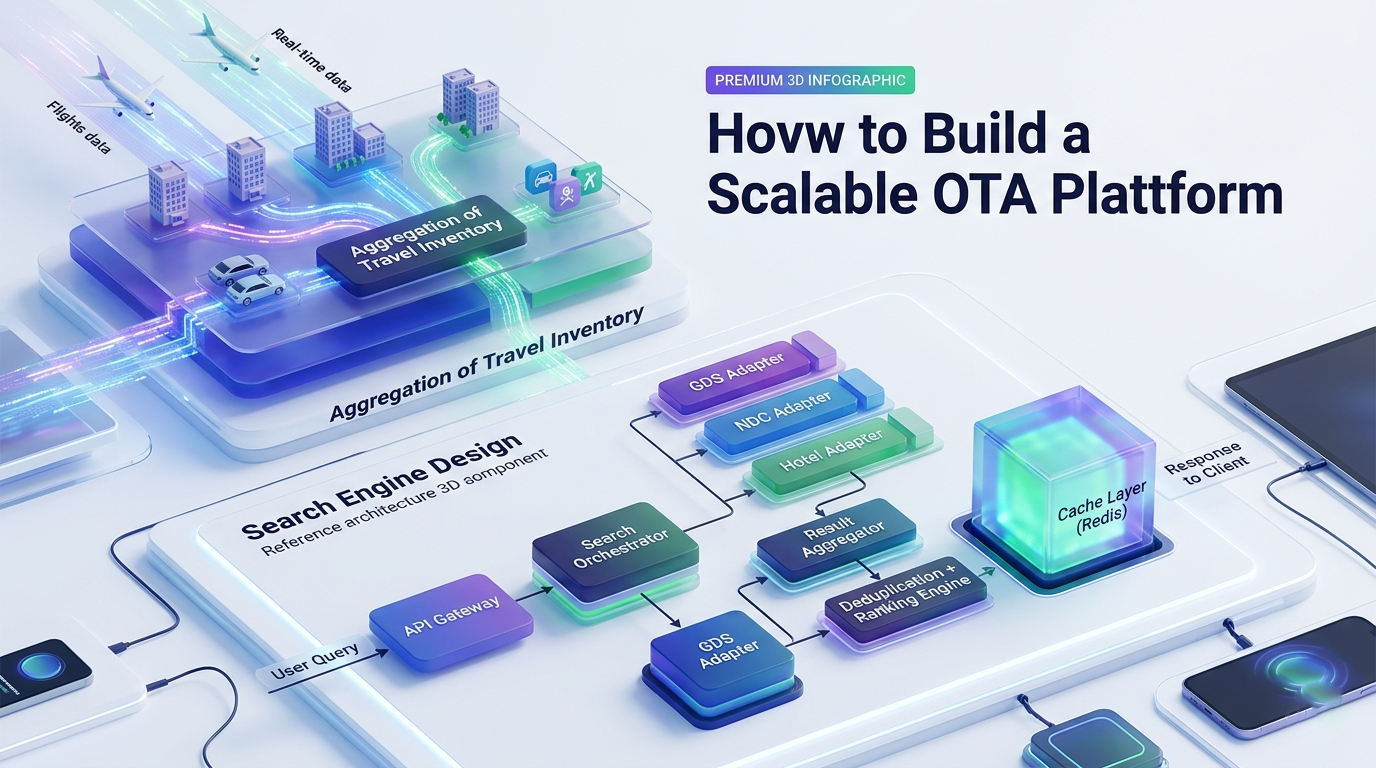
The search layer is where performance is most critical. Here's a reference architecture:
.png)
Key design considerations:
Timeouts per supplier: Set individual timeouts (e.g., 4s for GDS, 2s for cached results) so one slow supplier doesn't block the response
Circuit breakers: Use the circuit breaker pattern (Hystrix, Resilience4j) to prevent cascading failures when a supplier goes down
Rate limiting: Protect supplier APIs from abuse and enforce quotas per search session
Result deduplication: The same flight often appears across multiple sources — deduplicate by flight number + itinerary before returning results
Pricing Engine
Airfare pricing is famously complex. A single route can have hundreds of applicable fares with different rules, restrictions, and combinations.
Your pricing engine needs to handle:
Fare basis codes and associated rules (advance purchase, minimum stay, etc.)
Tax calculation by origin/destination country (YQ, YR surcharges, government taxes)
Markup and commission logic — applying your margin on top of net fares
Dynamic pricing — adjusting prices based on demand, urgency, or user profile
Multi-currency support with live FX rate feeds
For hotels, pricing must handle rate plans (BAR, non-refundable, package), meal inclusions, and supplier-specific taxes.
Consider building your pricing engine as a separate microservice with its own rules engine (Drools or a custom DSL) so business teams can adjust pricing logic without code deployments.
Booking Flow and Transactional Integrity
The booking flow is where money changes hands — it must be reliable, idempotent, and fault-tolerant.
The Two-Phase Commit Problem
You're booking with a supplier AND charging a customer at the same time. If the supplier booking succeeds but the payment fails (or vice versa), you have a problem.
Strategies to handle this:
Pre-book / Hold: Reserve inventory with the supplier first, then charge the customer. Cancel the hold if payment fails.
Saga Pattern: Use a distributed saga to coordinate the multi-step booking process, with compensating transactions for rollbacks.
Idempotency Keys: Assign a unique booking reference before calling suppliers so retries don't create duplicate bookings.
State Machine for Bookings
Model every booking as a state machine:
.png)
Store state transitions in an audit log — this is essential for support, reconciliation, and debugging.
Infrastructure and Scalability
Kubernetes for Orchestration
Run your microservices on Kubernetes. Key practices:
Use Horizontal Pod Autoscalers (HPA) to scale search and pricing services based on CPU/request rate
Deploy across multiple availability zones for resilience
Use readiness and liveness probes to ensure traffic only reaches healthy pods
Database Strategy
Flight/Hotel search results: Don't store them — use Redis with short TTLs
Bookings and transactions: PostgreSQL or Aurora with ACID guarantees
User profiles: PostgreSQL or DynamoDB
Analytics and reporting: Columnar stores like BigQuery or Redshift
CDN and Edge Caching
Static assets, search result pages for popular routes, and landing pages should be cached at the CDN edge (Cloudflare, Fastly). This dramatically reduces latency for geographically distributed users.
Observability: Monitoring, Logging, and Alerting
At scale, you cannot debug what you cannot observe. Instrument everything:
Distributed tracing (Jaeger, Datadog APM) — trace a single user search request across all services
Metrics (Prometheus + Grafana) — track supplier response times, cache hit rates, booking success rates
Centralized logging (ELK Stack or Datadog Logs) — structured logs with correlation IDs
Alerting — PagerDuty alerts for supplier downtime, booking failure spikes, or payment gateway errors
Key OTA-specific metrics to track:
Metric | Target |
|---|---|
Search response time (p95) | < 3 seconds |
Supplier availability | > 99.5% |
Booking success rate | > 98% |
Cache hit rate | > 70% |
Payment authorization rate | > 95% |
Security and Compliance
OTA platforms handle sensitive personal and financial data. Non-negotiables:
PCI-DSS compliance for all payment flows — use a tokenization provider (Stripe, Adyen, Braintree) to keep card data off your servers
PII encryption — encrypt passport numbers, dates of birth, and contact details at rest and in transit
Rate limiting and bot protection — OTA search endpoints are a prime target for fare scraping and inventory abuse
Fraud detection — integrate with services like Sift, Kount, or Stripe Radar for booking fraud scoring
GDPR / DPDP compliance — maintain data residency requirements and support right-to-erasure requests
Scaling Checklist for OTA Platforms
Before going to production at scale, verify:
All supplier integrations are behind circuit breakers
Search is asynchronous with streaming results
Redis caching is in place with appropriate TTLs
Booking flow uses idempotency keys
Saga/compensating transaction logic handles booking failures
Kubernetes HPA is configured for peak traffic
Distributed tracing is instrumented across all services
PCI-DSS tokenization is in place
Load testing has been run at 3–5x expected peak load
Conclusion
Building a scalable OTA platform is a multi-year engineering investment. The platforms that succeed treat scalability not as an afterthought but as a first-class architectural concern — from the way supplier APIs are integrated, to how search results are cached, to how booking transactions are made fault-tolerant.
Start with a clean microservices boundary, invest early in observability, and build your supplier integration layer with abstraction so new suppliers can be added without rewriting core logic. As your platform grows, the architectural decisions you make today will determine whether you scale smoothly or fight fires constantly.
The travel industry rewards reliability and speed. Build for both.