
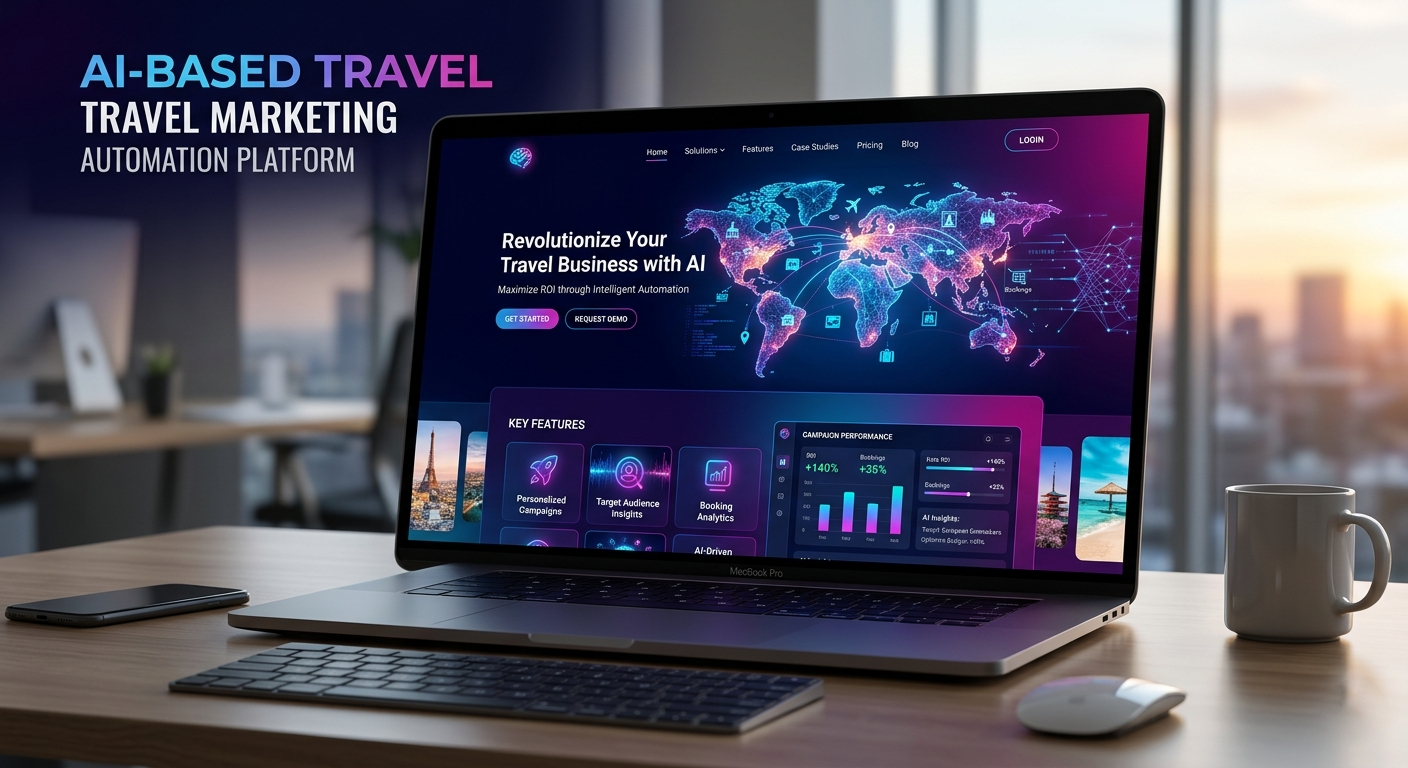
AI-Based Travel Marketing Automation Platform
Introduction
The travel industry runs on intent. A traveler searching for "beach vacation in October" is signaling desire, timing, and budget — all at once. The OTAs and travel brands that capture that intent first, with the most relevant offer, win the booking.
That's exactly what AI-based travel marketing automation is built to do.
Traditional marketing automation — rule-based drip emails, batch-and-blast campaigns, static audience segments — can't keep up with the pace and complexity of modern travel demand. Travelers switch devices, browse multiple destinations, abandon carts, and rebook within hours. The signals are rich. The window is narrow.
An AI-driven marketing automation platform replaces static rules with predictive models, replaces generic campaigns with hyper-personalized journeys, and replaces gut-feel decisions with data-backed recommendations — at a scale no human team could manage manually.
This guide covers everything you need to architect and build one.
What Is an AI Based Travel Marketing Automation Platform?
At its core, a travel marketing automation platform is a system that:
Collects and unifies traveler data across all touchpoints (web, app, email, ads, call center)
Applies AI and ML models to understand traveler behavior, predict intent, and personalize content
Orchestrates marketing actions across channels — email, push notifications, SMS, paid ads, onsite personalization — automatically and in real time
Measures and optimizes campaign performance using closed-loop attribution and continuous learning
The "AI" layer is what separates this from legacy marketing automation tools like older versions of Salesforce Marketing Cloud or Marketo. Instead of marketers writing rules ("if user visited Bali page 3 times, send Bali email"), the system learns patterns from data and acts on them dynamically.
The Architecture: Key Components
1. Customer Data Platform (CDP)
Everything starts with data unification. Travelers interact with your brand across dozens of touchpoints, often anonymously. A CDP is the foundation that:
Resolves identities — stitches together anonymous web visits, email clicks, app sessions, and past bookings into a single unified profile
Ingests data in real time — from your website (via pixel/SDK), mobile app, booking engine, CRM, and third-party sources
Maintains a 360° traveler profile — preferences, past trips, searched destinations, price sensitivity, loyalty tier, lifetime value
Popular CDPs used in travel include Segment, mParticle, and Tealium. For large OTAs, a custom-built CDP on a data lakehouse (Databricks, BigQuery, Snowflake) may be more appropriate given the data volume.
Key data signals to capture:
Signal Type | Examples |
|---|---|
Behavioral | Pages visited, searches, dwell time, scroll depth |
Transactional | Past bookings, cancellations, spend per trip |
Contextual | Device, location, time of day, weather |
Preference | Destination affinity, hotel star rating, cabin class |
Engagement | Email opens, push notification clicks, ad interactions |
2. AI/ML Engine
This is the intelligence layer — the set of models that turn raw data into actionable predictions and recommendations.
Core models to build or integrate:
a) Intent Prediction Model Predicts the likelihood that a given user will book in the next 7, 14, or 30 days, and for which destination. Built on gradient boosting (XGBoost, LightGBM) or neural networks trained on historical search and booking sequences.
b) Next Best Offer (NBO) Model Given a traveler's profile and current context, recommends the single most relevant product — a destination, hotel, or flight deal — to present. Collaborative filtering and session-based recommendation models work well here.
c) Churn / Cart Abandonment Model Identifies users who showed booking intent but dropped off, and scores them by likelihood of recovering with an intervention (discount, nudge, retargeting ad).
d) Price Sensitivity Model Segments users by willingness to pay, enabling dynamic discount logic — show a 10% discount to price-sensitive users, no discount to loyalty users who book regardless.
e) Lifetime Value (LTV) Prediction Predicts a user's expected long-term revenue, used to prioritize acquisition spend and personalize retention efforts.
f) Sentiment and NLP Models Process user reviews, support chat transcripts, and survey responses to extract themes, complaints, and satisfaction signals that feed back into personalization.
3. Campaign Orchestration Engine
Once you know who to target and what to offer, the orchestration engine decides when, where, and how to reach them.
This is essentially a decision engine that, for each user, answers:
Which channel should we use? (Email, push, SMS, paid retargeting, onsite banner)
What message variant should we show?
What is the optimal send time?
What is the frequency cap to avoid fatigue?
Should we send anything at all right now?
The orchestration engine should support:
Real-time triggers — act within seconds of a user action (abandoned search, price drop on a watched route)
Scheduled campaigns — seasonal promotions, loyalty anniversary emails
Journey-based flows — multi-step sequences that adapt based on user response at each step
A/B and multivariate testing — built-in experimentation to continuously improve
4. Personalization Engine
Personalization in travel is multi-dimensional. It's not just "show Bali content to someone who searched Bali." It means:
Homepage personalization: Show the right hero destination, featured deals, and recommended searches based on the user's profile
Email content personalization: Dynamically populate deal blocks, images, and CTAs per recipient at send time
Push notification copy: Tailor message language and offer based on user segment
Search result ranking: Promote hotels or flights that match the user's inferred preferences (budget range, brand affinity, amenity preferences)
Build your personalization layer around a feature store — a centralized repository of precomputed user features that all models and personalization services can access with low latency (Redis or Feast are common choices).
5. Channel Connectors
The automation platform needs to connect to every outbound channel:
Email: SendGrid, Amazon SES, Iterable, Braze
Push Notifications: Firebase Cloud Messaging (FCM), APNs, OneSignal
SMS: Twilio, Sinch, Kaleyra
Paid Media: Google Ads Customer Match, Meta Custom Audiences — push suppression and lookalike audience lists automatically
Onsite: A headless CMS or personalization SDK (Optimizely, Dynamic Yield) for real-time content swaps
WhatsApp: Twilio or Meta's WhatsApp Business API for high-engagement markets like India and Southeast Asia
Each channel connector should support event-driven triggers so the orchestration engine can fire messages within seconds of a qualifying user action.
6. Attribution and Analytics Layer
Without closed-loop attribution, you're flying blind. The analytics layer must:
Track conversions back to campaigns — which email, which push, which retargeting ad drove the booking?
Handle multi-touch attribution — a user may have clicked an email, seen a retargeting ad, and received a push notification before booking. Credit all three appropriately.
Feed performance data back into models — the AI engine should continuously retrain on what messages and offers actually converted
Support self-serve reporting — dashboards for marketing teams covering open rates, conversion rates, revenue attributed, cost per booking, and ROAS
Key AI Use Cases in Travel Marketing
Hyper-Personalized Email Campaigns
Instead of sending a "Summer Sale" email to your entire database, the AI platform:
Identifies users with high booking intent for summer travel
Predicts the most relevant destination per user
Dynamically selects the best-performing creative variant
Chooses the optimal send time per user (based on historical open patterns)
Suppresses users who are already mid-booking or recently converted
The result: the same campaign delivers 3–5x higher conversion rates compared to a broadcast approach.
Real-Time Price Drop Alerts
One of the highest-converting triggers in travel marketing. When a fare drops on a route a user has searched, the platform:
Detects the price change from the pricing engine in real time
Checks which users have that route in their search history
Scores each user by likelihood to convert at this price
Sends a personalized alert via the highest-engagement channel (push for mobile users, email for desktop)
Includes a deep link directly to the booking flow
This requires tight integration between your pricing/inventory system and the marketing automation platform.
Abandoned Search and Cart Recovery
A traveler searches London → New York, views three flight options, and leaves. The recovery sequence:
T+0 minutes: Onsite exit-intent overlay with a soft prompt ("Save this search")
T+30 minutes: Push notification with price and urgency cue
T+4 hours: Personalized email with the exact itinerary + 3 hotel recommendations in New York
T+24 hours: Retargeting ad on Meta and Google with dynamic creative showing their searched route
T+48 hours: Final email with a time-limited offer if user is price-sensitive
Each step is conditional — if the user books at any point, the sequence stops.
Loyalty and Re-engagement Campaigns
AI helps identify the precise moment a loyal customer is at risk of churning to a competitor:
Frequency drop: A user who books quarterly hasn't traveled in six months
Engagement decline: Open rates and click rates falling over the past 60 days
Competitor signal: A user who searched your platform but completed booking elsewhere (inferred from ad click patterns or partner data)
Re-engagement campaigns for these users are highly personalized — a loyalty tier milestone email, a "We miss you" offer calibrated to their LTV, or a first-look at a new destination they've never searched but are statistically likely to enjoy.
Dynamic Pricing Campaigns
Combine your pricing engine with the marketing platform to run demand-responsive campaigns:
When load factors on certain routes are low, automatically activate discounting campaigns targeting the right audience segments
When a destination is trending (news event, viral social content), surface it to users with affinity for that region before demand peaks and prices rise
Suppress discount campaigns for routes already selling well, preserving margin
Data Privacy and Consent Management
AI-driven personalization is powerful — and heavily regulated.
Key compliance requirements:
GDPR (EU): Requires explicit consent for marketing communications, right to erasure, and data portability
DPDP Act (India): India's Digital Personal Data Protection Act imposes consent and data localization requirements
CAN-SPAM / CASL: Governs email marketing in the US and Canada
Apple ATT (iOS 14.5+): App Tracking Transparency limits cross-app data collection for personalization
Architectural requirements:
Maintain a consent management platform (CMP) — OneTrust, Cookiebot, or custom — as the source of truth for user preferences
Propagate consent signals in real time to your CDP, email platform, and ad connectors
Implement data minimization — only collect signals you have a clear use case and legal basis for
Honor opt-outs within 24 hours across all channels
Store data in the appropriate region for data residency compliance
Building vs. Buying: The Platform Decision
Most travel companies face a build-vs-buy decision at some point. The reality is usually a hybrid.
Capability | Buy | Build |
|---|---|---|
Email / Push / SMS delivery | Braze, Iterable | Rarely worth building |
CDP / Identity resolution | Segment, mParticle | Only for very large OTAs |
Recommendation engine | Depends on scale | Often worth building custom |
Orchestration logic | Braze Canvases, Adobe Journey | Build if you need complex real-time logic |
Attribution | Rockerbox, Northbeam | Build if you have custom booking data |
AI/ML models | Vertex AI, SageMaker (infra) | Build the models, buy the infra |
The rule of thumb: buy the pipes, build the intelligence. Use proven delivery and data infrastructure, but invest in custom AI models trained on your proprietary travel data — that's where your competitive moat is.
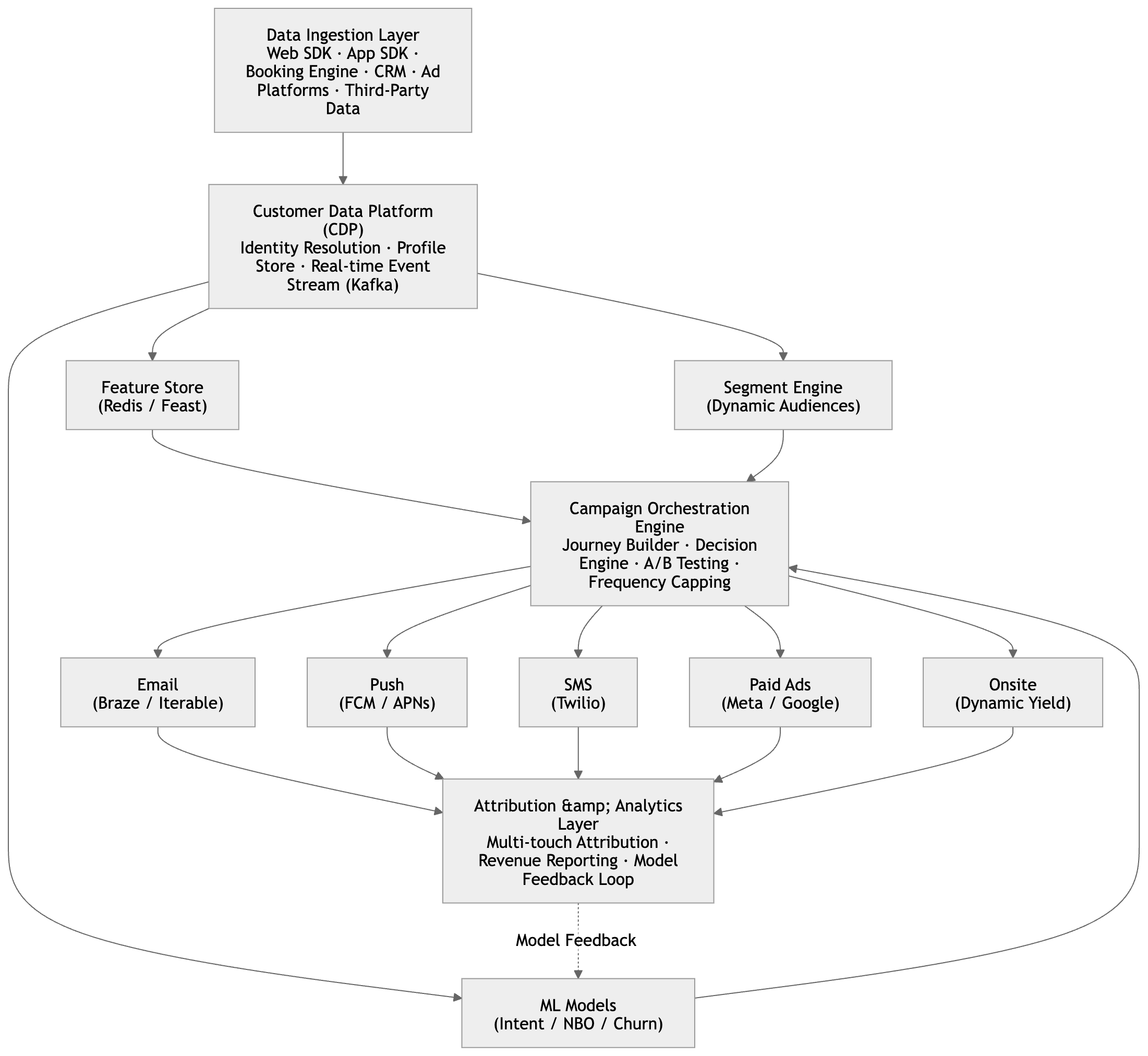
Platform Architecture Overview
Measuring Success: KPIs for AI Marketing Automation
KPI | Description | Target Benchmark |
|---|---|---|
Email conversion rate | Bookings driven per email sent | 1.5–4% (varies by segment) |
Push notification CTR | Clicks per push delivered | 3–8% |
Abandoned cart recovery rate | % of abandoned searches that result in booking | 8–15% |
Personalization uplift | Revenue lift vs. control (non-personalized) | 15–35% |
Model accuracy (intent) | AUC-ROC on booking intent prediction | > 0.80 |
Cost per booking (CPB) | Total marketing cost / bookings driven | Varies by market |
Email unsubscribe rate | Benchmark for over-messaging | < 0.3% per campaign |
Implementation Roadmap
Building a full AI travel marketing platform is a multi-phase effort. A practical approach:
Phase 1 — Foundation
Deploy a CDP and implement web/app tracking
Set up email and push delivery infrastructure
Build basic segmentation and manual campaign workflows
Phase 2 — Automation
Launch abandoned search and cart recovery journeys
Implement price drop alert triggers
Set up A/B testing framework
Phase 3 — Intelligence
Train and deploy intent prediction and NBO models
Connect feature store to personalization engine
Launch onsite personalization
Integrate paid media audience automation
Conclusion
An AI-based travel marketing automation platform is not a single tool — it's an integrated system of data infrastructure, machine learning models, orchestration logic, and channel connectors working in concert.
The travel brands winning today are those that treat their customer data as a strategic asset, invest in proprietary AI models trained on their unique booking patterns, and deliver genuinely relevant experiences at every touchpoint — from the first anonymous search to the post-trip re-engagement.
The gap between a broadcast email and an AI-personalized journey isn't just a technical difference. It's the difference between noise and signal. In a market where every OTA is fighting for the same traveler's attention, that signal is everything.