

Case Study: Hotel Booking System Using Hotelbeds API
Building a hotel booking system from scratch demands more than a clean UI — it requires access to real, bookable inventory at competitive rates. For OTAs, travel management companies, and digital travel startups, connecting to a global bed bank like Hotelbeds is one of the fastest ways to go live with a rich accommodation catalog. This case study walks through the end-to-end journey of building a hotel booking system using Hotelbeds API — from architecture decisions to sandbox testing, certification, and production deployment.
What Is Hotelbeds and Why It Matters for Booking Platforms
Hotelbeds is a leading global bed bank that sources hotel rooms in bulk from hospitality providers at wholesale rates and redistributes them to more than 60,000 B2B travel partners. With a portfolio spanning over 300,000 properties across 170+ countries — including hotels, resorts, boutique properties, apartments, villas, and B&Bs — it offers unmatched coverage for platforms targeting global travelers.
What makes Hotelbeds particularly relevant for booking system development is its APItude suite — a collection of RESTful APIs that collectively process over 80,000 bookings and 14 million searches per day. For development teams building an OTA, a white-label booking engine, or a corporate travel portal, this kind of scale and reliability is a significant technical asset.
Beyond accommodation, Hotelbeds also exposes APIs for:
Experiences — a catalog of over 23,000 activities, including tours, theme parks, and cultural excursions
Mobility — transfers across 9,000+ routes and car rentals with major brands like Hertz, Avis, and SIXT
This "Beyond the Bed" inventory creates upselling and cross-selling opportunities that increase booking value per customer — a key metric for any travel business.
System Architecture Overview
Before a single API call is made, the architecture of the booking system must be clearly defined. The following diagram illustrates the high-level data flow between the end user, the booking platform, and the Hotelbeds APItude services.

The architecture separates dynamic content (live availability and pricing, pulled in real time via the Booking API) from static content (descriptions, photos, and location data, synced periodically and stored locally). This split is a fundamental best practice when building a hotel booking system using Hotelbeds API.
Phase 1 — Pre-Integration Assessment
Defining Scope
The first step is mapping your product requirements to the correct API endpoints. A platform aiming for a full OTA experience will need:
The Hotel Booking API for search, rate checks, and reservations
The Hotel Content API for property descriptions, images, and amenity data
The Hotel Cache API if the platform requires price-comparison views or package bundling
Teams that also want to offer ground transport or activities will additionally integrate the Transfers and Activities API sets.
Technology Stack Considerations
Hotelbeds APItude is RESTful and supports both JSON and XML, with JSON preferred. Most backend frameworks — whether Node.js, Python (Django/FastAPI), Java Spring Boot, or PHP Laravel — integrate cleanly. Authentication requires SHA-256 hashing, so any language with standard crypto libraries is sufficient.
Reading the Documentation
This step is non-negotiable. The APItude documentation is detailed and covers rate limits, error codes, sandbox behavior, and certification requirements. Skipping or skimming it typically leads to failed certification and costly rework.
Phase 2 — Integration Setup
Registration and API Keys
Hotelbeds offers a free API key registration for development purposes. Upon signup, the developer dashboard issues three separate API key pairs — one for Hotel APIs, one for Activities, and one for Transfers. Each key comes paired with a secret used during request signing.
Authentication Flow
Every API request to APItude must be authenticated using a signature generated on the server side. The X-Signature is a SHA-256 hexadecimal hash derived from three inputs: the API key, its corresponding secret, and the current Unix timestamp in seconds.
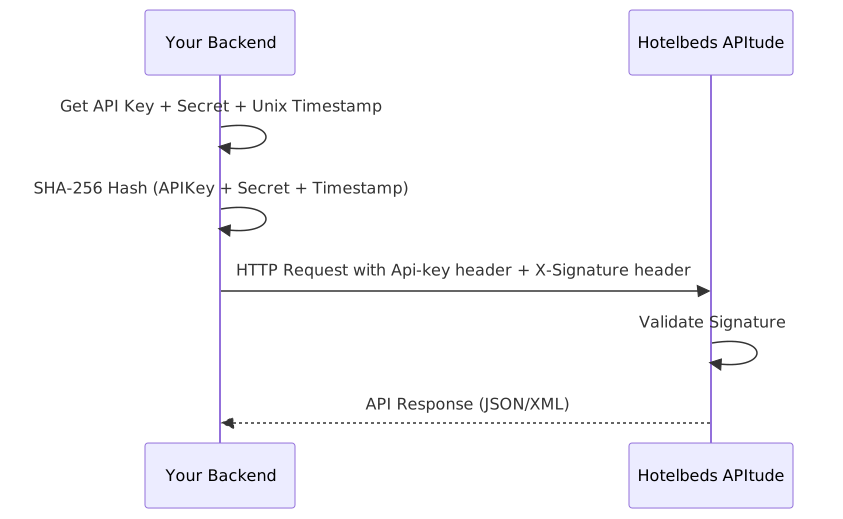
The timestamp must be current — signatures generated with stale timestamps will be rejected. This means the backend must generate a fresh signature for every request, not cache them.
Sandbox Testing
The Hotelbeds sandbox environment closely mirrors production behavior. Bookings made in sandbox do not result in real reservations or charges. However, the sandbox enforces a limit of 50 requests per day, which requires disciplined test planning.
Key sandbox behaviors to account for:
Search results return cached data with approximate pricing; exact rates are confirmed via
/checkratesThe sandbox does not guarantee real-time inventory accuracy, but the API response format is identical to production
Postman collections and Swagger specs are available from Hotelbeds to accelerate initial request testing
Phase 3 — Building the Hotel Search and Booking Flow
Step-by-Step Booking Workflow
The core booking flow for hotel reservations follows this sequence:

The /hotels endpoint performs the initial availability search, accepting parameters like destination, check-in/check-out dates, number of adults, and children's ages. It returns a list of matching properties with room types, board options (room only, breakfast included, all-inclusive, etc.), and rates with discounts applied.
The /checkrates call is a critical intermediate step. For some properties, rates are dynamic and may change between the search and booking. This method refreshes the pricing and availability for a specific rate key and may also surface upselling options.
The /bookings endpoint finalizes the reservation. Upon confirmation, the system must generate a voucher — the official booking document presented to the traveler containing hotel details, reservation number, dates, board type, payment summary, and cancellation policy.
Multi-Room Bookings and Children
Hotelbeds requires children's ages to be specified explicitly in the request — not just a count. A common integration error is passing a child count without ages, which causes either incorrect results or request rejection. The certification process specifically validates this behavior.
Cancellation Policies and Simulation Mode
The /bookings DELETE method supports a simulation mode that returns applicable cancellation fees without actually cancelling the booking. This is useful for building a cancellation preview screen in the UI before the user confirms the action.
Phase 4 — Content Strategy and Local Storage
One of the most impactful architectural decisions in this integration is how static content is handled. The Hotel Content API returns descriptions, images, location coordinates, amenities, facilities, and room-type details — information that changes infrequently but is large in volume.
The recommended approach:
On initial setup, perform a full bulk extraction of all content for your target markets
Store the data in your own database (PostgreSQL, MongoDB, or an Elasticsearch index for fast search)
Run a daily differential sync — checking Hotelbeds for any updated records and pulling only changes
This local content layer means your frontend never waits on a Content API call during a user session. Property pages load from your own database, while the Booking API handles live availability in real time.
The Hotel Cache API complements this by providing hourly pricing snapshots in CSV format, useful for populating a price-calendar widget or a destination-level price index.
Phase 5 — Certification
Before going live, all Hotelbeds integrations must pass a formal certification process. The certification is initiated by emailing apitude@hotelbeds.com with details about the integration workflow, distribution channels, and the certification URL.
What Certification Covers

A few critical certification requirements to prepare for:
GZIP compression must be enabled on all requests to reduce payload size
Availability requests must be batched — each call should cover as many hotels as possible, with a maximum of 2,000 properties per request
Opaque rates (discounted rates that hide the hotel brand) can only be displayed when bundled with another product such as a flight, transfer, or car rental — they cannot appear as standalone hotel listings
The live test requires creating a real booking at least six months out, with two adults and two children, then immediately cancelling it after the Hotelbeds team verifies the voucher
Phase 6 — Third-Party Aggregator vs. Direct Integration
For teams that want to accelerate go-to-market, integrating Hotelbeds through a third-party API aggregator is a viable alternative. Aggregators consolidate multiple supplier APIs — including bed banks, airlines, and car rentals — under a single normalized interface.
Trade-offs to consider:
Factor | Direct Hotelbeds API | Via Aggregator |
|---|---|---|
Time to integrate | Longer (certification required) | Faster (aggregator handles cert) |
Cost | Wholesale rates, Hotelbeds margin only | Aggregator fee on top |
Flexibility | Full APItude feature access | Depends on aggregator support |
Multi-supplier access | Hotelbeds only | Multiple suppliers via one API |
Commercial negotiations | With Hotelbeds directly | Separate deals per supplier |
The aggregator route is particularly useful when launching an MVP quickly or when the platform needs inventory from multiple bed banks simultaneously.
Phase 7 — Deployment and Ongoing Operations
With certification complete, the final deployment decision is whether to roll out the integration to all users simultaneously or follow a phased launch — starting with a subset of markets or user segments.
Post-launch, the integration is a living system. Key operational tasks include:
Monitoring API response times and error rates (watch for rate limit breaches, authentication failures, and timeout spikes)
Running the daily content sync reliably — missed sync cycles lead to stale property data
Logging and analyzing booking conversion rates at each funnel step (search → checkrate → confirmation)
Keeping up with Hotelbeds API changelog updates and deprecation notices
Key Lessons from Building with Hotelbeds API
Developers who have worked extensively with the APItude suite consistently surface a few lessons that aren't obvious from documentation alone:
Plan your sandbox usage. With only 50 requests per day in the test environment, every call should count. Define your test scenarios upfront and group related tests into efficient sequences.
Invest in documentation reading early. The APItude docs are comprehensive and well-structured. Engineers who read them thoroughly before writing code avoid the most common integration mistakes — particularly around request sequencing, authentication, and content caching.
Build the local content layer first. Teams that defer the content caching strategy and query the Content API in real time end up with slow, unreliable product pages and high API usage bills. The local sync approach should be part of the initial architecture, not an afterthought.
Test cancellation policies from day one. Booking platforms that don't surface clear cancellation terms see higher dispute rates post-launch. The simulation mode on /bookings makes this easy to implement during development.
How Teenva AI Can Help You Build Your Travel Booking Platform
At Teenva AI & Digital Ventures, we specialize in building travel technology platforms — from hotel booking engines and OTA portals to full-stack travel marketplace solutions. Our team has deep expertise in third-party API integrations including bed banks, GDSs, and activity providers, combined with modern AI-driven features that enhance search, personalization, and conversion.
Whether you're looking to integrate a hotel booking system using Hotelbeds API, build a white-label travel portal, or scale an existing platform with new inventory sources, we can help you architect, build, and certify the right solution.
Get in touch with our team:
Email: sales@teenvaai.com
Phone: +91 9572020107
Website: teenvaai.com
Let's turn your travel platform idea into a fully operational booking system.